
CHAPTER 8: THE COMPTROLLERS FREQUENCY
The yellow halogen beams raked across the pitted facade of the pumping station, pinning Mark and Eleanor against the reinforced iron hatch like figures caught in a trench raid.
The heavy diesel engine did not shut off. It sat idling forty feet away, vibration trembling through the packed gravel and into Mark’s boots. The driver killed the headlights, leaving the site bathed in the oscillating amber pulse of the cab’s roof strobes. In the rhythmic sweep of yellow light, two silhouettes emerged from the truck: the man in the utility cap from the driveway, and a taller, thicker figure stepping down from the passenger side, pulling an oilskin duster tight against the evening damp.
Arthur Harlan didn’t carry tools. He walked with the heavy, unhurried gait of a man who had sat on the county bonding commission for twenty-four years and viewed physical property as an abstraction on a spreadsheet.
“You’re working outside your jurisdiction, Eleanor,” Harlan said. His voice was gravelly, resonant, easily cutting through the subterranean thrum of the intake turbines below. “And you’re trespassing on regional utility authority property with a deadly weapon.”
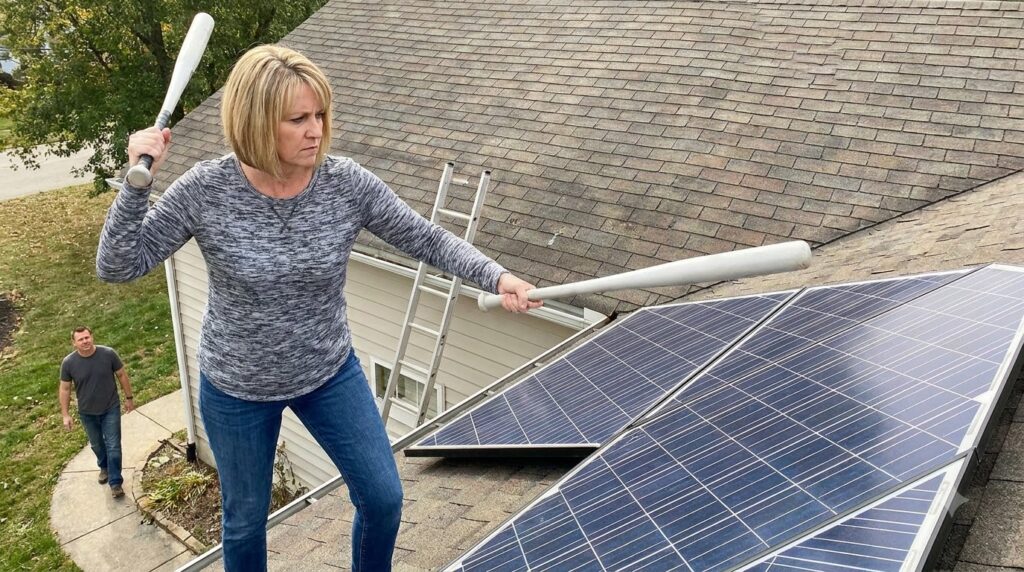
Eleanor didn’t lower the white baseball bat. She rested the chipped aluminum barrel squarely against the collar of the intake housing, using her body to shield the small brass cylinder Mark had just uncapped.
“The easement lapsed three weeks ago, Arthur,” Eleanor replied, her voice cold and steady. “The moment David’s death certificate was filed with the state recorder, your indemnification clause expired. That means every packet your repeater pulled off the residential lines since Tuesday is an unauthorized wiretap.”
Harlan stopped ten paces out, just beyond the swing of the bat. His hands remained open, resting casually in the deep pockets of his coat. He looked past Eleanor, his pale, hooded eyes fixing on Mark.
“He didn’t tell you, did he, Mark?” Harlan asked softly. The tone wasn’t threatening; it was patronizing, the practiced sympathy of an executor explaining an insolvent estate. “Your father didn’t put that node on your roof to protect the town. He put it there because he was three million dollars short on the 2018 sewer revenue bond.”
Mark’s fingers remained locked around the brass key. His skin was smeared with black bearing grease from the intake cap, the stinging chemical bite of it seeping into the open blisters on his knuckles.
“The requisition tags were logged under my consulting firm’s ID,” Mark said, his voice flat, calculating the distance between Harlan’s man and the iron hatch. “My firm didn’t exist in 2018.”
“Your firm was incorporated in 2018, son,” Harlan said smoothly. “Check the state registry. David filed the papers the month you graduated from engineering school. He assigned thirty percent of the municipal data contract to your tax ID before you ever signed your first client.”
The cold iron beneath Mark’s boots felt suddenly weightless.
“He shielded you from the audit by making you the primary beneficiary of the escrow reserve,” Harlan continued, taking a slow half-step forward. The man in the canvas jacket moved parallel to him, his hand remaining rigid inside his coat pocket. “If the state examiners open that archive down there, they don’t find my name on the offshore routing logs. They find the digital signature of the chief consultant. That’s you, Mark. That’s always been you.”
“He’s lying,” Eleanor said, though she didn’t turn her head. Her jaw was clamped tight, her knuckles dead white on the baseball bat. “The ledger in the oilcloth—look at the clearing account.”
Mark pulled the crumpled carbon receipt from his pocket with his left hand, angling the fragile slip toward the passing arc of the amber strobe.
The receipt showed a transfer authorization for two point eight million dollars. The issuing party was marked Mercer Regional Water & Power. But beneath the stamped approval line was a dual signature block.
The top line was signed in Arthur Harlan’s sharp, slanting hand.
The bottom line bore the neat, looping script of David Vance. But beneath it was a secondary co-signer’s mark: a crude, adolescent signature, penned in faded blue ballpoint, dated fourteen years ago on Mark’s eighteenth birthday—the day his father had brought home a stack of “standard college trust documents” to sign at the kitchen table.
A sudden, deep shudder rattled the concrete apron under their feet.
The subterranean turbines shifted pitch. The dull drone rose into a high-frequency, teeth-jarring hum, the ground vibrating at precisely forty-two cycles per second.
Inside the uncapped housing, the tiny brass diaphragm needles began to chatter.
“Give me the key, Mark,” Harlan said, extending an open hand, his face bathed in the yellow strobe. “We close the hatch, we burn the local archive, and the bonding commission writes off the shortfall as infrastructure depreciation. Nobody goes to a federal penitentiary. You walk away with the house, the firm, and a clean slate.”
Mark looked down at the key in his hand. The three perforations along its shaft were already catching the resonance of the turbine below, singing with a faint, acoustic whistle.
He looked up at Harlan, whose outstretched palm remained steady, waiting for the calculated surrender.
“You audited the bond six months ago, Harlan,” Mark said quietly. “If my signature was the only thing holding the liability, you wouldn’t have brought a winch to tear down my porch. You wouldn’t have tried to wipe the flash drive before I saw the hardware.”
Harlan’s smile didn’t reach his eyes. “That was for your protection, Mark.”
“No,” Mark said, his grip tightening until the brass teeth bit into his palm. “You didn’t come to save me from the audit. You came because the drive in the attic wasn’t just mirroring the town’s traffic.”
Mark jammed the lead-cored key directly into the vibrating bore.