
CHAPTER 2: THE ANGLE OF DESCENT
The dial tone droned once, a flat mechanical pulse against Mark’s eardrum, before the connection snapped open with an audible click.
“Nine-one-one, where is your emergency?”
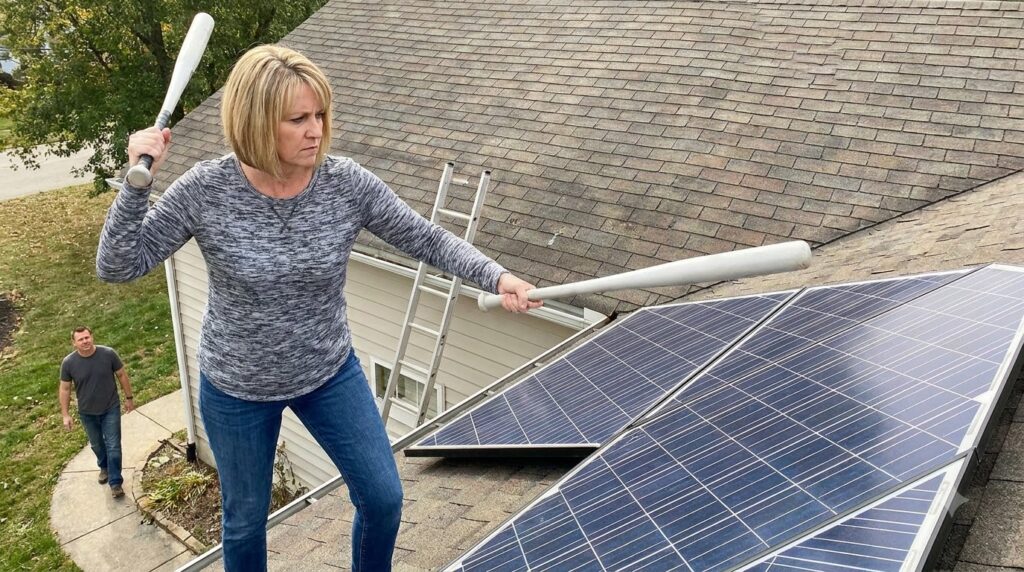
Mark didn’t answer right away. His gaze was anchored eight feet up, where the yellow inspection tag swung in the dry thermal rising from the roof. It fluttered against the shattered blue wafer like a dead leaf. Stamped into the corner in black indelible ink was the serial code: VCR-09-T. It was his handwriting. He had logged that hardware into the logistics depot off County Line Road three weeks ago, marked for municipal infrastructure, not private installation.
Above him, the woman did not raise the bat again. She lowered herself into a low, steady crouch, the heels of her running shoes wedging into the lip of the zinc gutter. Her fingers—pale, the joints swollen with mild arthritis—reached down, not to clear the jagged debris, but to trace the severed coaxial line.
“Caller, I have an open line,” the operator’s voice sharpened, mechanical and distant. “Do you require police, fire, or medical?”
“Stay on the line,” Mark said. His voice was low, flat, dropping into the controlled cadence he used when an inventory discrepancy meant someone was walking out of the depot in cuffs. He lowered the phone two inches from his ear, pressing the speaker button with his thumb, but did not break eye contact with the roof. “Roof,” he called up, the word clean and clipped. “You’re going to step back from the fascia.”
The woman tilted her head. Her hair was cut so straight the blunt ends looked like they had been trimmed with shears against a ruler. She wasn’t breathing hard. The exertion of swinging a thirty-two-ounce bat into three-ply laminate hadn’t flushed her cheeks; the cold precision remained.
“You took the ladder down,” she said. Her voice had the thin, raspy texture of someone who hadn’t spoken since morning. “That was your third mistake, Mark.”
The name hit the humid air like cold iron.
Mark’s jaw tightened, the muscle ticking once against the collar of his dark gray shirt. He had never seen her face at the township board meetings, never passed her in the supermarket aisle three miles out on Route 4. But she knew the layout of his gutters, she knew the ladder’s pivot point, and she knew his name.
“The line is live to county dispatch,” Mark said, angling the phone screen upward so the three glowing green numerals caught the hard daylight. “They track the cell tower handoff within thirty seconds. You have about ninety before the first cruiser turns off the avenue.”
The woman looked down at the glowing display, then slowly let her eyes drift to the aluminum ladder resting prone in the grass. A thin, humorless twitch pulled the left corner of her mouth.
“The township won’t send a cruiser for an alarm on this parcel,” she said softly. Her hand moved deliberate and unhurried into the pocket of her gray patterned pullover. She didn’t pull a weapon; she pulled a small, brass-cased jeweler’s loupe, its lanyard wrapping twice around her wrist. “Not after the easement waiver you signed on the fourteenth. You told them this address was an unoccupied testing site. You told the county assessors there was no active residential occupancy.”
Mark felt the ground beneath his sneakers turn thin.
The easement waiver was an internal document. It was filed under his personal account in the firm’s encrypted portal, accessible through dual-factor authentication that required his physical key fob.
“Who gave you the gate code?” he asked. The question was narrow, stripped of anger, designed purely to measure the perimeter of the breach.
“The gate was open, Mark. It’s always open when the current surges.” She leaned forward slightly, her balance extraordinary for someone her age on a pitch that steep. She used the tip of the bat to nudge a dangling fragment of glass, sending it clattering into the downspout. Beneath the fractured silicon, the junction box lay exposed. It wasn’t standard ABS plastic. It was a brushed aluminum housing, completely unbranded, sealed with four tamper-resistant Torx screws.
Three of the screws had already been drilled out before she ever took the first swing with the bat. The clean, silver shavings still dusted the black asphalt shingle around the mount.
She hadn’t climbed up there to break the glass. The bat was the cover. She had climbed up to retrieve what was inside the casing before the relay completed its cycle.
“You think you’re containing it,” Mark said, his mind running through the network logs from the previous night, the steady 2:00 AM upload spikes he had dismissed as automated diagnostics. “You don’t even know what’s linked to that transceiver.”
“I know what isn’t linked to it,” she replied, her eyes narrowing as she looked past him, down the long, empty gravel driveway toward the tree line where the county road vanished into the pines. “The power grid isn’t. The meters aren’t turning, Mark. Check your meter on the south wall.”
A sharp burst of static came through the phone receiver. The operator’s voice did not repeat the call prompt.
Instead, a different tone cut through the small speaker—a brief, two-tone digital handshake, followed by an automated automated voice that spoke a six-digit string:
“Authorization confirmed: User Four-Zero-Niner. Standby for local override.”
The screen of his phone flickered, the red “End Call” icon graying out as the dialer interface vanished entirely, replaced by a monochrome system diagnostic screen showing a real-time transfer bar at sixty-eight percent.
Mark stared at the display. The dispatch line hadn’t hung up; the signal had been rerouted through an internal network bridge that recognized his phone’s IMEI number as an administrative node.
“Drop the phone,” the woman whispered from the roof, her voice suddenly devoid of mockery, replaced by something brittle and urgent. “Drop it on the gravel and kick it away from the foundation. Now.”