
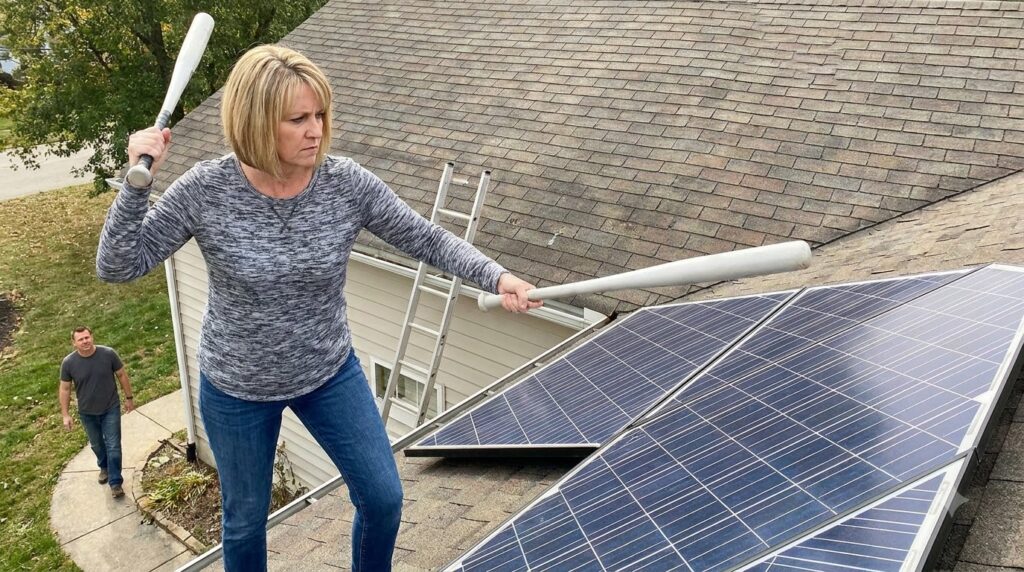
CHAPTER 5: THE SEVERED GROUND
The diesel engine died at the foot of the drive, leaving only the wet, rhythmic tick of cooling manifold steel and the silent, sweeping arc of amber strobes against the cedar siding.
Two men stepped out of the cab. They wore high-visibility canvas jackets over heavy dark work trousers, moving with the flat-footed efficiency of contractors on an unrecorded municipal ticket. Neither looked at the ladder resting in the grass. Neither looked at Mark’s sedan parked in the bay. Their eyes went straight up to the roof pitch, where the shattered photovoltaic panel threw fractured yellow flashes into the afternoon sky.
The driver reached into the bed of the truck, unlatching an aluminum equipment crate with a sharp double clatter of toggle clamps.
“They have the field extractor,” Eleanor Vance said. Her voice didn’t rise above a razor-thin murmur, but on the steep rake of the roof, three feet away, every syllable cut like sheared metal. “Once that crate connects to the junction loop down at the transformer pedestal, the drive in your attic triggers a high-voltage wipe. Three seconds. Every partition zeroed out.”
Mark remained crouched on the cedar shingles. Below, the second man slammed the passenger door and reached for a heavy canvas tool roll, his face hidden beneath the brim of a utility cap. They weren’t calling out to announce themselves. They weren’t asking why two people were perched on a residential roof in broad daylight with an aluminum baseball bat. They already knew.
Mark looked at the housing. The four tamper-proof Torx screws had been drilled out, their heads sheared into bright, burred silver craters. Beneath the jagged blue laminate of the panel, the brushed aluminum lid was loose, held down only by the suction of a scorched rubber gasket.
“If I pry the chassis,” Mark said, his voice flat, stripped of breathing room, “the capacitor bank discharges.”
“It discharges into the frame,” Eleanor said. She stepped down one rung of the roof shingles, wedging the sole of her sneaker against the bottom lip of the racking channel. She extended the white baseball bat not as a weapon, but as an insulated lever, sliding the flattened aluminum barrel beneath the lip of the metal housing. “It’ll bite, Mark. But it won’t kill you unless you touch the ground rail.”
The men on the ground were moving now. The driver rounded the corner of the garage toward the utility meter, carrying a thick umbilical harness wrapped in braided kevlar sleeve. His boots crunched methodically across the pea gravel.
“Do it,” Mark said.
Eleanor threw her weight backward, using the leverage of the roof angle.
The aluminum casing popped with a sharp, pneumatic hiss. A sharp reek of heated thermal paste and scorched silicone billowed out, catching in Mark’s throat like ground glass.
Inside the cavity lay no commercial inverter board.
There was a double-stacked, custom-milled solid-state processing array, shock-mounted on silicone dampers. Tiny, frantic green LEDs flickered across the motherboard like fireflies trapped under resin, pulsing in time with the high-frequency whine coming through the attic vent. But behind the circuit board, nestled directly into the milled heatsink housing where a heat pipe ought to have run, was a physical object wrapped in oilcloth.
Mark’s fingers moved before his brain could second-guess the current. He drove his hand into the recess, ignoring the vicious electrostatic snap that bit into his knuckles, leaving a row of white, bloodless blisters along the tendon.
His fingers clamped around the cloth. He pulled.
The bundle tore free from a dual-pin ribbon cable with a clean, brittle snap. The frantic green LEDs died instantly. Above their heads, the screaming cooling fan in the soffit vent wound down, dropping pitch through an ugly, rattling decrescendo until the attic was dead silent.
Below, the footsteps on the gravel halted abruptly.
“Line’s dead,” a voice shouted from the side of the garage—harsh, impatient, authoritative. “The handshake dropped out. He broke the junction!”
Mark peeled back the stiff canvas of the oilcloth on his knee.
Inside was not a hard drive. It was a single, heavy brass safety-deposit key, stamped with the insignia of the First Mutual Trust of Mercer County, and an old, carbon-paper ledger receipt dated five days before his father died.
The handwriting on the receipt was sharp, aggressive, slanting hard to the right. It wasn’t his father’s careful, looping cursive.
It was the handwriting of the county comptroller—the man who had signed Mark’s own corporate consulting contracts for the past six years.
Mark looked up from the brass key. His gaze shifted from the receipt to Eleanor Vance.
Her bat was lowered now, the dented aluminum barrel resting against the shingle grit. She was watching him not with triumph, but with the cold, assessing detachment of a predator watching another animal finally realize the jaw of the trap had been closed for months.
“Your father didn’t build this network to hide his own money, Mark,” she said, her voice dropping into the quiet void left by the silenced fans. “He built it to track theirs. He set the node on his own roof because he knew they wouldn’t dare raid his personal parcel while he held the regional bonding authority.”
She pointed the tip of the bat toward the edge of the gutter, where the shadow of the truck’s high-profile utility rack cut across the driveway.
“The day he died,” she whispered, “they didn’t lose their partner. They lost their leverage. And the moment you registered this parcel under your name last month, you signed the paperwork that made you their fall guy.”
A heavy metallic click echoed from the corner of the porch below.
The man in the utility cap had stepped onto the lowest step of the porch, his hand resting inside the deep pocket of his canvas coat, looking directly up at the two figures silhouetted against the afternoon sky.
“Mark,” the man called up, his tone measured, cordial, and completely empty of warmth. “Step away from the gutter. Let’s bring that ledger down before somebody takes a fall.”
🥻Structural Status: [INITIATE_CASE_B]