
CHAPTER 3: THE SPLICED VEIN
Mark did not drop the device. In the field, surrendering your terminal meant conceding the network topography to whoever held the sniffer.
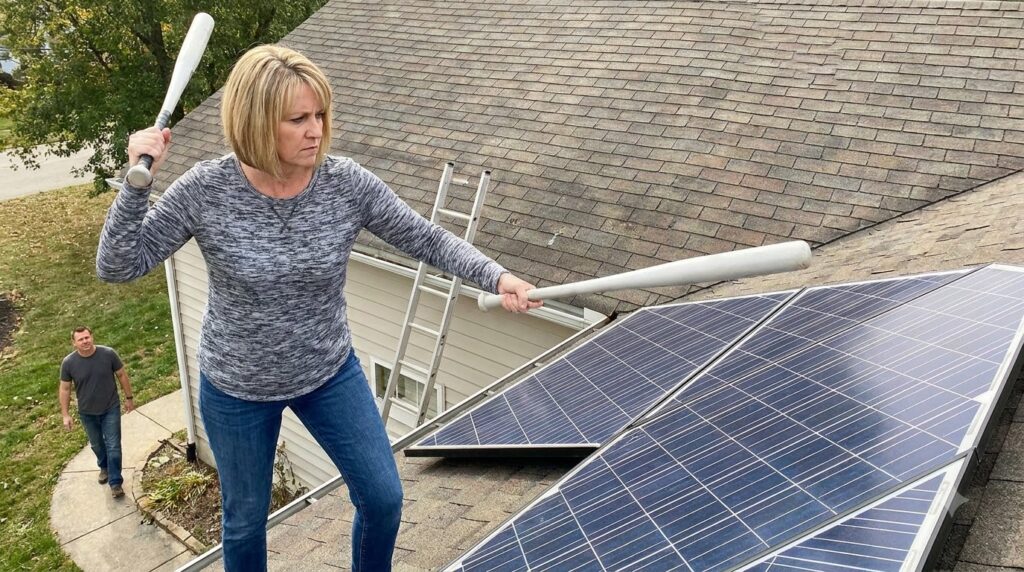
Instead, his thumb jammed against the volume rocker and side switch, initiating a hard hardware interrupt. The screen flickered violently, the monochrome progress bar freezing at seventy-one percent before the display collapsed into a dead black line. He shoved the deadweight of the phone into his rear pocket, stepped past the grounded ladder, and gripped the lowest bracket of the downspout to hoist his boot onto the brick sill of the utility alcove.
“I said get away from the foundation,” the woman snapped, her voice dropping an octave, razor-sharp with irritation rather than panic.
“This is my parcel,” Mark said, hauling himself onto the low slant of the porch roof with two fluid, practiced motions. “And whatever is transmitting through my junction box carries my serial number.”
His rubber-soled sneakers found purchase on the grit of the composite shingles. The angle here was shallow, but the main pitch where the woman stood rose sharply at a thirty-five-degree rake. Up close, the damage was far more calculated than it had appeared from the pea-gravel drive.
She had not struck the tempered glass at random. The impact points were clustered entirely within an eight-inch radius of the primary junction box. The white barrel of the baseball bat was powdered with pulverized glass and silver conductant paste, its aluminum skin pitted with shallow crescents. She remained balanced on the ridge caps, the bat held across her knees like a balance pole, her eyes locked on his hands.
“You think you stamped that tag?” she asked, her voice dry, cutting through the heavy hum of the cicadas in the pines. “Look at the rivets, Mark. Look at the alloy.”
Mark did not drop his guard. He kept his center of gravity low, three paces below her on the roof slope, eyes flicking between her hands and the ruptured housing. He extended his right hand, his fingers skimming over the jagged teeth of broken solar glass, ignoring the micro-shards that caught in the calluses of his palm.
The junction box was not standard polycarbonate. It was cold, aircraft-grade milled aluminum, anchored to the rafter struts with recessed security fasteners. He knew the casing. He had authorized the purchase requisition for twenty identical units six months ago under a municipal infrastructure grant for the county’s water treatment facility.
Except this one was bolted to his private roof.
“The seal is unbroken on the chassis,” Mark said, his jaw locked. “No one accesses the board without the key-card tool.”
“Then explain why the interface is warm,” she countered.
He reached past the fractured blue silicon wafer, his fingertips pressing against the side of the metal casing. It was vibrating. A steady, high-frequency thrum pulsed through the metal—not the sixty-hertz buzz of household alternating current, but the distinct, heat-heavy murmur of an active solid-state drive writing at maximum throughput.
Beneath the mounting bracket, hidden within the shadow of the shingle overlap, lay the feed line. It did not route downward toward the external electrical meter or the main circuit panel on the garage wall.
A secondary, copper-shielded ribbon cable had been punched directly through the cedar soffit, disappearing into the dark plenum of his own attic.
“The meter isn’t spinning because this array doesn’t generate power,” she said quietly, her knuckles tightening on the grip of the bat. “It draws it. It’s been siphoning forty amps off your garage sub-panel since May to keep the transponder cool while it mirrors every encrypted packet coming through the regional exchange.”
Mark’s pulse hammered behind his eyes, cold and methodical. “Who installed the bypass?”
“Check the requisition signature,” she whispered, leaning slightly forward, the shadow of her frame blocking the harsh glare of the sun. “You think you’re running a clean firm, Mark. You think you’re the only one with administrative keys to the township trust account. But someone used your digital signature to log this parcel as a redundant municipal node three weeks after your father’s estate cleared probate.”
Mark stared at the yellow tag swinging from the frayed copper wire. The ink was his, yes, but the date code at the base of the stamp read 11-04—a Sunday. He had been four hundred miles south that weekend, clearing out the deed box in his father’s study.
Before he could answer, a sharp, mechanical chime echoed from the vents beneath the eaves—the sound of an internal cooling fan spinning up to maximum velocity inside his own attic ceiling.