
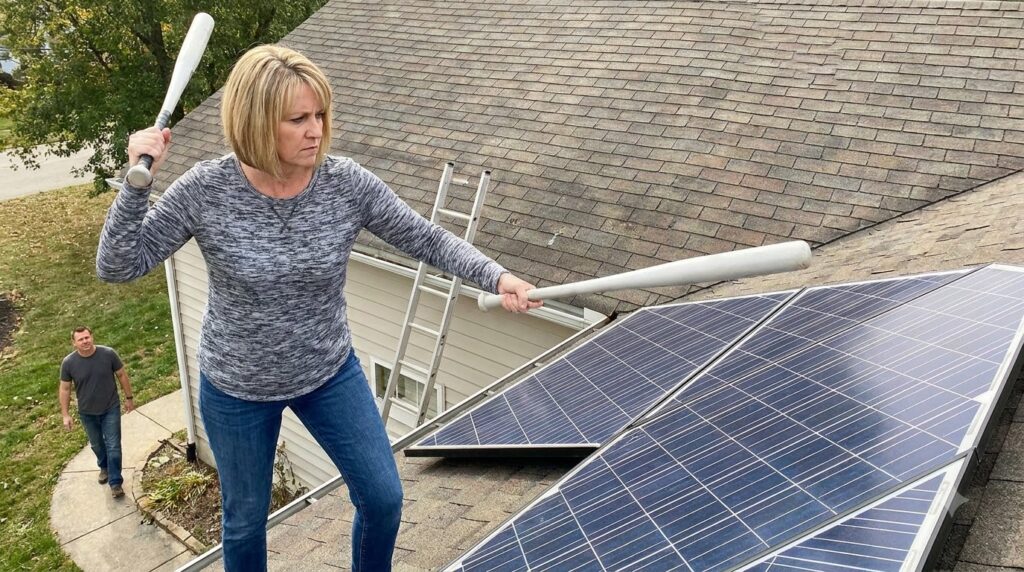
CHAPTER 1: THE CRACK OF TEMPERED GLASS
The percussion struck before the echo did—a dry, violent crack that tore through the dead afternoon heat.
Mark halted on the asphalt apron. The sound was not hail or a falling pine branch; it was the specific, high-tensile shatter of hardened industrial glass under targeted blunt force. He did not yell. He did not run. In suburban cul-de-sacs, shouting simply gave away your angle of approach. Instead, his boots shifted on the pea gravel, cutting a silent diagonal across the manicured turf toward the eastern elevation of the house.
Above the roofline, the silhouette was already cocking back for a second blow.
She stood balanced across the cedar shake, knees bent, centering her mass squarely above the rear photovoltaic bank. An older woman—blonde hair cropped tight, shoulders taut beneath the dull gray weave of a patterned pullover. Her grip on the white aluminum bat was choke-tight, knuckles bloodless. There was no hesitation in her posture, no manic tremble of an erratic neighbor venting spite. Her movements possessed the clean, repeatable leverage of a factory press.
The bat descended.
The dull thunk vibrated through the roof trusses, followed immediately by the webbed craze of three hundred watts of crystalline silicon yielding to alloy. A shower of granular shards hissed down the slope, catching the blinding glare of the three-o’clock sun before pinging against the concrete patio below.
Mark calculated the geometry. The white extension ladder was propped against the gutter seam eight paces ahead—the sole line of ascent, and the only path down.
Every move was leverage. If she intended to destroy the full twelve-panel array, she needed fifteen minutes. If she wanted to breach the mounting chassis underneath, she needed five.
He moved toward the ladder, his sneakers finding the damp shadow of the foundation wall. His hands locked around the cold aluminum rails, muscles knotting as he lifted the feet free of the sod. He dragged the base two feet outward, breaking the friction, then pivoted the entire twelve-foot frame sideways, letting the top rungs slide with a low, metallic shriek against the fascia before resting flat against the earth.
Isolation first. Confrontation second.
High above, the woman did not startle. She didn’t drop the weapon or scramble for the lip of the eaves. She simply lowered the bat until its taped tip rested in the pulverized center of the solar cell, her gaze tracking downward to meet his. Her pale eyes were flat, devoid of panic, looking through him rather than at him—calculating the ladder’s removal not as a trap, but as an inconvenience she had already factored into the cost.
Mark reached into his pocket, his thumb sliding the lock screen upward on his phone. Three digits dialed blind: 9-1-1. He pressed the receiver to his ear, his chest steady, keeping his vision locked onto her hands.
Then he looked at the base of the shattered panel, right where the white barrel of the bat had punched through the backing foil.
Dangling from the freshly split junction box was not the thick, black gauge of an alternating-current inverter wire. Spilling through the cracked glass were ribbons of copper-shielded coaxial cable—military-grade, color-coded, and bearing the yellow inspector’s seal of his own private consulting firm.