CHAPTER 6: THE FALL OF THE WALL
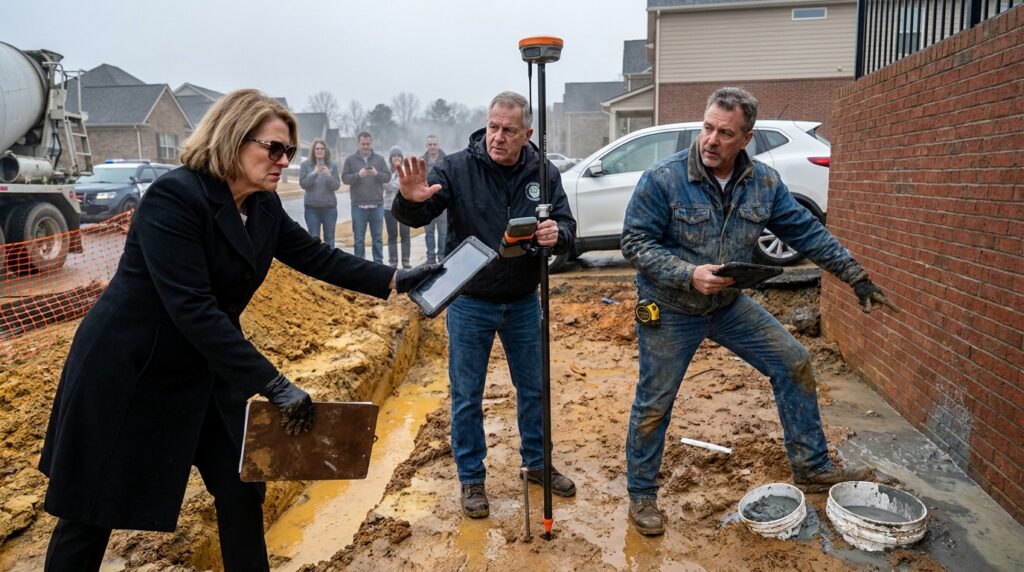
The red-brick retaining wall stood six feet tall, its face dark with wet moss and the slow seepage of grey stormwater. Behind it, Brenda Whitlock’s white crossover sat idling on a bed of dark, stenciled asphalt—asphalt that Inspector Thomas Hayes’s digital survey pole was currently mapping six feet inside David Mercer’s boundary line.
Officer Kowalski didn’t draw his weapon, but his hand rested flat against his duty belt as he stepped up the grass incline toward Brenda. “Mrs. Whitlock, turn off the engine and step away from the crossover. Now.”
Brenda’s jaw worked silently. Her dark sunglasses had slipped down her nose, revealing wide, bloodshot eyes fixed on the carbon-fiber GPS rod held in Hayes’s hand. “This is a technical discrepancy,” she whispered, her voice stripped of its crisp theatrical authority, leaving behind a sharp, raspy edge. “The builder in 2019 placed the course… it was an contractor variance… it was approved by the board—”
“The board of a civic committee doesn’t have the legal authority to grant building variances on county land bank property, Brenda,” Inspector Hayes snapped. He opened his leather map case, pulled out a bright orange, weather-resistant citation form, and slapped it flat against his clipboard. “You built a three-ton masonry wall and fifty feet of custom asphalt across an unrecorded property boundary without a township permit. And then you tried to use municipal code enforcement to seize his equipment before he dug a trench deep enough to strike your footing.”
David stepped up beside Hayes, his work boots planted firmly in the yellow clay at the base of the wall. He reached down, picking up a loose fragment of red brick mortar that had crumbled into his trench.
“You knew the backflow vault would require a six-foot wide excavation along the easement,” David said softly, looking straight at her. “You knew as soon as my track loader took the first pass, the bucket would hit the sub-base of your driveway. So you called Gable Towing. You called Miller Concrete. You buried survey ribbons and you poured quick-set mortar down my pipe at one in the morning.”
The two neighbors who had stood on the sidewalk all morning walked up to the edge of the grass line. The taller neighbor—a man named Henderson who lived three doors down—looked at the orange GPS pole, then at the bright red citation form Hayes was signing, and finally at Brenda.
“Brenda,” Henderson said, his voice heavy with disbelief. “You told us at the annual meeting that the township gave us that slope to protect our entrance values. You took three hundred dollars from every house on this street for the ‘parkland maintenance fund.'”
“I maintained the entrance!” Brenda shouted, turning on him, her voice cracking across the cul-de-sac. “I kept this street pristine for five years! If I hadn’t built that wall, the soil would have washed out into the cul-de-sac! I did it for the neighborhood!”
“You did it to expand your driveway by six feet so you could park your crossover next to your husband’s boat,” Inspector Hayes countered coldly. He tore the top copy of the citation from his pad and handed it to Officer Kowalski. “Officer, she has twenty-four hours to move her vehicle out of the setback zone. If that crossover is parked on Mercer’s parcel tomorrow morning, issue a township impound warrant.”
Kowalski took the citation, stepping directly between Brenda and her car door. “You heard the inspector, Mrs. Whitlock. Step back onto your legal property line, or I will take you into custody right now for criminal mischief and interference with a public utility.”
Brenda looked around the cul-de-sac. The tow truck driver was gone. The concrete mixer driver was already at his chute, preparing to flush the fresh aggregate down David’s cleared trench line. Her neighbors were staring at her with cold, distant disgust, their phones raised to record every second of her retreat.
Her shoulders slumped. She turned on her heel, her white leather shoes sliding on the wet grass as she trudged up her driveway, past the red-brick wall, and vanished into her front entryway, slamming the heavy oak door behind her with a echo that rattled the glass panes.
Inspector Hayes turned to David, handing him a yellow duplicate copy of the municipal order. “The township will issue an immediate structural abatement notice on her wall, Mercer. She’ll have thirty days to dismantle the brickwork and retreat six feet behind your boundary, or the county will hire a contractor to tear it down and put a tax lien on her house to cover the bill.”
David took the paper, holding it flat against his denim thigh. He looked down into his utility trench.
Toby was already in the pit with a heavy brass scraper and a portable flush pump, clearing the last remnants of the soft mortar sludge before it could fully cure inside the PVC fitting. The concrete mixer chute clanked into position over the vault pad, dropping three yards of rich, grey aggregate into the steel-reinforced base.
“How’s the manifold, Toby?” David called down.
Toby looked up, wiping a smear of grey clay from his forehead with the back of his sleeve, a small, quiet grin breaking through his exhaustion. “Flow line is clear, Dad. Intakes are open. The vault base is ready for inspection.”
Inspector Hayes stepped to the trench line, clicked his pen, and placed his official township stamp onto the laminated permit card zip-tied to the orange safety cone.
“Site approved for pour, Mercer,” Hayes said, giving David a brief, firm nod. “Get your concrete down, get your pipe set, and put your fence up right on that steel pin.”
David stood at the edge of the lot as the heavy drum of the mixer emptied its load into the earth, the vibration humming through the soles of his boots. He reached into his pocket, pulled out the brass tape measure, and clipped it back onto his belt—not to measure a boundary, but to mark a foundation that wasn’t going anywhere.