CHAPTER 5: THE PROOF AT THE TRENCH LINE
The heavy rubber chute of the Miller Concrete mixer swung over the trench, dropping three inches before David’s hand slammed flat against the steel guide lever, locking the swivel joint in place.
“Hold the chute!” David shouted up to the driver.
The driver leaned out his cab window, wiping his brow with a greasy shop rag. “What’s the hold up, Mercer? Aggregate’s sitting in the trough!”
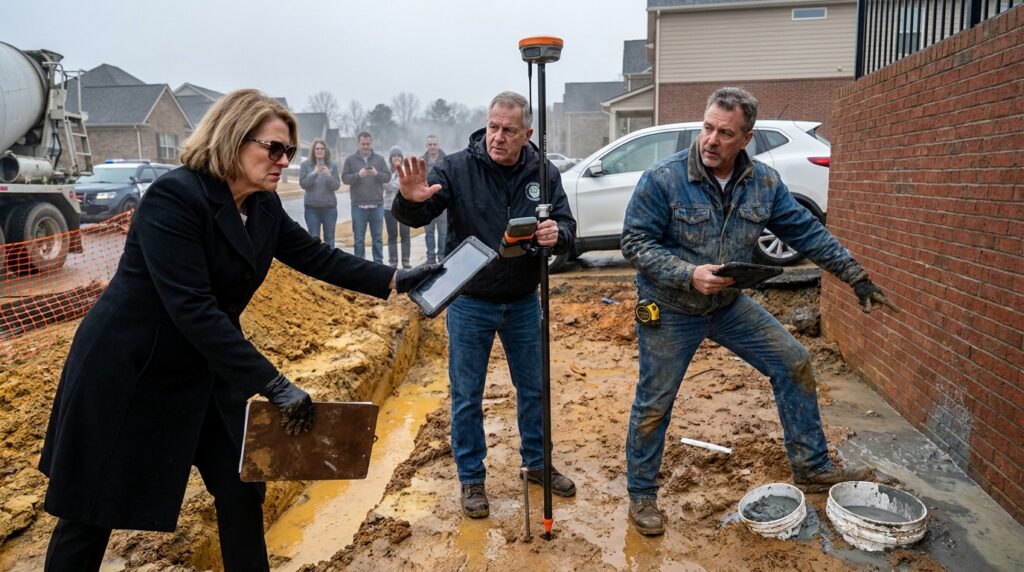
David didn’t answer. He jumped straight down into the three-foot trench, his boots sinking into six inches of standing rainwater and soft yellow clay. At the base of the cut, where the main PVC backflow manifold met the property line, a thick, milky crust of grey silt had dried across the rim of the four-inch cleanout pipe.
He reached down, plunging his gloved hand into the open manifold. His fingers hit a solid, unyielding plug three inches below the collar.
Toby dropped to his knees at the edge of the pit, leaning over the timber shoring. “Dad? What is it?”
David pulled his hand back. His leather work glove was coated in dark grey, sand-heavy sludge that reeked of lime and industrial accelerators. He picked up a long steel alignment bar from the ditch bank and rammed the chisel tip down into the pipe collar.
CLANG.
The steel bar bounced back as if striking solid granite. Someone had poured at least two gallons of quick-setting masonry slurry straight down his utility intake, sealing the municipal connection solid before the morning crew even arrived.
“The pipe’s plug-cured,” David said, his voice dropping into an icy, measured quiet that made Toby go completely still. “They filled the manifold overnight.”
From the top of the trench, Inspector Hayes stepped up to the edge, his boots crunching on the loose gravel. Officer Kowalski stood beside him, his radio crackling with low static.
“What do you mean cured, Mercer?” Hayes asked, kneeling to inspect the pipe mouth.
“Look at the rim, Thomas,” David said. He pointed the tip of his alignment bar at a jagged shard of white plastic wedged in the hardened mortar rim—the broken bail-handle of a five-gallon hardware store bucket. “Quick-set mortar slurry. Poured straight into the throat while the rain was falling.”
Across the lot, Brenda Whitlock had reached her crossover door, key fob in hand. She paused, her hand resting on the door handle as she looked back over her shoulder at the trench line. Her expression wasn’t angry anymore; it was cold, calculating, and satisfied.
“Well, Mr. Mercer,” Brenda called out across the thirty feet of raw dirt, her voice ringing clear over the idling police cruiser. “It appears your infrastructure is defective after all. If your intake pipe is blocked, you cannot connect to the municipal main. Inspector Hayes cannot certify a clogged line.”
“She’s right about the code, David,” Hayes muttered, frustration burning in his eyes as he looked at the ruined PVC. “If the manifold is plugged with cured masonry, I can’t sign off on the backflow vault. You’ll have to dig up twenty feet of pipe and re-lay the main line from the street.”
Toby’s face turned pale. “That’s three days of excavation! The permit expires on Friday!”
“It doesn’t take three days,” David said smoothly. He climbed out of the pit, wiped the lime sludge from his glove onto a rag, and reached into his back pocket. He pulled out his rugged tablet, tapping the screen three times to open the Trail-Max cloud archive.
“Officer Kowalski,” David said, stepping past the concrete truck and standing directly between Brenda and her car door. “I’d like you to review a live transmission recorded at 1:14 a.m. on Camera 03.”
Brenda’s hand froze on the door handle.
Officer Kowalski walked over, taking the rugged tablet from David’s hands. Inspector Hayes leaned over his shoulder.
The high-definition infrared footage lit up the screen in crisp, high-contrast monochrome. The timestamp in the lower left corner read 01:14:22 A.M.
On screen, a figure wearing a hooded dark rain jacket walked carefully across the wet sod along the brick retaining wall, carrying a heavy plastic bucket. The camera’s night-vision array captured every detail in sharp clarity: the person stepping over the orange surveyor’s pin, kneeling at the edge of David’s trench, pulling up two wooden survey stakes, and tilting the bucket over the exposed PVC cleanout pipe.
As the grey slurry glugged into the throat, the figure straightened up, wiping a splash of wet mortar from their sleeve. The floodlight sensor on Camera 03 tripped, bathing the site in 2,000 lumens of bright white light.
The figure jerked their head up in shock, looking straight into the lens. The hood slipped back three inches, fully illuminating Brenda Whitlock’s face, her oversized sunglasses pushed up onto her hair, her eyes wide with sudden panic before she kicked dirt over the spill and hurried back toward her driveway.
Officer Kowalski’s hand tightened on the frame of the tablet. He raised his head slowly, his eyes locking onto Brenda.
The silence on Orchard Meadow Drive was absolute.
The two neighbors who had stayed on the sidewalk gasped. One of them pulled out her phone, taking a photograph of Brenda standing frozen against her white vehicle.
“Mrs. Whitlock,” Officer Kowalski said, his voice dropping into a stern, formal tone as he reached for his belt. “Step away from the vehicle, please.”
“That’s… that video is altered!” Brenda stammered, her voice cracking for the first time as she took a trembling step backward into the grass. “It’s an unverified digital file! He set up illegal cameras to frame me!”
“The file is cryptographically watermarked and timestamped to a secure cloud server, Mrs. Whitlock,” Toby spoke up from the trench edge, holding up his phone. “The hash signature matches the township’s evidentiary upload protocol.”
Inspector Hayes stepped up to Officer Kowalski’s side, his face dark with fury. “That cleanout manifold is municipal utility property once it crosses the easement line, Brenda. You didn’t just mess with a neighbor’s dirt. You poured quick-set cement into a public water infrastructure pipe.”
“I was protecting our property values!” Brenda shrieked, her composure shattering completely as Officer Kowalski stepped onto her lawn. “He’s destroying the entry corridor! He’s digging up the slope!”
“No, Brenda,” David said, his voice ringing out with unshakeable clarity across the cul-de-sac as he pointed his finger at the base of her red-brick retaining wall. “You weren’t protecting property values. You were trying to stop us from uncovering what you buried under that brickwork five years ago.”
Inspector Hayes frowned, looking from David to the brick wall, then down at the master GIS plat map displayed on his carbon-fiber survey receiver. He tapped the touch screen, overlaying the 1994 county boundary lines over the fresh satellite scan.
Hayes stared at the screen, his mouth opening slightly in realization.
“My God,” Hayes whispered, looking up at Brenda in utter disbelief. “Your entire brick retaining wall… and six feet of your stenciled asphalt driveway… are sitting right on top of Mercer’s deeded land.”
The true reality hit the cul-de-sac like a physical wave. Brenda hadn’t been fighting for parkland or community standards. Her entire luxury driveway and structural retaining wall were built six feet over her property boundary on land she had tried to steal through tax-sale manipulation—and David’s permitted utility trench was six inches away from triggering a mandatory, forty-thousand-dollar municipal demolition order.