CHAPTER 4: THE SIEGE AT THE CULDESAC
At 6:45 a.m., the low rumble of a heavy diesel engine shook the condensation from the pine needles above the trench.
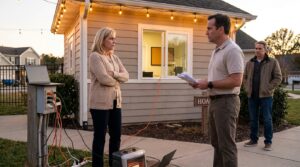
David sat in the cab of his work van, a cold cup of black coffee wedged in the console holder. Beside him, Toby was fast asleep against the passenger door, his jacket pulled tight around his shoulders. The screen of the rugged laptop mounted between the seats flickered with green-tinted infrared feeds, showing twelve hours of uninterrupted, quiet drizzle across the yellow clay. No one had stepped into the camera zone during the night.
Then a sharp air-brake blast hissed through the morning mist.
David opened the van door and stepped out into the biting air. At the curb, the rusted yellow Gable Towing truck had returned—not alone, but backed up by a full-sized flatbed recovery rig with a hydraulic tilt-bed. Behind the recovery rig, Brenda Whitlock’s white crossover sat idling on the grass verge, flanked by two neighboring SUVs. A crowd of four residents in heavy morning coats stood along the sidewalk, watching with folded arms.
A second later, a Miller Concrete mixer truck rounded the corner of Orchard Meadow Drive, its drum revolving slowly with three yards of wet vault aggregate.
The driver of the flatbed, a stocky man in a hi-vis vest over a greasy flannel shirt, dropped his hydraulic ramp onto the asphalt with a deafening metallic CLANG. He pulled a heavy steel winch cable toward the locked track loader.
“Hold on,” David said, crossing the muddy lot in three long strides. The air smelled of raw exhaust and wet cement. “You’re touching machinery on a permitted site.”
The driver didn’t pause. He dragged the heavy iron hook across the track loader’s steel frame. “Got an emergency removal order from township code enforcement, buddy. Access corridor obstruction. This track loader is blocking emergency service transit for the cul-de-sac.”
“This loader is parked twelve feet inside my property line,” David replied, his voice dropping into that quiet, impenetrable register. “Where is the township order?”
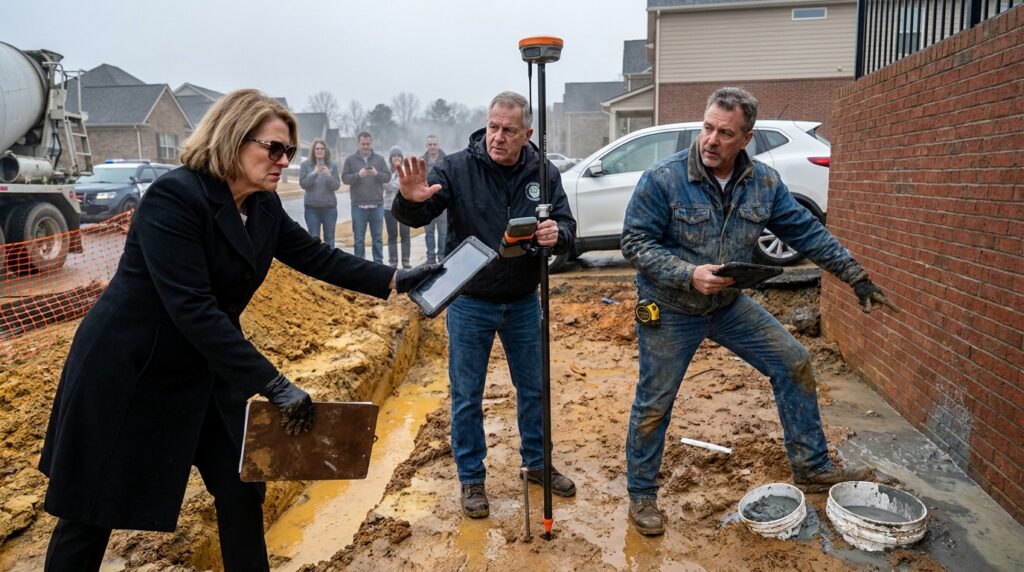
Brenda Whitlock stepped out from behind the recovery truck, her leather clipboard held flat against her chest. She wasn’t wearing her floral blouse today; she wore a tailored black coat and dark leather gloves. Her expression was triumphant.
“Right here, Mr. Mercer,” Brenda announced, her voice carrying clearly across the street to the gathering neighbors. “Emergency Ordinance 204. Any construction site operating without a certified environmental impact waiver that obstructs natural stormwater flow is subject to immediate equipment impoundment.”
She handed a paper to the flatbed driver, who unhooked his winch cable and prepped the hook to bite into the loader’s chassis.
The concrete mixer driver stuck his head out of his cab, idling fifty feet down the road. “Hey! Mercer! I got forty minutes before this load sets in the drum! Am I dropping this pour into your trench or turning around?”
“You’re turning around,” Brenda called out to the driver before David could speak. “This site is seized!”
“He doesn’t work for you, Mrs. Whitlock,” David said smoothly. He walked past the flatbed driver and stood directly between the winch cable and the track loader’s front bucket, placing his boots over the orange surveyor’s pin buried in the mud. He reached into his jacket and pulled out his plastic binder. “This lot is Parcel 410-B. The township issued permit 884-A on Tuesday. If your driver hooks this cable to my machine without a signed judicial warrant from the county magistrate, I am filing immediate criminal charges for grand larceny and property destruction against Gable Towing.”
The flatbed driver paused, the heavy steel hook swinging inches from David’s chest. He looked at Brenda, then at David’s unblinking eyes, then at the laminated permit binder.
“Look, lady,” the driver muttered to Brenda, taking a step back. “You said you had a magistrate’s seizure warrant. An administrative notice ain’t a police warrant. If he calls the sheriff for a stolen rig, my boss loses his county towing license.”
“He’s bluffing!” Brenda snapped, her voice tightening as two neighbors on the sidewalk leaned in to whisper. “He doesn’t own the access easement! This entire strip is community parkland deeded to the Orchard Meadow Civic Committee in 1998!”
There it was. The claim was out in the open, uttered aloud in front of five witnesses and the concrete driver.
David felt the piece fit into place—the Layer 1 decoy she had spent days hiding behind fake notices and tow trucks. She wasn’t just claiming an aesthetic violation. She had convinced the entire neighborhood that his private tax-sale lot was designated public parkland, using their collective fear of losing green space to turn the street into her personal enforcement crew.
“Community parkland?” David repeated, his voice calm, ringing out over the rumble of the diesel engines. “Is that what you told the neighbors, Mrs. Whitlock? That the county sold you a public park at a tax auction?”
“It’s in the subdivision charter!” Brenda insisted, her knuckles turning white around her clipboard. “You took advantage of a clerical tax error to steal our common entry park!”
A white township utility truck pulled up behind the concrete mixer, its amber roof lights flashing slowly through the morning fog. Inspector Thomas Hayes stepped out of the cab, carrying a thick leather map case and a digital GPS survey receiver mounted on a carbon-fiber pole. Behind him, a marked township police cruiser glided quietly to a stop at the curb.
Officer Kowalski got out of the cruiser, adjusting his duty belt as his boots crunched on the gravel.
“Alright,” Hayes said, his gravelly voice cutting through the idling engines as he walked onto the mud lot. “What’s the circus about today, Brenda?”
“Inspector!” Brenda marched toward him, gesturing aggressively at David and the locked loader. “This man is illegally excavating civic parkland and threatening private contractors! I demanded an immediate emergency impoundment under Ordinance 204!”
Hayes didn’t look at her clipboard. He set his GPS pole down directly over the orange-capped steel pin where David was standing. The digital receiver beeped three times, locking onto the county satellite grid.
Hayes looked down at the screen, then looked up at Brenda with a cold, tired stare.
“Ordinance 204 doesn’t apply to private real estate, Brenda,” Hayes said clearly, so every neighbor on the sidewalk could hear. “And Parcel 410-B has never been community parkland. It was platted as an independent residential lot in 1994, foreclosed by the county land bank in 2018, and legally purchased by David Mercer three months ago.”
A collective murmur broke out among the neighbors on the sidewalk. One of the men in heavy coats frowned, looking at Brenda. “Wait… Brenda, you told us at the annual meeting that the township deeded that lot to the HOA back in nineties.”
Brenda’s face went pale, but she held her chin high, her eyes darting between Officer Kowalski and the GPS pole. “The deed language was ambiguous! The committee has maintained adverse possession over that grass line for a decade!”
“Adverse possession doesn’t run against municipal tax liens, Mrs. Whitlock,” David said softly, stepping forward beside Inspector Hayes. “You knew this wasn’t parkland. You knew it when you tried to buy it from the land bank yourself in 2018 and got outbid by the county.”
Brenda froze. Her lips pressed into a tight, white line as the neighbors began talking openly, their voices rising in confusion and anger.
“Hayes,” the concrete truck driver called out from his cab, holding his elbow out the window. “My drum is still turning. Are we pouring or what?”
“Pour it,” Hayes ordered, pointing toward the open trench. “His permits are valid, his boundaries are verified, and this site is clear.”
The flatbed driver immediately started winching his ramp back onto his truck, eager to distance himself from the scene. “I’m out of here,” he muttered to Brenda, climbing into his cab and slamming the door.
Brenda stood alone on the edge of the asphalt as the concrete mixer began backing down the driveway toward David’s trench, its chute clanking into position. The fake parkland narrative had collapsed right in front of the people she had manipulated.
Yet as David watched her step back toward her crossover, he saw no surrender in her eyes. Her gaze wasn’t fixed on the concrete truck or the neighbors. Her eyes were fixed squarely on the exposed earth beneath her brick retaining wall, where the grey water was still trickling silently through the mud.
He realized then that the parkland lie was only the outer shell. She hadn’t fought this hard just to save a fake park. She was fighting to keep anyone from digging deep enough to see what lay directly beneath her driveway.