CHAPTER 3: THE EYES IN THE PINE
David ended the call and slipped the heavy phone into his front pocket. The trickle of grey, sediment-choked water continued its quiet erosion along the base of the brickwork, cutting a narrow, cloudy seam through the damp yellow clay toward the exposed PVC manifold.
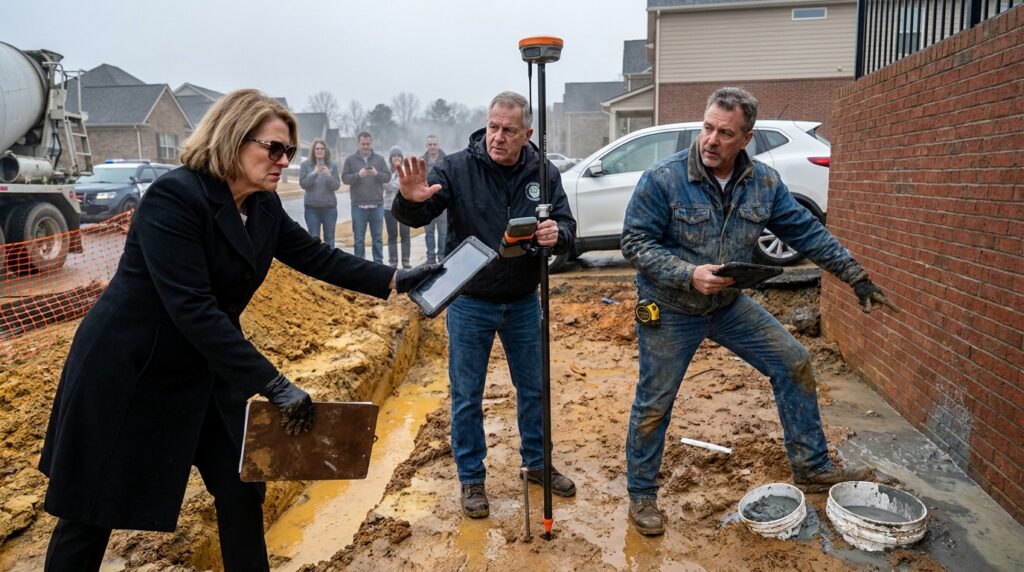
Toby stood at the edge of the trench, his boots caked in thick, iron-rich mud. He had picked up a small wooden surveyor’s stake and was probing the wet soil where the run-off originated. “That’s not rain runoff, Dad. Rain doesn’t wash out with that density of pulverized limestone unless it’s cutting through crushed aggregate base.”
“She knows,” David said softly. He stepped over the open trench, the wet earth settling under his heel with a dull, heavy squelch. “She knows if Hayes brings out the county surveyor to verify the drainage easement, he won’t just look at my backflow vault. He’ll check the bench mark.”
“So she’s trying to force us off the lot before Hayes gets here,” Toby realized, his thumb tracing the jagged edge of the broken survey stake. “The boot on the loader, the supplier call… she’s trying to trigger an abandoned-site citation so the township halts the permit automatically.”
David walked toward the back of his work van, the rusted rear doors grooving open with a sharp metallic groan. Inside, lined up along the reinforced steel shelving, sat the tools of a trade built on precision: brass pressure gauges, hydrostatic testing pumps, rolls of Teflon tape, and four matte-black weather-sealed cases.
He unlatched the second case. Inside lay three cellular Trail-Max security units, each equipped with non-reflective infrared lenses, 4K sensor arrays, and low-profile mounting brackets forged from powder-coated aluminum. He had bought them two years ago during the court proceedings over his old partnership—a habit born from learning the hard way that people only respect what can be proved in court.
“We aren’t cutting the boot,” David said, handing two of the heavy black units to Toby. “And we aren’t leaving the site unattended tonight.”
Toby weighed the cold steel brackets in his palms. “Where are we hanging them?”
“First one goes twelve feet up in the white pine on the east corner,” David pointed, his index finger tracing a line through the damp air toward a thick evergreen whose lower branches overhung the boundary line. “Angle the lens thirty degrees down, catching the loader’s drive gear and the orange survey pin. Second one goes in the cedar along the north slope, facing the brick retaining wall.”
Toby nodded, his eyes sharpening as he checked the battery seals. “What about the third?”
“The third stays in the van cab, aimed through the rear tint directly at the cleanout pipe,” David replied, pulling a roll of dark green utility wire from his tool rack. “If anyone comes onto this dirt after dark, I want three distinct angles, high-definition, backed up to the cloud server the second the motion sensor trips.”
For forty-five minutes, father and son worked in synchronized, methodical silence. They spoke only in the abbreviated language of site mechanics—measuring sightlines, adjusting focal lengths, securing wires against the sway of pine branches in the rising evening wind. The air grew colder as the afternoon light faded into a bruised, overcast slate grey.
As Toby tightened the thumb-screw on the tree-mount bracket twelve feet above the soil, a sharp, metallic clack echoed from the street.
David turned. Brenda Whitlock was standing at the edge of her manicured lawn, framed by the dark, wet expanse of her stenciled asphalt driveway. She was dressed in a thick wool coat, but her dark sunglasses remained firmly in place despite the twilight. In her hands, she held a long-lens camera, clicking several rapid shots of Toby mounted in the pine tree.
She stepped off the curb, her white leather shoes stopping just short of the mud line.
“Mounting unauthorized surveillance equipment directed at private residences is a violation of township privacy ordinances, Mr. Mercer,” she called out, her voice clipped, sharp, and entirely devoid of hesitation. “I am adding illegal electronic recording to the civic committee’s filing tomorrow morning.”
David walked to the edge of his lot, stopping four feet from her, his hands resting naturally on his leather tool belt. The brass tape measure gleamed dully under the streetlights that were just beginning to flicker alive down the cul-de-sac.
“The camera is mounted on my private timber, Mrs. Whitlock,” David said, his voice flat, low, and perfectly level. “Its field of view is calibrated strictly to the boundary line and my permitted utility trench. Every frame recorded stays within Parcel 410-B.”
Brenda smiled, a thin, tight line that didn’t reach her eyes. She adjusted her grip on the camera. “Parcel 410-B is under administrative dispute. You’re fighting a losing battle, Mr. Mercer. This neighborhood has spent fifteen years establishing an elite standard. A man in grease-stained overalls running an unapproved contractor operation out of a dirt pit does not fit the master plan.”
“Your master plan seems to have a water leak,” David remarked softly, glancing down at the grey, lime-heavy silt creeping past her white shoes toward his boundary pin.
Brenda’s posture went rigid for a fraction of a second. Her hand tightened over the camera grip until her leather glove creaked. “The drainage on Orchard Meadow Drive is fully compliant with all historic committee agreements. You would know that if you were capable of understanding community governance.”
“I don’t need to understand governance to read a slope, Mrs. Whitlock,” David replied. “Water flows downhill. And when crushed stone aggregate washes out from under an unpermitted brick wall, the earth beneath it gives way.”
Brenda’s lips parted slightly, but before she could speak, a sharp ping echoed from David’s phone. He drew the device out, looking at the screen. A automated notification from the Trail-Max cloud portal popped up: Camera 01: System Online. Storage Verified. Infrared Armed.
David looked up, holding her gaze in the dimming light. “The system is live. Anything that touches this trench tonight will be broadcast directly to the county inspector’s server.”
Brenda didn’t reply. She turned abruptly, her heels clicking a sharp, hurried rhythm on the wet asphalt as she retreated up her driveway, her silhouette vanishing into the towering shadow of her brick retaining wall.
David walked back to the trench, kneeling in the damp clay beside Toby. Beneath the dark earth, right where the grey water trickled through, a small piece of old PVC pipe stuck out from the mud—its end crudely cut, unsealed, and hidden beneath a loose pile of decorative river rock.
Toby looked at his father, his voice quiet. “She didn’t just route her driveway drainage onto our land, did she?”
“No,” David said, touching the cold edge of the exposed PVC. “She routed her storm run-off into our backflow easement so the township would force us to abandon the site before we dug deep enough to find where the pipe connects.”