
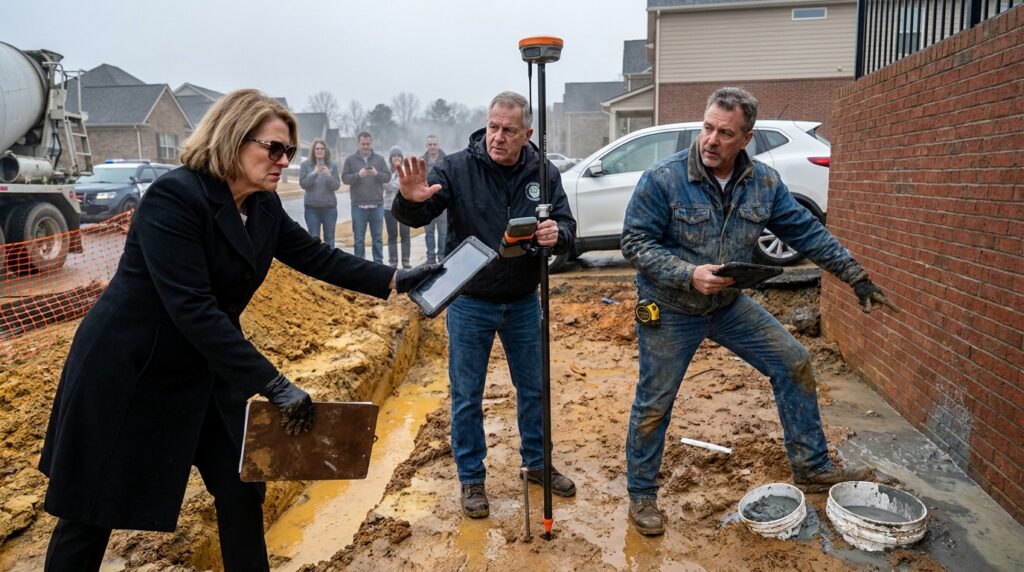
CHAPTER 2: THE BOOT ON THE TREAD
The frayed yellow ribbon pulled free from the mud with a soft, wet suction. David knelt on the clay bank, thumbing the slick plastic strip between his calloused fingers. It wasn’t standard municipal tape. The printing along its length was faded, the black lettering eaten away by years buried in sulfurous ground: SPECIAL TRACT BOUNDARY — COUNTY LAND BANK 2018.
Someone had deliberately buried the old marker ribbon beneath two inches of freshly laid sod, trying to obscure where the municipal parcel ended and the subdivision’s unmaintained timberline began.
David stood up slowly, the cold rain beginning to seep through the shoulders of his denim jacket. Across the raw dirt plot, his son Toby was coming around the side of the tool shed, carrying a pair of heavy brass pipe wrenches and a digital surveyor’s level tucked under his arm. Toby’s face was pale, his eyes darting toward the curb where Brenda Whitlock’s white crossover had disappeared past the manicured hydrangeas of Orchard Meadow Drive.
“She called the supply yard, Dad,” Toby said, his voice dropping as he stepped into the trench beside David. “I was on the phone with Miller Concrete when she drove off. The dispatcher said a woman claiming to represent township legal compliance told them our site was under an environmental injunction. They cancelled our 2:00 p.m. pour for the vault base.”
David didn’t slam his fist against the excavator or curse. In thirty years of pipe fitting, he’d learned that anger was like air in a hydraulic line—it softened your leverage and wasted pressure. He reached into his pocket, pulled out his pocketknife, and scraped a wedge of yellow clay from the treads of the track loader.
“Did Miller cancel the ticket or just delay the truck?” David asked.
“Delayed,” Toby muttered, setting the digital level down on a dry concrete pad. “They want a signed clearance from the county inspector before they send three mixers of quick-set mix down a residential cul-de-sac. That’s four hundred dollars in idle crew fees every hour we sit here.”
“Then we don’t sit,” David said. He handed Toby the slick piece of buried ribbon. “Log the coordinates where I pulled this out. Take three clear photos with the GPS timestamp, then upload them to the project folder.”
Toby looked down at the frayed plastic. “What is this?”
“An old boundary tie from the 2018 county foreclosure auction,” David said, his gaze drifting up the gentle slope toward Brenda’s property line two hundred feet away. Her two-story colonial sat elevated above the street, framed by a newly poured, dark-stenciled asphalt driveway and a massive red-brick retaining wall that met the edge of David’s lot. “Someone went to a lot of trouble to bury this six inches past where her turf ends.”
Before Toby could reply, the sharp sound of metal grinding against metal echoed from the front of the lot.
David turned. At the curb, a faded yellow pickup truck with a rusted utility bed had pulled in behind his flatbed trailer. A tall man in grease-stained coveralls was kneeling beside the track loader’s steel treads, slamming a heavy iron lock mechanism around the sprocket.
David walked across the plot, his boots leaving deep impressions in the yellow muck. Toby followed a half-step behind, holding the digital level like a club before catching himself and lowering it to his side.
“You’re on private property,” David said as he reached the curb. The air smelled of burnt oil and wet iron from the yellow truck’s idling tailpipe.
The man in coveralls didn’t look up immediately. He tightened a thick steel padlock through the teeth of a heavy yellow boot clamp, locking the excavator’s drive sprocket solid. Only when the key clicked did he stand, wiping his oil-slicked hands on an old shop rag.
“Gable Towing and Recovery,” the man said, gesturing with a greasy thumb toward the laminated card jammed beneath the loader’s windshield wiper. “Got a commercial nuisance order from the neighborhood committee. Unauthorized heavy machinery parked on a residential access route without a transit permit.”
“This lot is private land, and the machine is ten feet off the public right-of-way,” David said calmly. He pointed to the zip-tied permit card fluttering on the orange cone three feet away. “Township permit 884-A. Signed by Thomas Hayes.”
“I don’t deal with Hayes,” the tow driver said, stepping back toward his rusted truck. “I deal with the civic committee. Mrs. Whitlock pays the impound retention fee upfront. If you want this clamp off, you take your paperwork down to the magistrate on Monday morning and pay the code clearance deposit.”
“Monday?” Toby cut in, his voice cracking slightly with frustration. “We have a municipal concrete pour scheduled for today! You can’t just lock a working rig on a permitted site!”
The driver gave Toby a flat, indifferent look—the look of a man who had spent twenty years hauling repossessed cars out of muddy driveways and didn’t care who was crying on the porch. “Take it up with the committee, kid. Touch that clamp with a torch or a grinder, and I call county sheriff for destruction of private impound property.”
He climbed into the cab of his yellow truck, slammed the dented door, and pulled away, leaving a dark cloud of diesel smoke hanging over the wet asphalt.
Toby took two quick steps toward the locked track loader, inspecting the thick iron jaw biting into the drive gear. “Dad, I can cut this off in ten minutes with the angle grinder in the van. The steel isn’t hardened.”
“No,” David said instantly. “He wants us to use the grinder. That gives her a sheriff’s report for property destruction before the inspector even steps on the dirt.”
David walked back to the trench, his mind working through the geometry of the site like a friction calculation. Brenda hadn’t just called a tow truck; she had timed the clamp to hit right when his concrete pour was scheduled, trapping his equipment while simultaneously poisoning his supplier against him. It was organized, methodical, and designed to force a frantic mistake.
He pulled his phone from his pocket and dialed the direct extension for the township municipal building.
“County Utility Inspection, Hayes speaking,” a gravelly voice answered after three rings.
“Inspector Hayes. It’s David Mercer out on Orchard Meadow Drive.”
A brief pause drifted over the line, punctuated by the sound of shuffling papers. “Mercer. I already got two phone calls from your street this morning. Mrs. Whitlock says you’re running heavy diesel equipment past the residential noise threshold and encroaching on municipal park drainage.”
“I’m standing next to the steel survey pin you verified on Tuesday, Thomas,” David said, keeping his tone measured. “She just had a private tow operator put a boot on my loader’s drive sprocket. And my concrete supplier won’t drop the vault pad because she claimed we’re under a county environmental hold.”
Hayes let out a slow, weary sigh over the receiver. “Brenda Whitlock doesn’t have the authority to issue environmental holds. But she does know how to file formal administrative complaints that trigger automatic twenty-four-hour review periods. If I come out there, David, I have to inspect the entire boundary line, not just your vault trench.”
“Come out then,” David said smoothly. “Bring the county GIS plat maps for Parcel 410-B. The ones with the 2018 land bank overlay.”
There was a sudden, sharp silence on the other end of the line.
“What are you looking at out there, Mercer?” Hayes asked, his voice losing its tired administrative edge.
David looked across the mud toward the edge of the lot, where the red-brick retaining wall supporting Brenda’s elevated driveway met his property line. Along the base of the brickwork, a small trickle of grey, sediment-heavy water was washing out from beneath the mortar, cutting a clean, unnatural channel straight into his open utility trench.
“I’m looking at an unpermitted drainage discharge,” David said softly, “coming right out from under her retaining wall.”