
Chapter 3: Ruth’s Empty Chair
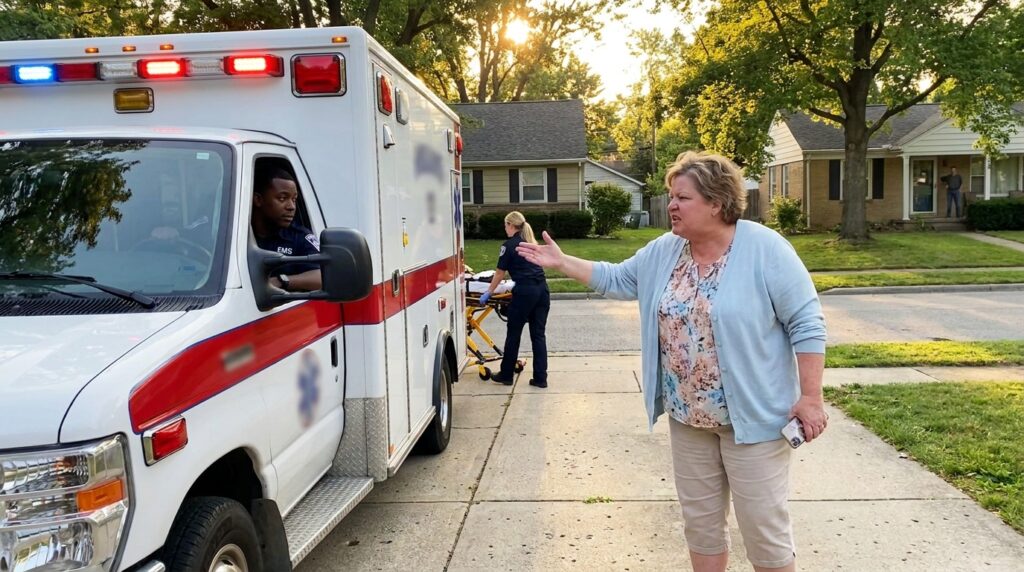
The next morning, Karen walked across the street.
Ruth’s curtains were closed.
Her front garden, usually immaculate, looked strangely abandoned.
Karen almost turned around.
Then Ruth’s niece, Emily, opened the door.
She recognized Karen immediately.
“You’re the woman from yesterday.”
Karen felt her face grow hot.
“I wanted to check on Ruth.”
Emily hesitated before opening the door wider.
“She’s in the hospital.”
Karen stepped inside.
The house smelled faintly of lavender and old books.
On the refrigerator was a photograph of Ruth and her late husband standing beside a young tree in the backyard. On the kitchen table sat two untouched coffee cups.
Emily explained what had happened.
Ruth had suffered a serious cardiac episode.
She had managed to call 911 herself, but by the time the ambulance arrived, she was too weak to walk to the door.
The EMTs had needed the stretcher.
The ambulance had stopped where it did because it was the safest position to reach the house quickly.
Karen listened without interrupting.
Then Emily said something that stayed with her.
“Ruth was conscious the whole time.”
Karen looked up.
“She was?”
“She kept asking whether the ambulance was blocking somebody’s driveway.”
Karen’s stomach tightened.
Emily gave a small, tired smile.
“I told her not to worry about it.”
Karen looked toward the front window.
For a moment, she imagined Ruth lying on the floor, waiting for help, while Karen stood outside arguing about concrete.
“I didn’t know,” Karen said.
Emily’s expression softened.
“I know.”
Those two words were harder to hear than anger would have been.
Karen expected Emily to accuse her.
Instead, she simply said, “You didn’t know.”
On the way home, Karen noticed Linda standing outside.
Linda didn’t wave.
Karen walked past her.
Then she stopped.
“Can I see the rest of the camera footage?”
Linda looked surprised.
“Why?”
“I want to know exactly what happened.”
Linda went inside and returned with her phone.
There was more footage.
It showed Karen arguing.
But it also showed something else.
Before Karen arrived, Ruth had opened her front door herself.
She had been standing there, one hand against the frame.
She had looked toward the ambulance.
Then she had slowly lowered herself to the floor.
Karen watched the moment twice.
She finally understood why the EMTs had been moving so fast.
Ruth hadn’t been waiting comfortably inside.
She had been on the floor.
Karen handed the phone back.
That afternoon, she made a decision.
She was going to the hospital.
But before she could leave, another message appeared from the neighborhood association.
The complaint hearing had been scheduled.
And the person who had filed the formal complaint was not Linda.
It was the ambulance service.