Chapter 5: The Third Scratch
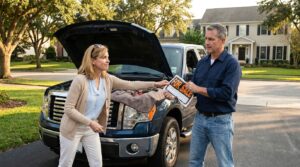
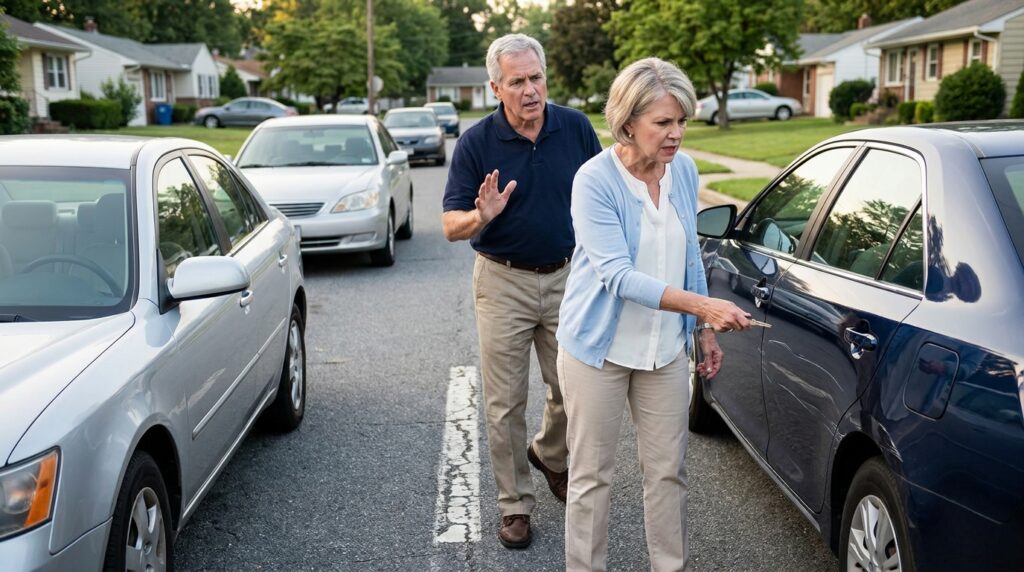
The next morning, Frank discovered another scratch.
Not on his SUV.
On the side of his wife’s car.
Maria had left it parked near the house overnight.
The damage was smaller than the others, but the meaning was unmistakable.
Karen had returned to the cars.
This time, there was camera footage.
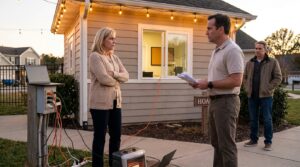
Linda had installed a small security camera after the first incident.
The footage showed Karen approaching the vehicle just before dawn.
She did not scratch it.
Instead, she placed a bright orange cone in front of it and left.
It wasn’t vandalism.
But it was deliberate interference.
When Tom confronted her, she denied touching the vehicle.
Then Linda showed her the footage.
Karen stared at the screen.
Her face became still.
“That doesn’t prove anything.”
“It shows you putting the cone there,” Linda said.
Karen’s eyes hardened.
“I was warning her.”
“For what?”
“That she’s trespassing.”
Tom felt the entire argument collapsing into something much larger.
Karen no longer needed to damage the cars to create trouble.
She was trying to control the space by force of repetition.
The HOA board issued a written directive requiring her to stop interfering with residents’ vehicles until the survey was finalized.
Karen refused to sign it.
That decision had consequences.
The board hired an attorney to review the easement and the association’s enforcement authority.
Tom worried about the cost.
So did the other residents.
This wasn’t some abstract neighborhood dispute anymore.
Everyone was paying for it.
Then Michael Reed delivered his preliminary survey report.
The faded pavement line was not the legal boundary Karen had imagined.
It was an old maintenance reference painted when the subdivision was first developed.
The actual legal documents established a shared access easement.
The parking arrangement, however, was more complicated.
Residents could use the strip, but they could not block access or treat it as private storage.
Karen had been wrong about ownership.
But she had been right about one thing.
The area needed rules.
The difference was that rules were not the same as ownership.
Helen called another meeting.
Karen didn’t attend.
Instead, David came.
He placed an envelope on the table.
Inside was the old tax map Karen had shown Tom.
David had found it in her office.
He apologized for bringing it.
But there was one thing the board needed to see.
On the back of the map was a handwritten note from Karen’s father.
It read:
“The shared lane stays shared. Don’t let anyone tell you otherwise.”
Nobody spoke.
Tom looked at David.
“Did Karen know this was there?”
David swallowed.
“I don’t think she ever turned it over.”
The truth was finally becoming clear.
But there was still one question.
What would Karen do when she learned that the document she had been using to justify everything actually contradicted her claim?