Chapter 2: The Cost of Being Certain
By seven the next morning, Tom had already received two estimates for the damage.
The numbers made his stomach tighten.
The scratches were too deep to polish away. The driver’s door would need sanding, repainting, and blending into the surrounding panels.
His insurance company wanted photographs.
The police wanted a statement.
Tom wanted neither.
He wanted his ordinary life back.
For fifteen years, the residents along Maple Ridge Court had treated the paved strip as shared parking. Older couples parked there when family visited. Contractors used it when unloading. Neighbors helped one another maneuver around it during snow or heavy rain.
No one had ever questioned the arrangement.
Until Karen did.
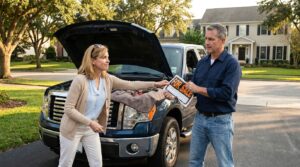
And now she had scratched three cars.
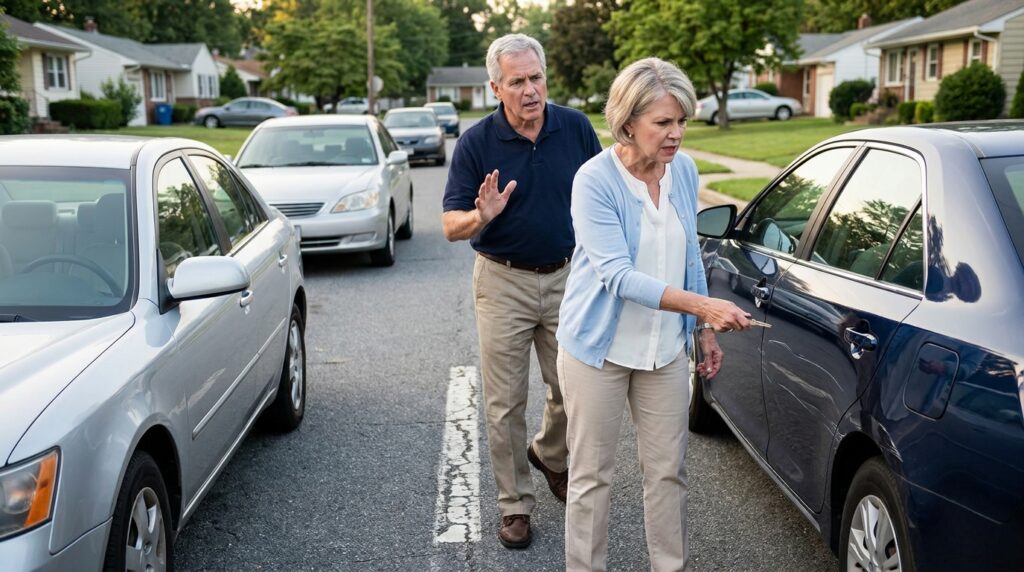
Tom’s, the silver sedan belonging to Linda’s husband, and an older SUV owned by Frank Morales, a retired school custodian who lived two houses down.
Frank was seventy-one.
The SUV was the vehicle he used to drive his wife, Maria, to medical appointments and grocery stores.
By lunchtime, the damage had become more than an argument.
It had become a problem for three households.
Tom drove to the county records office.
He brought a folder containing his deed, an old neighborhood plat he’d found in his garage, and photographs of the pavement.
The clerk studied the documents.
Then she pulled up the subdivision map.
“There are several easements in this development,” she explained.
Tom leaned closer.
“What’s this one?”
The clerk pointed to a narrow strip running along the front of several properties.
“It appears to be a shared access area.”
Tom felt some relief.
“Does that mean Karen doesn’t own it?”
The clerk shook her head.
“I can’t give you a legal interpretation. But the recorded documents should tell you what the strip is for.”
She printed several pages.
One showed an old subdivision plan.
Another showed a recorded easement.
The third made Tom stop.
There it was.
A narrow line crossing the same pavement Karen had claimed as hers.
But the document was almost thirty years old.
Tom wasn’t ready to assume that settled everything.
He took the papers home.
That afternoon, Karen’s husband, David, knocked on his door.
David was quieter than Karen. He was in his late sixties, thin, gray-haired, and visibly uncomfortable.
“I heard you went to the county.”
Tom nodded.
“I had to.”
David looked toward the driveway.
“I’ve been telling Karen we should let somebody verify the boundary.”
Tom expected an argument.
Instead, David lowered his voice.
“She found an old survey years ago. She became convinced that the paved strip belonged to your side of the street.”
“Then why didn’t she show anyone the survey?”
David hesitated.
“Because she couldn’t find it.”
That answer bothered Tom more than if David had defended her.
“Did she actually have proof?”
“I don’t know.”
David looked down at the scratches on Tom’s car.
“I’ve never seen anything that proves what she says.”
Then he walked away.
Tom watched him cross the street.
Behind him, on the kitchen table, the county documents remained open.
The next morning, Tom planned to take them to the HOA office.
But that evening, an envelope appeared beneath his front door.
Inside was a photocopy of an old property survey.
At the bottom, someone had written three words in blue ink:
LOOK AT THE DATE.