Chapter 4: What Karen Thought She Was Protecting
Friday morning brought rain.
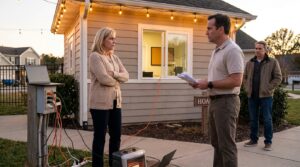
The surveyor arrived at nine.
His name was Michael Reed, and he spent nearly three hours walking the neighborhood with measuring equipment, photographs, and copies of the recorded plat.
Karen watched from her porch.
She did not speak to him.
Tom expected the survey to settle everything.
Instead, Michael asked for another document.
“The original subdivision plan,” he said.
Helen produced it from the HOA records.
Michael studied it.
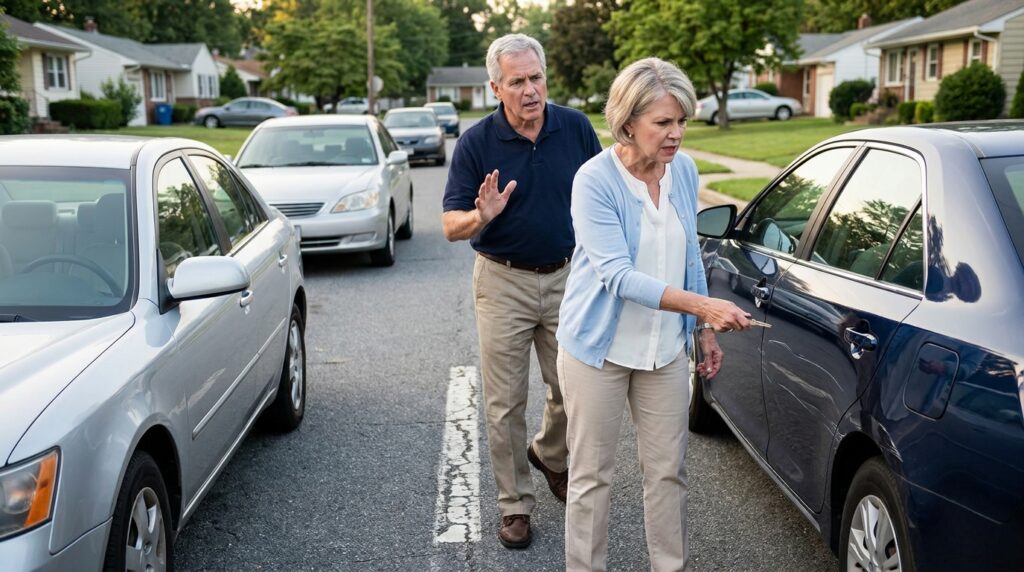
Then he looked toward the pavement.
“The current pavement doesn’t perfectly match the original drawing.”
Tom felt his stomach drop.
“What does that mean?”
“It means we need to distinguish between the legal boundary and what was physically built later.”
Karen immediately stepped forward.
“So the line doesn’t prove they can park here.”
Michael remained calm.
“I haven’t said that.”
“But you’re saying it isn’t simple.”
“I’m saying the documents matter more than assumptions.”
Karen folded her arms.
For once, she had nothing to say.
The survey continued.
By late afternoon, Michael had enough information to prepare a report.
But there was one problem.
The old access easement appeared to remain active.
The paved strip wasn’t Karen’s private driveway.
It was part of a shared access arrangement serving multiple properties.
That explained why everyone had used it for years.
It also explained something else.
Karen had been responsible for maintaining a portion of it because the HOA documents assigned maintenance duties to her side of the development.
She had mistaken responsibility for ownership.
Tom felt an unexpected sadness.
Not sympathy for the damage.
But sadness at how far the misunderstanding had gone.
Then David called him.
“Can we talk?”
They met at the corner.
David looked exhausted.
“Karen found the old survey after her father died,” he said. “She believed the family had lost part of the property when the subdivision was developed.”
Tom listened.
“She thought somebody had taken land from her father?”
“Yes.”
“Did her father ever say that?”
David shook his head.
“No. That’s the strange part.”
He explained that Karen had spent years trying to find documents supporting the belief. Every time a neighbor parked near her property, she interpreted it as proof that people were taking advantage of her.
“She stopped trusting the HOA,” David said. “Then she stopped trusting the neighbors.”
Tom looked toward Karen’s house.
“Why didn’t you stop her?”
David’s face fell.
“I tried.”
That evening, Karen came outside.
She walked toward Tom.
For a moment, he thought she might apologize.
Instead, she held up a new document.
“You’re going to regret this.”
Tom looked at the paper.
It was an old tax map.
Karen tapped it with her finger.
“This proves I’m right.”
Tom didn’t argue.
He simply said, “Then give it to the surveyor.”
Karen hesitated.
She had the paper in her hand.
But she didn’t hand it over.
She folded it.
And walked back inside.
The document might have been proof.
Or it might have been the final piece of a misunderstanding.
Tom wouldn’t know until someone read it properly.