
CHAPTER 9: The Trial of the Old Patent
The gray light of dawn had barely begun to streak across the ridge when the heavy diesel roar woke the cul-de-sac.
Marcus didn’t wait for a knock. He pulled on his canvas jacket, stepped out onto the porch, and looked down toward the subdivision entrance. Two flatbed semi-trucks bearing the crimson emblem of Apex Earthworks Corp. were idling right across the main access lane, their dual stacks belching pale blue vapor into the freezing morning air. Behind them, a tracked excavator sat tilted off its trailer, its steel bucket resting directly on the property line where the old homestead boundary met the public asphalt.
From across the street, Miller stepped out onto his lawn, his breath pluming white in the crisp air. “They’re trying to fence off the drainage corridor,” Miller called out, his voice sharp with sudden panic. “The county guys are already putting up chain-link fencing panels along the curb.”
Marcus didn’t answer. He walked down his driveway, his boots hitting the hard concrete with steady, rhythmic force, and headed straight for the front gate.
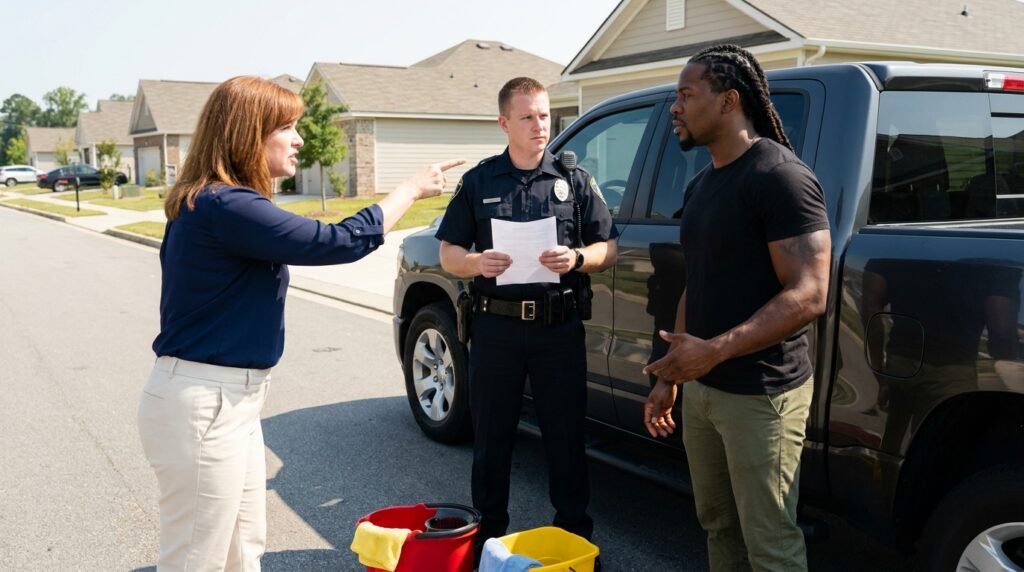
Standing beside the excavator was a man in an unzipped corporate parka, a hardhat pushed back on his forehead, gesturing aggressively at a pair of county sheriff deputies who stood near a patrol cruiser. Next to them stood Eleanor, her coat buttoned tight against the chill, her expression a mask of desperate, razor-thin defiance. She had her phone pressed to her ear, arguing with someone in the county permit division.
“The board’s temporary injunction hasn’t been formally vacated by the circuit judge yet,” Eleanor shouted over the rumble of the idling excavator engine, her voice thin and manic. “Apex Earthworks has a legal contract to clear this utility corridor. Move out of the way, Marcus, or I’ll have the deputies haul you for criminal interference.”
The foreman from Apex Earthworks stepped forward, shaking a clipboard in Marcus’s direction. “Look, pal, I got a signed municipal clearance stamped by the zoning board three days ago. Unless you got a judge’s stay right here in your hand, my operator drops this bucket and we clear the trench.”
Marcus stopped four feet from the edge of the steel track. He didn’t flinch. He reached into his jacket, pulled out the oilcloth-wrapped transit notebook alongside the original master patent signed by the territorial governor, and held them out toward the senior deputy.
“You can drop the bucket,” Marcus said, his voice cutting through the mechanical din like a cold blade. “And then the county is going to impound every piece of iron this company owns for trespassing on an unsevered private estate.”
The senior deputy—an older officer with graying temples—took the heavy, linen-backed patent from Marcus’s hands. He unfolded it slowly, running a calloused thumb over the embossed red wax seal at the bottom corner. Then he looked up at the Apex foreman, his eyes narrowing. “Where did your office pull the clearance map for this site?”
“City zoning database,” the foreman muttered, shifting uneasily. ” Standard residential parcel expansion.”
“Then your office pulled a ghost file,” the deputy said flatly, turning the document toward the foreman. “This tract was never annexed. It’s an independent homestead patent protected under state conservation statute four-B. Any commercial work done on these coordinates without the direct signature of the primary heir is felony property damage.”
Eleanor staggered backward half a step, the phone slipping from her fingers to dangle by its wrist strap against her coat. “No… that’s impossible. We paid the municipal fees. We had the permits.”
“You paid off local code inspectors to look the other way while you sold land you didn’t own,” Marcus said, stepping past the halted excavator toward the edge of the asphalt. He pointed a finger down at the faint, circular impression of a brass survey pin buried beneath the frost in the center of the lane—the exact marker Vance had drawn in the notebook fifty years ago. “And your lease just expired.”