CHAPTER 5: The Line at the Boundary
The white beam of the flashlight locked against Marcus’s eyes like a physical barrier, throwing the dust motes in the small office into a violent, spinning dance.
Eleanor didn’t scream. Panic was a luxury she didn’t allow herself until the math failed. Her hand stayed frozen on the handle of her polished handbag, her knuckles whitening against the leather as she saw the dark bulge beneath Marcus’s canvas jacket—the distinct, rectangular spine of the financial ledger he had pulled from the filing cabinet.
“You’re standing in a restricted administrative space,” Eleanor said, her voice dropping an octave, losing its brittle public theater and hardening into something cold and desperate. “Tyler, get the phone out. Call the county dispatch. Tell them an unauthorized person is tampering with municipal records.”
Tyler fumbled in his pocket, his thumb hovering over the glass screen, but he didn’t dial. He was looking past Marcus, out the glass window toward the cul-de-sac.
The low, heavy rumble of a diesel engine rolled over the asphalt, shaking the prefab walls of the office. Two county cruisers pulled up side-by-side, their bumpers cutting off the exit lanes, blocking the white contractor flatbed and trapping Eleanor’s vehicle against the curb. Officer Reyes stepped out of the lead cruiser, his boots crunching sharply on the loose gravel. He wasn’t holding a citation this time. He had a heavy, leather-bound volume tucked under his arm—the county clerk’s master land registry index from nineteen-seventy-nine.
Marcus didn’t wait for them to reach the door. He stepped past Eleanor, his shoulder brushing hers with the quiet, immovable weight of an oak beam, and walked out into the cold morning air.
“You’re out of time, Eleanor,” Marcus said, his voice carrying clearly across the silent street where neighbors were beginning to step onto their front porches in bathrobes and heavy coats.
Eleanor followed him onto the pavement, her heels clicking a frantic, irregular rhythm against the asphalt. “You broke into private board property! That ledger is proprietary association data. It’s confidential!”
“It’s a record of extortion,” Marcus corrected, pulling the handwritten book from his jacket and tossing it onto the hood of the contractor’s flatbed. The pages fell open to the entries showing the sale of unauthorized parking corridors and the missing reserve funds. “You sold off common access rights that didn’t belong to you to cover a sixty-thousand-dollar deficit in your own accounts.”
“She had the authority,” Tyler stammered, stepping out behind her, his voice cracking. “The board voted—”
“The board hasn’t had a quorum since the spring,” Reyes said, stepping up to the flatbed and flipping open the leather-bound volume he carried. He laid it flat beside Marcus’s old survey map. The pages weren’t modern zoning prints; they were faded linen-backed plats signed by the territorial surveyor before the county was even mapped.
Reyes ran a finger down the margin, stopping at a red-inked stamp near the bottom corner. “And according to the original master patent filed under Section Four, this entire tract—every foot of this alley, this drainage ditch, and the ground beneath this office—was deeded as an unseverable private estate belonging to the direct heirs of the original homestead patent. Which means the association was never incorporated legally. You’ve been collecting dues on land you never owned, under an authority that never existed.”
The street went entirely dead. The distant hum of the highway a mile away seemed to fill the sudden, hollow vacuum left by Reyes’s words.
Eleanor stared down at the red-inked stamp, her face draining of every drop of color until she looked like chalk carved in the morning light. Her mouth opened, but no sound came out—only the dry, shallow intake of air as she realized the entire empire of paper notices and petty tyranny she had built had rested on nothing more than sand.
Miller stepped off his porch across the street, his cold coffee cup still in his hand, his eyes fixed on the ledger spread across the hood. Slowly, deliberately, he set the cup down on his porch railing.
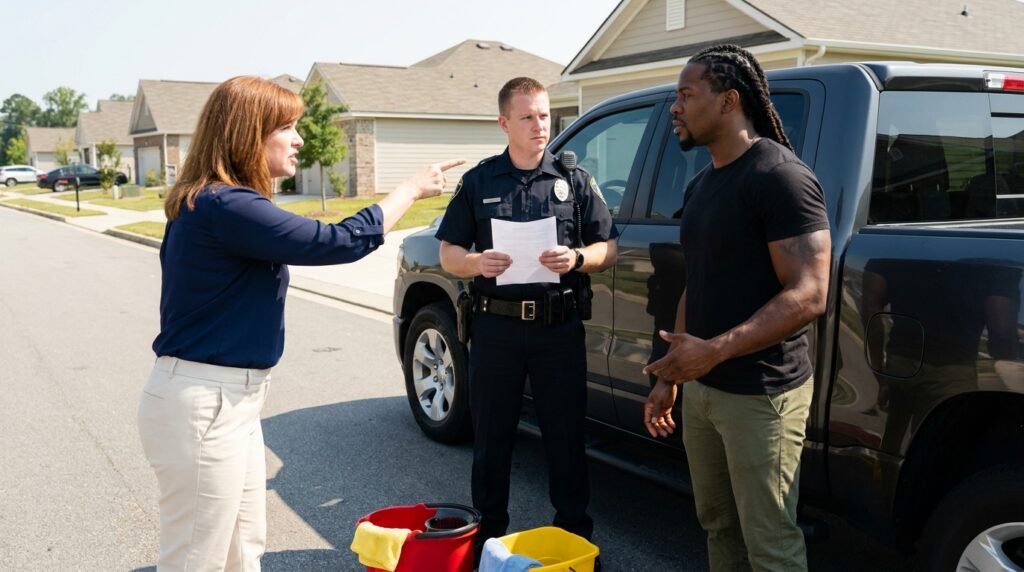
Marcus picked up his survey map, folded it with slow, deliberate creases, and slid it back into his pocket. He didn’t look at Eleanor as she backed away toward her car, her professional composure shattered into pieces on the gravel. He walked back to his truck, grabbed his sponge from the bucket of soapy water, and swept it across the dusty windshield, clearing the view for the road ahead.