
CHAPTER 2: The Ledger and the Iron Gate
The grease on Marcus’s knuckles didn’t come off with soap; it took pumice and cold water to scrub away the gray tint of the diesel residue.
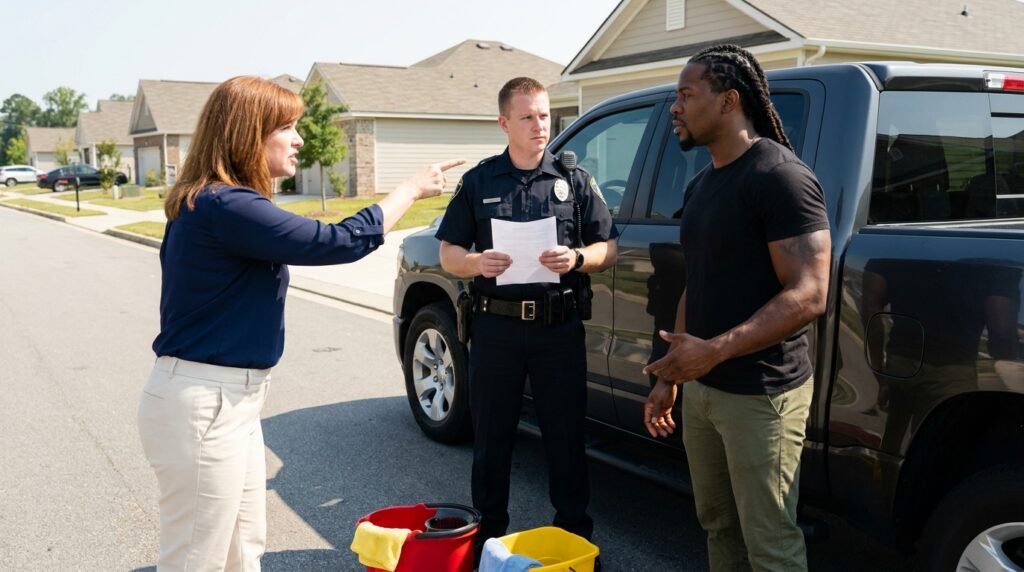
By four o’clock the next morning, the street was a flat, unblinking ribbon of tar under the sodium glare of the municipal overheads. There was no wind, only the dry, metallic pop of a cooling engine block three houses down and the rhythmic, heavy thud of Marcus’s boot heel against the porch timber. He wasn’t thinking about Eleanor’s pointing finger or the sharp, brittle tone of her voice. He was thinking about the paper Officer Reyes had held—not because of what it said about the truck’s VIN, but because of what was clipped to the back of it.
A carbon-copy invoice. Yellowish, onion-skin paper from an office supply store three towns over, stamped with an address that didn’t belong to any municipal department in the county.
The truck sat in the dark driveway, its tailgate catching the amber wash of the streetlamp like a scar. Marcus descended the wooden steps, his steps quiet against the gravel strip bordering the lawn. The air smelled of dry dust and crushed pine needles. He didn’t turn on the porch light. Drawing attention in this neighborhood was like tossing a match into a tinderbox; every window had a Ring camera blinking its small, circular blue eye into the night, recording the cadence of a man walking across his own land.
Down at the corner, where the cul-de-sac widened into the shared access lane, the subdivision’s wrought-iron gate stood open a fraction too wide. It was rusted at the lower hinge—a thick, orange bloom of iron oxide that Eleanor’s maintenance crews never seemed to touch, no matter how many violation letters they mailed out about unpainted trim.
Marcus didn’t go to his truck. He walked straight toward the gate, his hands jammed deep into the pockets of his canvas jacket, feeling the sharp corner of an old survey map folded inside his lining. The paper was soft, worn at the creases like a handkerchief.
A shadow shifted behind the thick laurel hedge bordering Lot 12.
“You’re up early, Marcus,” a voice murmured. It wasn’t Eleanor. It was Miller, the man who lived two doors down and spent his weekends measuring his lawn with a laser level. He was standing near his property line, holding a plastic tumbler of coffee that had gone cold hours ago.
“Truck needs to roll by six,” Marcus said, stopping two paces short of the hedge. He kept his voice low, measured, letting the distance between them do the work. “Got a site across the county line.”
Miller didn’t move. In the dark, his face was just a pale blur above a gray fleece pullover. “Eleanor’s been making calls. She had the town assessor out here last Tuesday. Said the easement running down the side of your fence isn’t residential anymore. They’re rezoning the alley for commercial utility access. Heavy equipment. Trailers.”
Marcus felt the skin tighten across his jawline. The easement had been a private family right-of-way since before the subdivision was ever carved out of the dry scrubland by the river. “The county didn’t send a certified notice.”
“They don’t have to,” Miller said softly, taking a slow sip of his cold coffee. “Not if the board files it under emergency infrastructure maintenance. She’s got the paperwork signed by three commissioners who haven’t held a public hearing in six months.”
Marcus stared at the rusted hinge of the iron gate. The metal was cold, pitted with age. He reached out, his bare fingers wrapping around the cold vertical bar, feeling the faint, greasy vibration of heavy trucks rumbling along the interstate a mile away.
Beneath the asphalt under his boots, beneath the manicured turf and the smart sprinklers and the endless stream of automated violation notices, something old and heavy was shifting. The officer’s paper hadn’t been a routine citation. It was an inventory list. And every vehicle parked within twenty feet of the drainage ditch had a small, handwritten tracking number scrawled in the margin—the kind of number a liquidator uses when a property is already marked down for disposal.
Marcus let go of the gate, wiped his hand against his thigh, and turned back toward his house without saying another word.