CHAPTER 1: The Line at the Asphalt
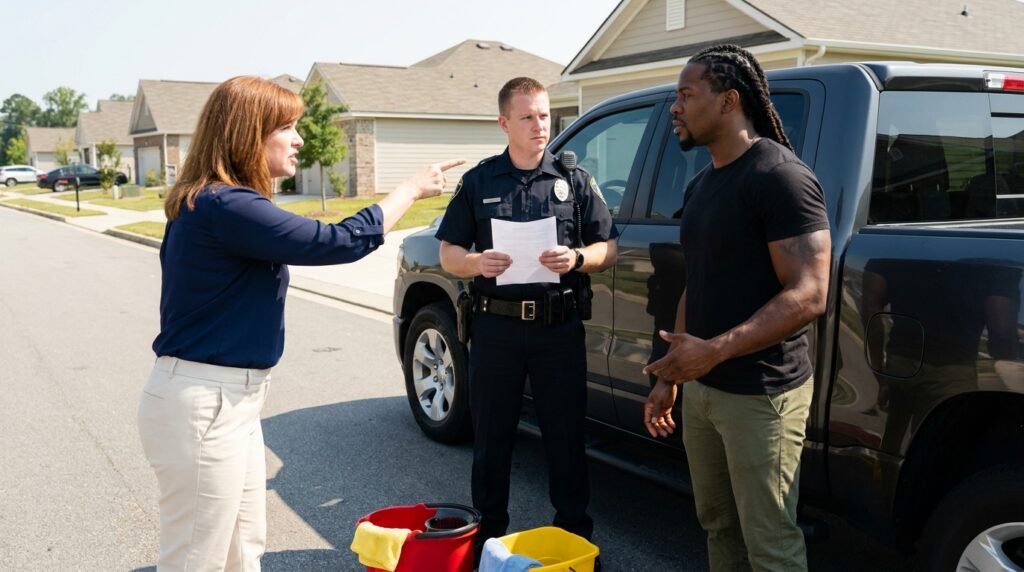
The suds on the yellow bucket were drying into a thin, white film by the time her heels clicked against the curb.
Marcus didn’t look up from the rocker panel of the pickup truck. He could feel the shadow of her navy blouse cutting across the edge of his shadow, long and deliberate, stretching over the sunlit concrete like an eviction notice. Behind him, the house was quiet—just the hum of the refrigerator through the kitchen window and the distant drone of a mower three streets over.
“You’re making a spectacle of yourself, Marcus,” she said. Her voice had the polished, brittle edge of someone who spent her mornings issuing fines and her afternoons pretending she didn’t hear the complaints.
Marcus set the microfiber cloth down on the rubber mat. He wiped his palms on his olive trousers, feeling the coarse weave of the cotton against his skin, then straightened his shoulders. He stood an inch taller than her, his dark braided hair pulled back tight, but she didn’t step back. People like her never stepped back because they believed the ground belonged to them long before the concrete was poured.
“I’m washing my truck, Eleanor,” he said. His voice was low, flat, sanded down by years of dealing with people who treated a driveway like a public park. “In my driveway. On my property.”
“That vehicle has been sitting in a prominent sightline for seventy-two hours,” Eleanor snapped, her chin lifting toward the neighbor’s yard across the asphalt. “And young Tyler needs a reliable hauler for his landscaping startup next week. The board has already voted on equipment sharing for underutilized commercial assets within secondary residential zones. You received the notice.”
“I received nothing because there is no notice to send,” Marcus said. He didn’t raise his voice. Raising a voice was a waste of breath; it signaled a crack in the wall. “And that truck isn’t a secondary asset. It’s how I put food on the table.”
That was when the cruiser turned the corner, its tires whispering over the loose grit of the suburban street. It didn’t flash lights; it didn’t need to. It coasted to a halt right on the dividing line between the grass and the road, heavy and black-and-white, cutting off Eleanor’s line of sight to the cul-de-sac.
The door creaked open, throwing a shaft of gray light across the asphalt. Officer Reyes stepped out, his utility belt clicking softly, his hand already resting on a single folded piece of paper held firmly at chest level.
“All right,” Reyes said, stepping between them before Eleanor could thrust her hand forward again. “Let’s slow this down and keep everyone calm. I need to see who’s holding the deed on this VIN.”
Marcus reached back, his fingers brushing the cool, dented metal of the tailgate, feeling the solid, unyielding reality of the steel. But as Reyes lowered his eyes to look at the document in his hands, a shadow flickered across the officer’s face—a sudden, quiet hesitation that didn’t belong to a routine property dispute. It was the look of a man who had just read a name on a warrant that wasn’t supposed to be in this county.