CHAPTER 4: THE BRASS BENCHMARK
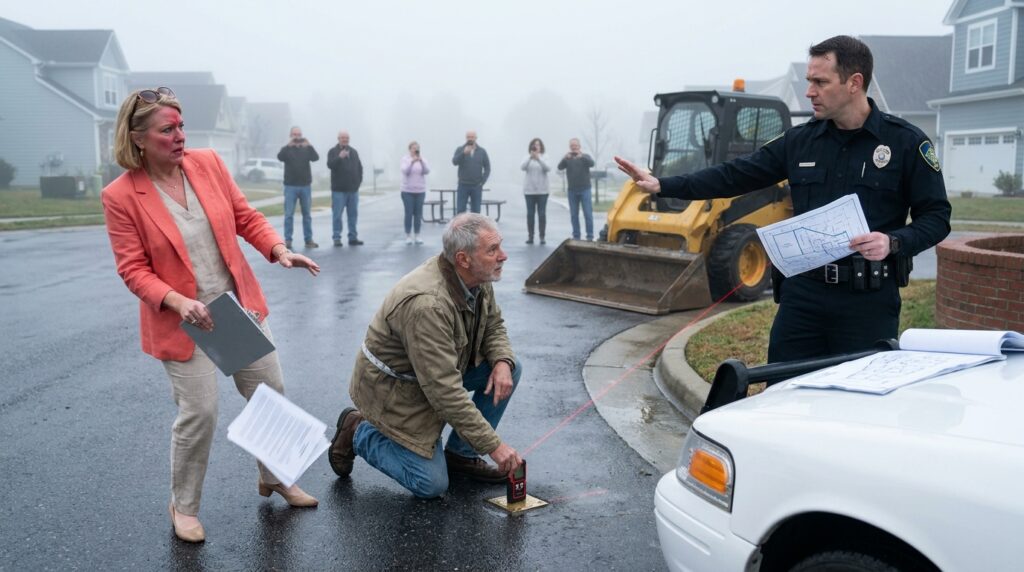
Officer Reyes walked with the slow, unhurried gait of a man who dealt with domestic arguments and civil property disputes four days a week. He let his eyes linger on the neon orange paint line, the skid-steer loader idling in the gutter, and then looked up at Arthur standing three feet off the ground on the brick planter wall.
“Step down off the masonry, Mr. Pendelton,” Reyes said, his voice even, carrying just enough resonance to quiet the low murmur of the neighbors.
Arthur didn’t argue. He stepped down off the wall, his boots hitting the damp turf of his yard. “Officer.”
Regina rushed forward before Reyes could take another step, her heels clicking fast against the asphalt. She thrust the bright yellow paper toward his chest. “Officer Reyes, I’m glad you’re here. This resident has constructed an unapproved, illegal masonry wall on association maintenance property. I am executing an emergency abatement order under HOA Section 4, and I have a town code violation notice right here.”
Reyes took the yellow paper, holding it between two fingers. He glanced at the case number, then looked over his shoulder at the street. “Who issued this violation notice, Mrs. Vance-Gentry?”
“The municipal inspector’s office,” she snapped. “Case 44-802. It was filed this morning.”
Arthur reached into his field jacket. He didn’t pull a weapon or make a sudden movement; he drew out the brass-brushed wire tool, a compact digital laser distance measure, and the certified, blue-line 1994 county plat Gus Miller had stamped two hours ago.
“Officer,” Arthur said quietly. “A town case number isn’t a demolition warrant. And an HOA board can’t abate what sits entirely on private deeded land.”
“It’s not private land!” Regina interjected, her voice rising an octave. “The 2012 easement schedule gives the association a twelve-foot corridor from the centerline of Bayview Drive!”
“Gus Miller at the county land records basement checked the volume and page twenty minutes before I drove home,” Arthur said, unrolling the heavy blue-line paper against the flat hood of the police cruiser. The paper rustled loudly in the damp air. “The 2012 schedule was never recorded. It has no clerk seal, no volume number, and no legal standing. The 1994 subdivision plat is the only recorded document governing this parcel.”
Reyes leaned over the hood of his patrol car, his thumb resting on his duty belt as his eyes scanned the purple ink seal stamped at the bottom of the blueprint. He looked at the dimensions marked along the frontage of Lot 14.
“Where’s the benchmark, Arthur?” Reyes asked.
Arthur knelt in the damp gutter right where his orange-painted line met the curb. He took the wire-brushed tool and scraped it hard across the wet concrete. Dirt, decomposed oak leaves, and loose gravel flaked away under the stiff steel bristles. Beneath the silt, a circular three-inch brass cap gleamed dull yellow in the gray overcast light.
“County Survey Marker 4B,” Arthur said, placing the flat tail of his digital laser measure squarely on the center crosshair of the brass cap. He pressed the power button. A crisp, bright red laser dot projected across the grass, hitting the bottom corner brick of his planter wall. “Read the screen, Officer.”
Reyes stepped closer, bending over the curb. The digital readout on the small LCD screen glowed in sharp black numbers: 9 ft 4.0 in.
“The ’94 plat specifies a nine-foot, four-inch setback from the brass benchmark to my property pin,” Arthur said, his voice cold and precise. “My planter wall sits eight inches inside my line. Every brick on this lot is on my deeded soil.”
The crowd of neighbors went dead silent. Doug, sitting in the cab of the skid-steer loader, leaned out the side window to look at the red laser dot sitting against the brick.
“Nine feet, four inches,” Doug muttered to himself. He reached over and pulled the engine shut-off lever. The diesel engine sputtered, coughed once, and died. The sudden silence that fell over Bayview Drive was almost deafening.
Regina’s face flushed a deep, blotchy red beneath her designer makeup. “That benchmark is outdated! The board’s authority override—”
“The board’s authority ends at the property line, Mrs. Vance-Gentry,” Reyes interrupted, his voice dropping into a firm, official register. He handed the yellow code paper back to her without looking at it. “This is a civil boundary matter, and according to the county clerk’s stamped plat, Mr. Pendelton is on his own property. If that machine touches those bricks, I will arrest the operator and you for criminal trespass and destruction of property.”
Doug raised both hands in the air inside the cab. “I’m out. I’m loading the rig.”
Arthur didn’t smile. He didn’t cheer. He stood up, wiping the wet dirt from his knees. But as he turned his laser distance measure around in his hand, his eyes drifted across the narrow street toward Regina’s property.
He aimed the red laser beam across Bayview Drive. The tiny red dot travelled over the asphalt, climbing up the steep slope of Regina’s custom-paved, white-stone circular driveway, and rested on the outer edge of her decorative stone retaining wall.
The LCD screen beeped twice, recalculating the offset from the same brass benchmark in the gutter.
4 ft 2.0 in.
Arthur looked at the reading, then looked up at Regina.
“While you were busy printing fake 2012 easement schedules to try and take three feet of my front yard, Regina,” Arthur said, his voice carrying clearly across the silent cul-de-sac, “you should have measured your own driveway.”
Regina froze, her clipboard wavering in her hand. “What are you talking about?”
“The town right-of-way extends ten feet from the centerline of this curb,” Arthur said, pointing his laser tool at the red dot resting on her stone wall. “Your circular driveway and retaining wall sit four feet, two inches past your property line. You didn’t just build in the setback—you paved over the town’s primary storm drainage easement. Every time it rains heavy, your driveway diverts two hundred gallons of runoff straight down into my ditch.”
Reyes blinked, turning around to look at the white paver driveway across the street. He looked at the laser reading on Arthur’s tool, then back at Regina’s stone wall.
“Is that right, Arthur?” Reyes asked, his tone shifting from routine patrol officer to attentive inspector.
“Check the 1994 drainage overlay on page three of this plat, Officer,” Arthur said, tapping the blue paper on the hood. “Her entire driveway structure is an illegal encroachment on municipal property. The town code enforcement office is going to love case 44-802 when they realize who’s actually blocking the drainage.”
Regina stood on the wet asphalt, her mouth slightly open, her clipboard slipping an inch down her side. The neighbors behind her began to murmur, paper plates tilting as several people pulled out their phones to take photos of the red laser dot resting squarely on her expensive driveway wall.
On the porch, Thomas slowly lowered his hands from his ears. He looked at Arthur, then at the silent, motionless skid-steer loader, and let out a long, quiet breath.