
CHAPTER 3: THE GATHERING AT THE CURB
The smell of lighter fluid and charred hamburger meat drifted through the heavy coastal fog, colliding violently with the acrid stench of unburned diesel.
Bayview Drive’s annual block party had always been a meticulously orchestrated affair—folding tables draped in checkered vinyl, portable speakers humming out muted classic rock, and coolers sweating onto the manicured lawns. But today, the center of gravity had shifted entirely to the edge of Arthur’s property. The twenty-odd neighbors who had been holding paper plates and plastic cups were now forming a loose, hesitant semicircle at the edge of the asphalt.
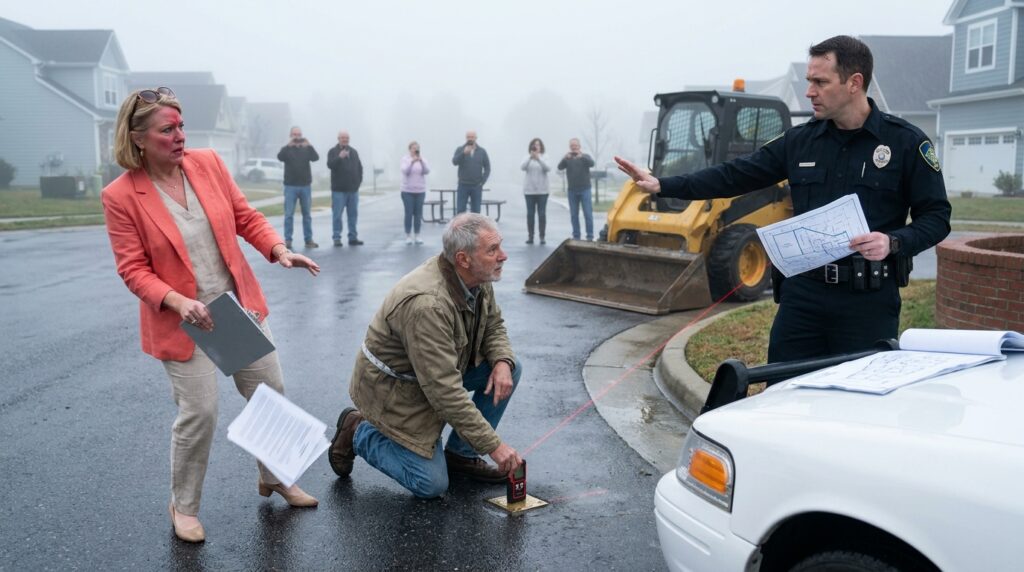
The yellow skid-steer loader sat idling inches from Arthur’s property line, its hydraulic cylinders weeping thin streaks of black fluid down the rusted lifting arms.
“Lower the bucket, Doug,” Regina commanded, her voice slicing through the low murmur of the crowd. She didn’t look at the contractor; her oversized sunglasses remained fixed entirely on Arthur.
Doug, a heavy-set man in a faded canvas vest, shifted uncomfortably in the operator’s cage. He nudged the left joystick. The heavy steel bucket descended with a metallic groan, hitting the asphalt with a sudden, bone-rattling clack.
On the porch, Thomas flinched. The sound hit him like a physical blow. He curled his shoulders inward, his hands coming up to press hard over his ears. He let out a low, continuous hum, a desperate attempt to drown out the mechanical vibration that was currently tearing through his carefully structured sanctuary.
Arthur felt the vibration travel through the soles of his boots. He looked at his brother, then back to the machine. The time for waiting on the porch was over.
He stepped off the concrete apron and walked deliberately toward the street, placing himself directly between the steel teeth of the bucket and the first course of his red brick wall. The bricks were rough and solid behind his calves, a physical anchor against the escalating chaos.
“You’re making a mistake, Regina,” Arthur said, keeping his voice steady and low, refusing to perform for the watching neighborhood. “You’re trying to use a crowd to bypass a legal boundary. It doesn’t work that way.”
Regina unclipped a can of bright orange inverted marking paint from her belt. She shook it, the steel ball bearing inside rattling like a spray-paint snare drum, a sound that made Thomas whimper on the porch.
“The board represents the community, Arthur,” Regina announced loudly, pivoting slightly so her voice would carry to the neighbors standing on the wet asphalt. “And the community has standards. We have a 2012 covenant amendment that clearly establishes a twelve-foot maintenance corridor from the centerline of this street.”
She pointed the aerosol can at the ground and sprayed a thick, neon-orange line across the asphalt, dragging it right over the dirt, the curb, and stopping mere inches from the toes of Arthur’s boots. The chemical smell of the aerosol immediately overpowered the barbecue smoke.
“Your little fortress is three feet over the line,” she said, tapping her clipboard. “It’s a hazard to municipal drainage and a blight on the neighborhood aesthetic. We are abating it.”
Arthur looked down at the bright orange paint. It was a bold, aggressive mark, but it was just pigment sitting on top of dirt. It had no weight. It had no root in the earth.
“An unrecorded piece of paper doesn’t move a property pin,” Arthur said, reaching into his jacket and pulling out the stamped, blue-line county plat he had retrieved from Gus Miller. He didn’t unfold it yet; he just held the heavy, folded parchment tightly in his weathered grip. “The 1994 plat is the only legally binding document on file with the county recorder. The line is nine feet, four inches from the brass cap in that gutter.”
“I have the authority of the board!” Regina snapped, her composure cracking just a fraction at the edges. She turned to the skid-steer operator. “Push it down, Doug. Now. I am authorizing the demolition.”
The diesel engine roared as Doug fed it throttle. Black smoke burped from the exhaust stack. The machine lurched forward a single inch.
Arthur didn’t flinch. He didn’t step back. Instead, he took one step up, planting his worn leather boots squarely onto the top course of the brick planter wall. He stood there, a static, immovable object against the revving machine.
“You push that bucket forward, Doug,” Arthur called out, his voice cutting through the engine noise with the absolute, unyielding clarity of a man who had spent forty years giving orders over the roar of earthmovers, “and you are committing criminal trespass and destruction of private property. My brother is a disabled veteran. I am defending my home. You touch this wall with me on it, and your commercial liability insurance won’t save you from the felony charge.”
Doug’s hands froze on the controls. The machine sat suspended, the engine howling, the hydraulic pump whining in protest. The operator looked at Arthur standing on the bricks, then down at Thomas rocking on the porch, and finally at the crowd of neighbors who were now lowering their camera phones, their expressions shifting from morbid curiosity to deep, uncomfortable tension.
“Regina,” Doug yelled over the engine, popping the safety bar up in the cab to disengage the hydraulics. “I ain’t hitting a guy standing on a wall. Not for five hundred bucks. Not for five thousand.”
“Put the bar down and do your job!” Regina shrieked, the veneer of the polished real estate agent entirely gone, replaced by a desperate, jagged panic.
She reached behind her clipboard and pulled out a second sheet of paper—a bright yellow slip. She thrust it into the air.
“I have the municipal code violation right here!” she yelled. “Case number 44-802! The town has already flagged this property!”
Arthur narrowed his eyes from atop the wall. A cold spike of adrenaline finally hit his system. The county plat he held in his hand proved his wall was legal, but Regina was holding a freshly printed town code violation notice. It had a stamped red case number on it. How could she have a town code violation for a wall he had only finished mortaring twenty-four hours ago? She had bypassed the standard reporting system. She had internal leverage at the municipal office.
A heavy, suffocating realization set in. Regina wasn’t just relying on an unrecorded HOA rule; she had weaponized the local bureaucracy. The physical boundary was true, but she was actively altering the bureaucratic reality to erase it.
Before Arthur could process the implication of the yellow slip, a sharp, electronic chirp cut through the heavy air.
A white municipal police cruiser turned onto Bayview Drive, its lightbar flashing a silent, rhythmic strobe of blue and red against the low-hanging fog. The cruiser rolled slowly past the folding tables and the barbecue grills, coming to a halt directly behind the flatbed trailer.
The heavy door of the cruiser opened, and Officer Marcus Reyes stepped out onto the wet asphalt, his hand resting casually on his duty belt, his eyes scanning the neon orange paint, the idling skid-steer, and the man standing resolute on the brick wall.
The true measurement was finally about to be taken.