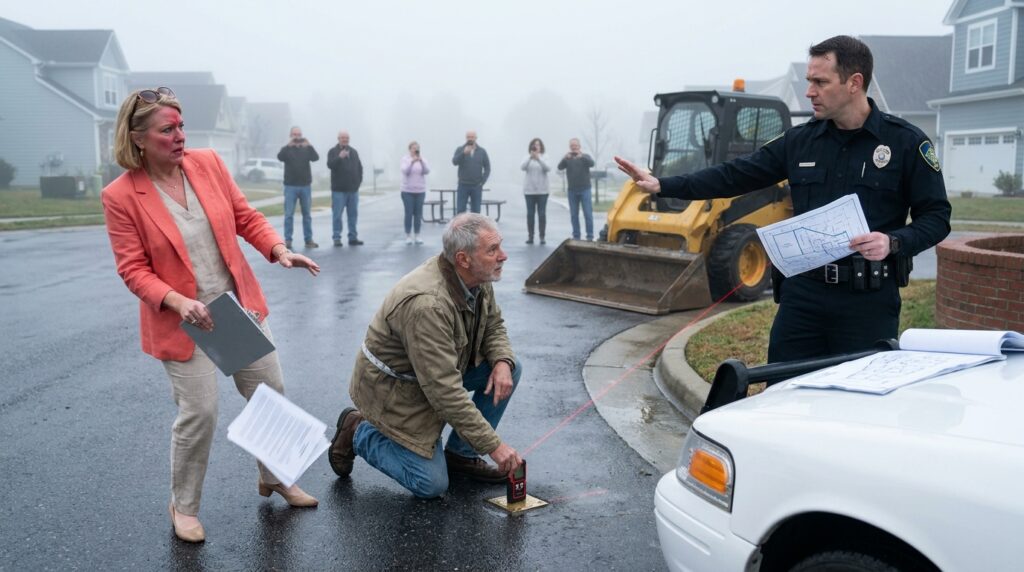
CHAPTER 2: THE PAPER FORTRESS
“You’re looking at a ghost, Arthur.”
Gus Miller didn’t look up from his desk. The retired assistant county registrar sat behind a counter that smelled perpetually of old floor wax, wet wool, and fifty years of degraded cellulose. His fingers, stained with ink and age spots, traced the edge of a heavy ledger bound in cracking brown buckram. On the wooden table between them lay a spread of large-format parcel plats, their blue line prints faded to a soft, chalky indigo.
Arthur pulled his glasses down his nose and leaned over the paper. The basement vault of the county clerk’s office was quiet, save for the rhythmic, metallic hum of the air circulation duct overhead.
“The board’s got a copy of this map in their packet, Gus,” Arthur said, pointing a calloused finger at a hatched section along the northern margin of Bayview Drive. “It shows a twelve-foot association setback, effective May 2012. Signed by the developer and the then-HOA board.”
“Look at the margin,” Gus muttered, dragging his thumb to the bottom right corner of the sheet. He tapped the bare white space beneath the signature block. “No file number. No volume and page. No seal from the register.”
Arthur squinted at the paper. The paper had the texture of heavy vellum, stiff and dry, but the legal certification block—the rectangular border where the county clerk’s heavy brass seal usually crimped the paper—was blank.
“Regina’s calling it a binding covenant update,” Arthur said softly. “She’s using it to claim my planter wall sits three feet inside their maintenance corridor.”
“She can call it the Declaration of Independence if she wants,” Gus said, finally looking up. His pale, rheumy eyes met Arthur’s over the rim of his bifocals. “If it didn’t cross the clerk’s desk in 2012, it didn’t happen. The town right-of-way remains thirty feet from the centerline of the asphalt. Your property line starts at nine feet four inches from the curb cap. That hasn’t changed since the original plat was recorded in 1994.”
Arthur stood up straight, feeling a familiar, dull ache in his lower back from hunching over the drafting tables. He reached down and retrieved his leather-bound field notebook, flipping to a fresh page. He sketched the outline of the cul-de-sac, entering the offset dimensions in neat, block lettering.
The math was clear. On paper, Arthur’s planter wall sat eight inches behind his front pin. By every recorded standard in the county vault, his brickwork was legally grounded on his own deeded soil.
Yet, a cold knot remained in his stomach. Regina Vance-Gentry wasn’t a fool. She had spent twenty years buying, flipping, and managing residential real estate in the county. She knew how to read a land record, and she certainly knew the difference between an unrecorded draft and a certified plat. If she was bringing a heavy skid-steer loader and a hired contractor to his driveway on a Saturday afternoon, she wasn’t relying on a legal mistake. She was relying on force. She was betting that Arthur would yield to public pressure before anyone bothered to trek down to the county basement to check the margin of a blue line print.
Arthur closed his notebook and tucked it back into his canvas coat. “Can you print me a certified copy of the original ’94 subdivision layout, Gus? Stamped and sealed.”
“Give me five minutes,” the old clerk said, pushing himself up from his swivel chair with a groan of springs. “I’ll run it through the copier in the back. Cost you four dollars.”
“I’ve got five,” Arthur said, placing a wrinkled bill on the counter.
He walked out into the corridor while the machine hummed in the back room. Through the high, narrow transom windows at the top of the basement wall, he could see the grey, slanting rain of late afternoon coating the courthouse steps.
When he returned to Bayview Drive an hour later, the rain had tapered off to a heavy, salt-laden fog rolling in from the sound. The neighborhood was quiet, but the air felt heavy, saturated with humidity and the lingering smell of wet asphalt.
He pulled his pickup into the gravel driveway. As he got out, he noticed Thomas sitting on the edge of the porch, his back pressed tight against the house siding. Beside Thomas lay a small stack of red clay bricks—spares left over from the planter project. Thomas was methodically wiping each brick with a dry rag, his movements repetitive, synchronized, and stiff.
“Did you find it?” Thomas asked without looking up. His voice was flat, but his eyes darted toward the street every time a car passed two blocks away.
“Found the original plat, Tom,” Arthur said, stepping onto the porch and resting a hand briefly on his brother’s shoulder. He could feel the tension locked in the muscles of Thomas’s upper back, hard as oak. “The ’94 survey is the only one on file. The line stays right where I set the string.”
Thomas stopped wiping the brick in his hand. He looked down at his boots, his breath coming in measured counts—four seconds in, four seconds out—the grounding technique his VA counselor had drilled into him.
“She brought the machine, Art,” Thomas murmured, his eyes fixing on the tire tracks the skid-steer had left in the grass near the road edge. “She stood right there. She had that paper.”
“Paper isn’t land, Tom,” Arthur said softly. He pulled the stamped blueprint from its cardboard sleeve, unfolding the stiff paper so Thomas could see the dark blue lines and the thick, purple ink of the county seal in the corner. “This is land. This is the county’s mark. It’s been here thirty years, and it doesn’t move because somebody brings a truck.”
Thomas stared at the purple ink seal for a long moment, then slowly nodded. He picked up his rag and went back to wiping the brick.
Arthur walked down to the edge of the driveway, stopping where his low brick wall met the concrete apron. He knelt in the damp grass, pulled the brass-brushed wire tool from his pocket, and leaned over the curb.
Right at the radius of the gutter, nearly buried under a crust of washed-in silt and rotting oak leaves, sat the round top of the county benchmark. He scraped the wire bristles across the metal face. The dirt flaked away, revealing the tarnished, dull yellow of the brass cap beneath, its stamped lettering—COUNTY SURVEY MARKER – DO NOT DISTURB—catching the dim afternoon light.
He set his steel tape against the center mark of the brass cap and pulled it toward the corner brick of his wall.
Nine feet, four inches. Exactly to the millimeter.
Arthur let the tape snap back into its casing with a sharp metallic clack. As he stood up, he looked across the narrow asphalt street toward Regina’s house. Her property sat higher on the rise, framed by a sprawling, white-paved circular driveway that swept down to the very edge of the road.
Arthur looked at her driveway apron, then down at the brass cap at his feet, then back at her property. His eyes narrowed. He pulled his notebook back out, his pencil hovering over the paper as he re-read the offset numbers from the 1994 plat.
He didn’t say a word out loud. But as the fog began to thicken between the pine trees, Arthur’s hands went very still.