
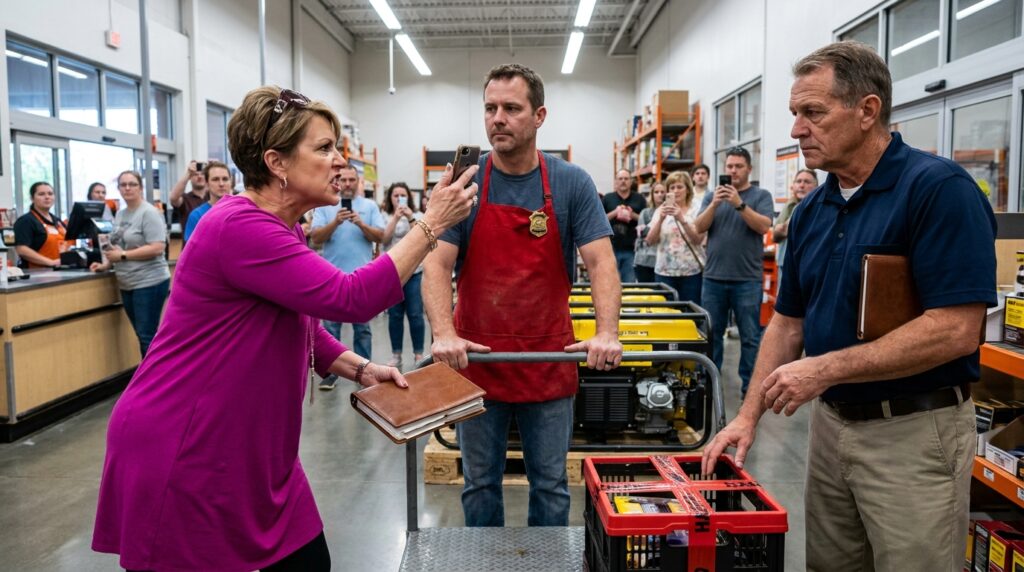
CHAPTER 5: THE FINAL AUDIT
Brenda’s hand froze two inches above the chrome door handle.
Outside the acoustic foam lining of the loss-prevention office, the low hum of Register Lane 3 seemed to quiet, replaced by the faint, rhythmic pulse of white-and-blue strobe lights reflecting off the high glass pane of the contractor exit.
In the small room, time seemed to dilate. The blue monitor glare caught the sharp edge of Brenda’s jaw, casting long, angular shadows across the white laminate desk. She didn’t turn around immediately. Her fingers remained hovering, stiff and trembling with the cold, absolute realization that the public arena she had weaponized twenty minutes ago had collapsed into a cage.
“David,” Brenda said, her voice dropping all theatrical resonance, reduced to a dry, harsh rasp. “Tell your guard to step away from the terminal.”
Manager Miller didn’t move. He stood beside the console, his eyes fixed on the red regional hold box still pulsing on the central monitor. The soft-spoken conflict-aversion that had defined his morning was gone, burned away by the cold realities of corporate liability and a federal freight flag stamped across his store’s system.
“I can’t do that, Brenda,” Miller said softly. “The terminal locked automatically. It’s out of my hands.”
Jenkins picked up the black desk phone, pressed three digits, and spoke into the receiver without taking his eyes off her back. “Loss Prevention to front desk. Deputy Lawson is in the vestibule. Direct him straight to Room B.”
Brenda turned around slowly. The leather binder she had carried like a broadsword throughout the morning now seemed impossibly heavy, her fingers digging into the worn grain of the cover until her knuckles turned chalk-white. The oversized sunglasses pushed onto her hair slipped down slightly, exposing eyes that darted frantically from Jenkins’s notepad to my face, searching for a single break in the line.
She found none.
“Marcus,” she whispered, her voice stripped of every administrative address term, every trace of authority. “You know how these commercial accounts work. The HOA board authorized the transport… I was simply handling the regional logistics…”
“The dock receiving log doesn’t care about authority, Mrs. Hollings,” I said, keeping my hands resting flat at my sides. “It only records serial numbers. And those three generators were logged as stolen cargo before they ever touched a flatbed in this county.”
The heavy steel door swung open with a dull metallic click.
Deputy Lawson stood in the threshold, six feet two of brown uniform wool, dark leather duty gear, and the quiet, unhurried demeanor of a man who had processed a thousand Saturday morning disputes. Behind him, visible through the open doorway, forty shoppers stood in a sprawling, silent arc across the register corridor.
The phones were still out. But nobody was shouting. The murmurs had died into a heavy, expectant hush as the store manager stepped out into the doorway behind the deputy.
“Mrs. Hollings,” Deputy Lawson said, his tone entirely conversational as he gestured toward the hallway. “We need to talk about three commercial generator chassis and a freight manifest from County Line Depot. Step out into the corridor, please.”
Brenda hesitated for two full seconds. Her chin attempted to rise, her shoulders straining to rebuild the posture of an HOA officer conducting an inspection, but under the glare of forty recording lenses and the quiet presence of uniformed authority, the illusion snapped. She stepped past Miller without looking at him, her leather binder held flat against her chest, her heels clicking flatly against the polished concrete.
As she crossed the threshold into the main lobby, Manager Miller stepped up to the head cashier’s microphone. His voice echoed clearly through the high steel rafters of the hardware store, carrying over Aisle 4, over the lumber racks, and straight down Register Lane 3.
“Attention Ridgeview shoppers,” Miller announced, his voice steady and amplified across the overhead speakers. “The inventory discrepancy at Register 3 has been fully audited and resolved by store security and local law enforcement. Associate Marcus Vance executed all terminal procedures with full accuracy and total compliance with store policy. We appreciate your patience.”
A single beat of silence passed. Then, near the battery display, the contractor in the grease-stained cap lowered his phone and let out a short, sharp clap. Within three seconds, the sound caught—a sudden, cathartic ripple of applause that moved through the weekend crowd, cashiers and contractors alike, before settling back into the routine rattle of scanner beeps and rolling cart wheels.
Deputy Lawson guided Brenda quietly toward the glass sliding doors of the main exit, where the blue lights of the cruiser flashed against the brick facade.
I stood by the service desk for a moment, adjusting the faded red apron over my shoulders. I felt no surge of triumph, no heat of anger—only the clean, quiet friction of a system restored to balance.
“Marcus,” Jenkins said, stepping out of the office behind me and resting a heavy hand on my shoulder. “Take ten minutes in the breakroom.”
“No need, Officer Jenkins,” I replied, turning back toward the contractor counter where a line of four flatbeds was already beginning to form. I picked up the handheld scanner, the green laser dot resting steady against my palm. “The weekend rush is just starting, and Aisle 4 needs a restock.”