
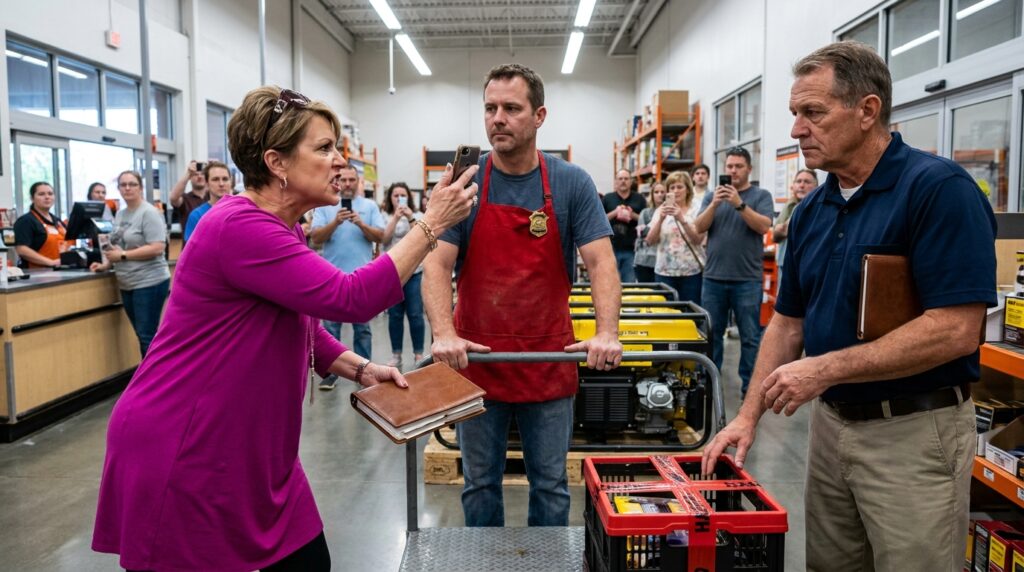
CHAPTER 4: THE PAPERWORK PARADOX
“The contractor terminal operator code at 08:45 AM was MV-48,” Officer Jenkins read aloud, his eyes tracking across the black-and-white terminal audit screen. “My employee ID.”
Brenda’s chin rose higher, her hands clasping tightly over the leather binder resting in her lap. “Which means the cash-void loop was initiated from your terminal, Marcus. Either you tried to pull cash out of an unassigned transaction, or you processed an unauthorized refund to clean up an incomplete inventory ledger.”
Manager Miller took two paces toward the terminal screen, his shadow stretching long against the acoustic foam of the office wall. “Marcus was on dock receiving until nine o’clock,” Miller said, though his voice lacked conviction. He tapped the laminated shift roster pinned to the desk. “He didn’t log into Terminal 3 until the floor shift change.”
“Then explain why his ID processed the transaction,” Brenda fired back, her tone sharp as broken glass. She pointed a manicured finger at the printed register tape. “Unless your store lets associates share override authority, someone used Marcus Vance’s active credentials to attempt a four-thousand-dollar cash payout on an invoice that was never scanned into your local stock.”
I stepped away from the back wall. The floor beneath my boots felt rigid, unforgiving. In logistics, when a paper trail contradicts physical location, it isn’t an error—it’s a deliberate diversion built to force an administrative panic.
“Officer Jenkins,” I said, my voice dropping into the quiet, measured tone I used during convoy manifest checks. “Pull up the receiving dock terminal log for 08:45 AM. Cross-reference the terminal ID with the regional serial database.”
Jenkins didn’t argue. His fingers flew across the mechanical keyboard, minimizing the store void display and opening the regional inventory tracking system. The server rack in the corner whirred loudly, its cooling fans kicking into high gear as the database query spooled across the screen.
“What are you fishing for, Marcus?” Brenda snapped, though her left foot began a rapid, silent tapping against the leg of her vinyl chair. “A glitch in the software? You were caught with staged equipment on the register floor, and your supervisor ID is tied to a fraudulent refund attempt.”
“The invoice she brought in,” I said, ignoring her, “was printed on a thermal roll with a green core-pin. Store 114 uses blue core-pins. We haven’t stocked green-core paper since the distributor changeover in March.”
Jenkins froze, his hand hovering over the mouse. Slowly, he reached down to the desk, picked up the folded thermal slip Brenda had shunted toward Miller, and turned it over. The inner cardboard tube of the receipt roll showed a distinct, faded emerald ring around the spindle hole.
“Where did you get this paper, Mrs. Hollings?” Jenkins asked.
Brenda’s posture didn’t collapse, but her jaw locked tight enough to turn her lips white. “I received that invoice at the contractor desk three weeks ago when our HOA purchased the generator units. If your department uses outdated paper stock, that’s an operational failure, not my burden.”
“It’s not an operational failure,” Jenkins said softly. He hit the enter key on the console. A bright red warning box flashed across the center monitor, accompanied by a sharp, electronic double-beep. “It’s a regional hold.”
Miller leaned in, squinting at the red box. “A hold? From who?”
“County Sheriff’s Department, Freight Fraud Division,” Jenkins read directly off the screen. His voice was entirely flat now, stripped of any retail customer-service inflection. “Three commercial generator units, matching serial numbers 88-Delta through 90-Delta. Reported missing from a regional transport flatbed at the distribution hub two counties over, six days ago.”
The quiet in the loss-prevention room became absolute. The only sound was the steady hum of the server rack and the faint, distant thrum of the store’s air handlers.
Brenda didn’t move. Her eyes remained fixed on the red border flashing on the screen.
“The 08:45 AM void loop wasn’t a clerk theft attempt,” I said, stepping right up to the edge of the console. I looked down at the leather binder in Brenda’s lap. “It was an automated flag. The system locked the transaction the second those stolen serial numbers were entered into a return terminal. You didn’t come here to get a refund, Mrs. Hollings. You came here to create a public scene so loud that Manager Miller would override the system block just to clear the register lane and avoid a viral video.”
Miller looked from the screen to Brenda, his eyes wide. “You tried to force a manager override on stolen freight?”
Brenda stood up slowly. She didn’t look at Miller, and she didn’t look at me. She adjusted the strap of her leather binder over her shoulder with meticulous, deliberate care, pulling her oversized sunglasses down over her eyes.
“This conversation is over,” she said, her voice smooth, level, and entirely devoid of the outrage she’d projected in Aisle 4. “You have no legal right to detain an HOA officer based on an internal system error. I am walking out of this building, and my attorney will contact your corporate legal department before noon.”
She turned toward the heavy steel door and reached for the chrome lever.
“Don’t touch that handle, Brenda,” Officer Jenkins said. He didn’t rise from his rolling chair, but his hand moved to the black desk phone beside his elbow. “The county transport unit is already in our parking lot for a routine drop-off. And unlike our floor cameras, their dash-cams don’t need a manager override to record a grand larceny arrest.”