
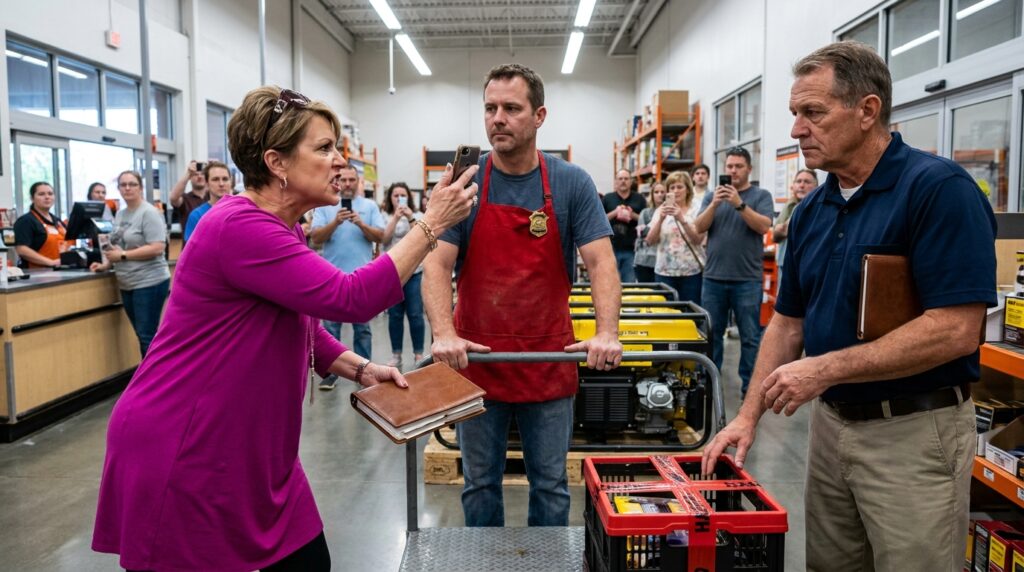
CHAPTER 3: THE FRAMEWORK IN REVERSE
The heavy door of the loss-prevention suite clicked shut with the dull, pneumatic thud of an industrial vault. Instantly, the roaring chaos of Register Lane 3—the blare of overhead announcements, the rustle of plastic bags, the low drone of outraged murmurs—was swallowed by two inches of acoustic foam.
The air inside smelled of warm copper circuit boards, ozone, and the sour remnant of cold coffee. Four high-definition monitors hung in a metallic arc above a scarred laminate desk, their blue glare washing across Brenda’s magenta tunic as she stood near the center of the room, her leather binder pinned against her ribs like armor.
“I am giving you five minutes, David,” Brenda said, her voice tight, cutting through the low whine of the server rack cooling fans. She did not sit in the black vinyl chair Officer Jenkins indicated. “Five minutes before I call the district corporate manager and inform them that Ridgeview Hardware detains retail customers who catch employee theft rings in progress.”
Manager Miller didn’t sit either. He stood by the corner of the desk, leaning his hip against the laminate edge, his arms crossed over his chest. His posture was stiff, the defensive slump from the register aisle replaced by a cold, bureaucratic detachment.
“Sit down, Mrs. Hollings,” Jenkins said quietly. He pulled out the rolling chair behind the console and keyed his six-digit supervisor code into the backlit keypad.
I stood against the back wall beside the fire extinguisher, my arms down, my thumbs hooked inside the hem of my red apron. In a small space, movement is noise. I gave them none.
“Marcus,” Jenkins said without turning around. “Track 4. Timestamp 09:14:20.”
I knew the camera angles by heart; I’d spent two weeks auditing inventory discrepancies with Jenkins back in November. “Dome 6 covers the contractor counter,” I said, my voice steady in the muffled quiet of the room. “Switch to Angle B for the lower shelf clearance.”
Jenkins’s thick fingers tapped the mechanical keyboard. A crisp, four-thousand-pixel video feed expanded across the center screen. On-screen, the time code in the upper right corner ticked forward in neon-green numbers: 09:14:18… 09:14:19… 09:14:20.
The high-angle shot showed the flatbed cart sitting beside the contractor desk. In the frame, my past self was visible from above, leaning over the register terminal, typing a command into the keyboard. My back was partially turned toward the cart as I waited for the thermal printer to spool out the dock manifest.
Brenda stepped closer to the screen, her oversized sunglasses pushed up into her short, styled hair. “There,” she pointed, her nail clicking against the glass display. “He’s deliberately looking away from the merchandise! He created a blind angle with his own body so an accomplice could slip the secondary crate onto the bottom tier!”
“Keep watching, Mrs. Hollings,” Jenkins said. His tone didn’t rise; it dropped into the flat, clinical cadence of a magistrate reading a summons.
On the screen, a figure in a bright magenta tunic stepped into the frame from the main aisle. On video, the action unfolded with devastating clarity. While my on-screen self was focused on the terminal screen, Brenda’s hands moved. She didn’t just stand by the cart—she reached down to the lower tier of a stationary stocking cart parked two feet behind her, picked up a flat, heavy cardboard box bound in red hazard tape, and slid it smoothly onto the bottom rack of my flatbed.
She did it with practiced, fluid efficiency, using her large leather binder to mask the lateral movement from anyone standing at the neighboring register.
The monitor hummed in the small room.
Miller leaned forward, his eyes narrowing as he stared at the loop. “Run that back three seconds, Doug.”
Jenkins hit the left arrow key. The footage reversed, frame by frame. 09:14:22… 09:14:19… 09:14:16. On screen, Brenda’s arm extended, the box slid into place, and her leather binder came down like a curtain over the lower frame.
“That’s an eighteen-hundred-dollar commercial inverter kit,” Miller said, his voice dropping an octave. “It was logged into the cage cage three hours ago by the night shift. Mrs. Hollings, you physically took that box off a staging cart and put it on Marcus’s flatbed.”
Brenda’s jaw tightened until the muscles along her neck stood out like cords. She didn’t flinch. She didn’t gasp. Instead, her posture straightened, her eyes locking onto Miller with a cold, predatory intensity.
“That footage is contextually incomplete,” she declared, her voice dropping into a razor-sharp whisper. “I saw that box sitting unsecured on an unattended cart in an active customer thoroughfare. As an HOA board member responsible for public safety standards in this district, I was securing hazardous commercial inventory that your employee left exposed!”
“You didn’t report an unsecured box,” I said from the back wall, speaking for the first time since the door closed. “You told four cashiers and twelve customers that I slipped it onto your cart to steal it.”
Brenda spun around, her eyes flashing under the room’s harsh fluorescent tubes. “You don’t speak to me! You are a part-time retail clerk who couldn’t even manage a proper inventory audit without creating a twenty-minute delay at the counter!”
“That’s enough,” Jenkins snapped, hitting the spacebar to freeze the video frame. The frozen image showed Brenda’s manicured fingers wrapped around the red hazard tape. “We’ve got the physical placement on tape, Mrs. Hollings. That clears the employee of internal theft staging.”
“It clears nothing!” Brenda barked, slapping her leather binder onto the desk with a crack that made Miller jump. “So I moved a box—fine! I was mistaken about who placed it on the flatbed! But that doesn’t explain the primary invoice, David!”
She pulled a folded sheet of thermal paper from the inner pocket of her binder and shoved it across the desk, right under Jenkins’s nose.
“Look at the bottom line,” Brenda hissed, her confidence surging back like an tide returning to a rocky shore. “The primary transaction for those three generators was processed under a store void code at 08:45 AM. The register tape shows a cash-drawer override. Someone in this building tried to process a four-thousand-dollar cash refund on my HOA account before I even walked through those front doors!”
Miller frowned, reaching down to pick up the slip. “A void loop?”
Jenkins looked down at the receipt, then slowly turned his head to glare at the lower monitor displaying the live Point-of-Sale logs. The green text spooled past in rapid lines of data.
My chest tightened as I watched Jenkins’s expression shift from cold professional detachment to sudden, sharp suspicion. Layer 1 had shattered right in front of us—the staged clerk theft was a bust, exposed by the dome camera in thirty seconds flat. But Brenda wasn’t backing down, because the paper in Miller’s hand wasn’t a distraction. It was a secondary fuse, burning fast, and the code stamped at the bottom of that thermal tape belonged to the contractor terminal I had logged into at seven o’clock that morning.