CHAPTER 2: THE CALCULATED ESCALATION
“Lower the phone, Brenda. We are not doing this in front of the weekend register line.”
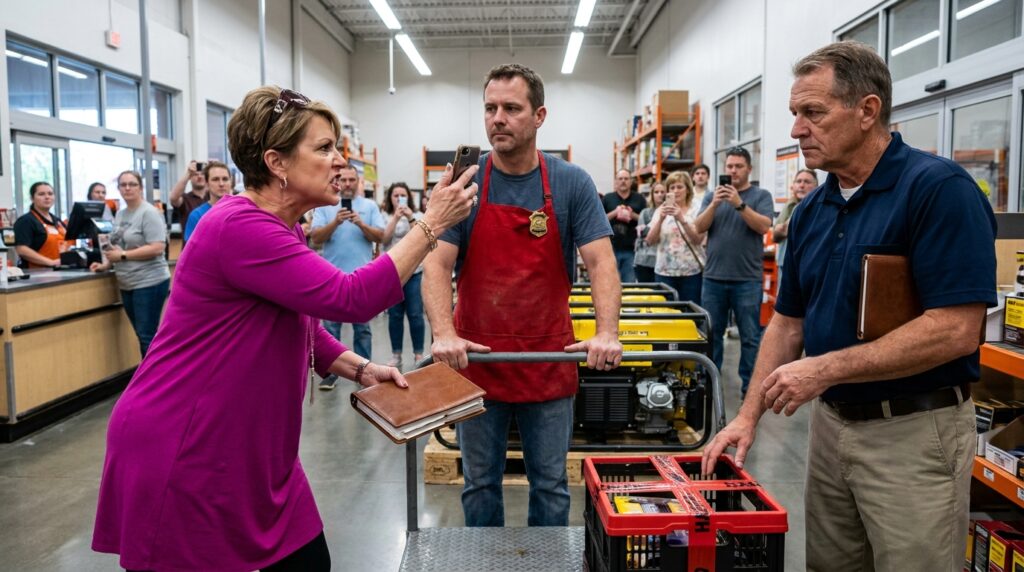
David Miller’s voice cut through the hum of the overhead circulation fans before his dress shoes even hit the polished concrete of Register Lane 3. The store manager’s tie was loosened, his collar unbuttoned by a half-inch—the universal sign of a man whose Saturday had been ruined three hours ahead of schedule. Behind him stepped Security Officer Doug Jenkins, five feet eleven of retired county deputy wearing a dark blue loss-prevention polo and carrying a thick leather-bound notepad.
Brenda didn’t lower the phone. She angled the lens two inches closer to Miller’s face, her oversized sunglasses reflecting the harsh fluorescent tubes in long, distorted bars of light.
“I will record whatever I need to protect the residents of Fairview Estates, David,” she said, her voice rising half an octave for the benefit of the four shoppers standing near the battery display with their own devices raised. “Your employee has three commercial generator units staged on a flatbed without an authorized manager override, and he’s refusing to process a legitimate HOA maintenance return.”
Miller didn’t look at the generators. He looked at me. His eyes flicked to my hands, resting flat against the cold tubular frame of the cart, then to the printed register tape curling out of the contractor terminal’s housing.
“Marcus,” Miller said softly, his voice calibrated for damage control. “What’s the status of the scan?”
“The return request lacks a validated store receipt,” I said, keeping my posture rigid, my chin level. “The invoice presented by Mrs. Hollings bears a secondary regional vendor code that doesn’t match our dock receiving manifest for this week. Per store policy Section 4, high-value commercial power equipment requires a terminal audit before any credit is issued.”
“It’s a form-four discrepancy!” Brenda interjected, her manicured index finger slamming against the top paper in her leather binder. “I paid four thousand two hundred dollars out of the HOA’s capital improvement fund for these units three weeks ago. The serial numbers on my document match the equipment on that pallet!”
Jenkins stepped forward, his boots making a distinct creak-snap on the smooth concrete. He didn’t look at Brenda’s phone, and he didn’t look at Miller. His eyes went straight to the pallet, scanning the yellow casing of the top generator unit, then dropped to the secondary compartment near the floor of the cart. He paused. His head tilted three degrees to the left.
“Marcus,” Jenkins said, his tone low, dry as cured pine. “Where did that accessory crate come from?”
The crowd shifted. A man in a grease-stained contractor cap leaned over the chrome guide rail to get a better angle with his camera.
“It was on the bottom rack when Mrs. Hollings approached the desk,” I said. “Unscanned.”
“It was not on the rack!” Brenda’s voice turned razor-sharp, dropping the administrative cadence for pure, focused aggression. “I brought three generator chassis to this counter. That secondary crate was placed there by your employee while he was pretended to clear the cache on his terminal! He was trying to sneak an eighteen-hundred-dollar inverter kit through the register lane behind my order!”
The accusation hung in the air like the smell of burning copper. Two cashiers exchanged wide-eyed glances. A woman in Aisle 2 gasped loudly enough to carry over the background noise of the outdoor garden center’s intercom.
Miller rubbed the bridge of his nose, a muscle in his jaw working beneath the skin. He was calculating corporate liability, customer relations scores, and Monday morning regional reviews in real-time. “Marcus, did you touch the lower shelf of that flatbed after Mrs. Hollings entered the aisle?”
“No,” I said.
“He’s lying!” Brenda turned her phone directly on me, the red recording indicator blinking like a drop of wet paint. “Look at him! No defense, no explanation, just stone-cold stonewalling. He knows the loss-prevention cameras in Aisle 4 have a blind spot behind the contractor lumber stack. He’s done this before.”
I felt the heat of forty eyes pressing into the front of my apron. My right thumb pressed against the heavy brass clip of my badge, the metal digging into the callous until the sharp bite of pain cleared the noise from my head. I didn’t glance at Brenda. I kept my eyes on Jenkins.
“Officer Jenkins,” I said calmly. “Check the seal on the accessory crate.”
Jenkins stooped down, his knees popping with a faint crack. He didn’t touch the box. He leaned in until his nose was six inches from the heavy strip of clear packing tape binding the cardboard flaps. His thumb traced the air an inch above the red border marker stamped across the seam—the restricted hazard mark from the back cage.
“That’s cage tape,” Jenkins muttered, standing up slowly and looking Brenda dead in the eyes. “That tape doesn’t leave the receiving dock unless an associate logs it out on a handheld scanner.”
“Which proves he took it out of the cage!” Brenda shouted, though her voice wobbled slightly on the last word as Miller took a half-step toward her cart. “He logged it out, staged it on my flatbed, and planned to let me walk out so he could claim I stole it—or meet his partner in the parking lot!”
“Mrs. Hollings,” Miller said, his tone dropping into the quiet, firm register used for dangerous equipment failures. “We’re going to step into the security office. Right now.”
“I am not going into a back room so you can sweep a felony theft attempt under the rug!” Brenda declared, raising her chin. “We will resolve this right here, under the lights, in front of the people who pay dues in this town.”
“You don’t have a choice, ma’am,” Jenkins said softly. He pulled his leather notepad from his pocket, flipped it open, and pointed a blunt thumb toward the double steel doors marked EMPLOYEE ONLY at the end of the customer service desk. “Because if we stay out here, I’m calling the county sheriff to process a live commercial theft investigation on the register floor. And the first thing the deputies are going to ask for is the overhead camera log from the primary ceiling dome directly above Register 3.”
Brenda’s hand froze mid-air, her smartphone hovering between Miller and the crowd. For a split second—no longer than a heartbeat—her eyes flicked from Jenkins’s badge to the dark glass hemisphere mounted twenty feet above us on the steel ceiling girder.
“The dome,” she repeated, her lip stiffening over her teeth. “That dome is an inventory tracker. It doesn’t record audio.”
“No,” Jenkins said, his face entirely unreadable as he gestured toward the double doors. “It records thirty frames per second in four-thousand-pixel resolution. And unlike the aisle cameras, it doesn’t have a blind spot.”