CHAPTER 5: THE SURVEYORS LINE
The crunch of heavy rubber tires biting into the gravel shoulder of the cul-de-sac signaled the arrival before the truck even came to a complete stop.
The county utility pickup swung wide, its amber roof beacon casting sweeping, rhythmic slices of orange light across the neutral grey facades of the houses. The engine groaned into idle, the transmission settling with a heavy mechanical clunk that rattled the loose chassis bolts.
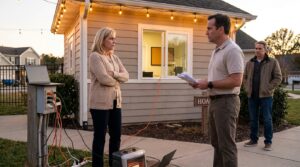
The project coordinator’s rigid posture instantly shifted. Her hand dropped from its defensive position over the clipboard, her fingers twitching against the yellow plastic edge as she pivoted toward the driver’s side door. For a fleeting moment, her professional composure flickered, replaced by the calculating urgency of someone accustomed to rewriting field logs before higher-ups could inspect the carbon copies.
“Inspector Vance,” she called out, pitching her voice over the steady hum of the municipal tanker’s water pump. She forced a tight, brittle smile onto her face, stepping away from the property line as the truck door creaked open. “We were just running a supplemental drainage contingency under the emergency transit clause. We’ve got a minor backflow issue developing down on Elm, and—”
“Save it, Miller,” a gravelly voice interrupted.
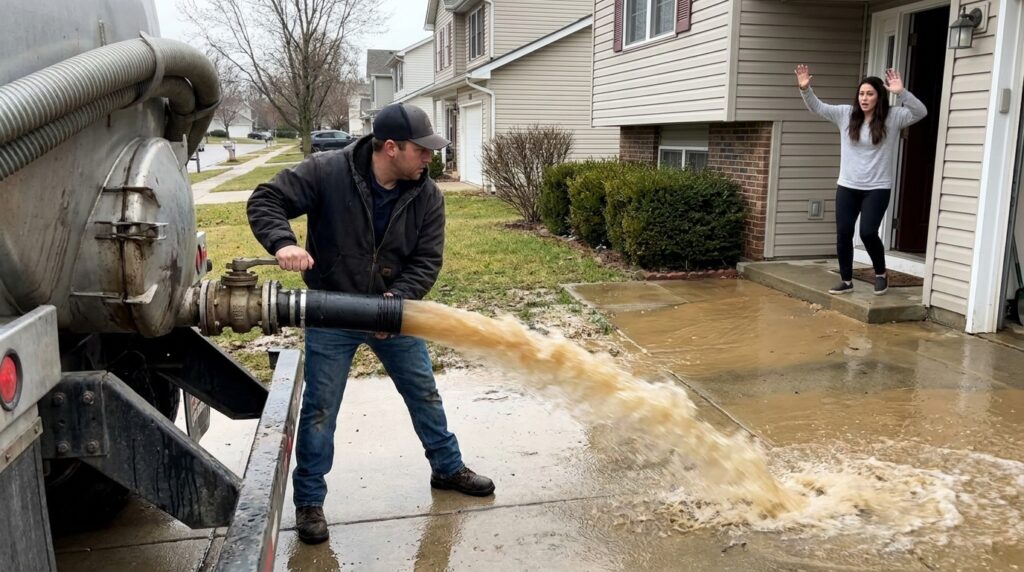
A man in a high-visibility lime-green vest stepped down from the cab, his boots hitting the sun-baked asphalt with a dull thud. He didn’t look at the project coordinator. Instead, his eyes went straight to the heavy black hose draped over the curb, tracking the dark, foaming stream of wastewater as it spent its final momentum against the lower edge of Elena’s concrete apron. A slow, disapproving shake of his head set his graying mustache twitching.
Elena did not drop her guard. Her fingers remained firmly wrapped around the thick manila folder containing the certified land survey map, her pulse hammering a rhythmic beat against her ribs. This was the razor’s edge—the exact moment where administrative bluster either collided with raw, unalterable geography or melted away under institutional protectionism.
“I received an automated priority alert from the digital registry,” Inspector Vance said, pulling a worn leather notebook and a fat metal tape measure from his belt loop as he walked toward the driveway. He cast a sideways glance at the doorbell camera recording his every movement from the porch eaves. “Property owner logged an active boundary infringement with attached digital evidence forty minutes ago.”
“She’s misinterpreting the emergency right-of-way act,” the coordinator interjected, stepping quickly into Vance’s path, her voice rising in defensive volume. “The drainage corridor encompasses all front aprons within fifty feet of a primary municipal junction during high-volume clearance operations. If we have to stop every time a homeowner worries about a little moisture on their driveway, the whole district—”
“Miller,” Vance cut her off again, his tone flat and devoid of professional warmth. He stopped at the edge of the curb, looking down at the yellow plastic survey marker embedded in the grass just inches from where the municipal hose had flattened the dry turf. “Let’s look at the actual pins before we start talking about district-wide clearances.”
The coordinator’s face tightened into a pale mask of suppressed fury. She crossed her arms over her chest, the yellow clipboard pressed hard against her ribs like a shield against an inevitable reckoning.
Elena stepped forward off the wood threshold, her sneakers crunching softly on the dry gravel as she extended the manila folder toward the inspector. The blue-and-white lines of the certified plat map unfolded crisply in the dry air, revealing the exact coordinates of the iron boundary pins driven deep into the earth four feet behind the current splash line of the municipal hose.
“The concrete sits entirely within private parcel limits,” Elena said, her voice clear and level, cutting through the ambient noise of the idling engines. “The easement ends at the utility pole ten yards down. They didn’t misroute the water by accident, Inspector. They used my property as a dumping ground to avoid paying overtime on the main trunk line.”
Inspector Vance took the map, his weathered thumb tracing the embossed county seal in the bottom right corner. He didn’t say a word, but the slight narrowing of his eyes told the whole story. He turned on his heel, walked over to the edge of the grass, and pulled a heavy metal pin from his belt, driving its tip into the dry earth directly beside the buried property marker.
The silence that followed was absolute, broken only by the steady, incriminating hiss of wastewater slowly pooling against the clean expansion joints of the private driveway.