CHAPTER 2: THE APPROACH
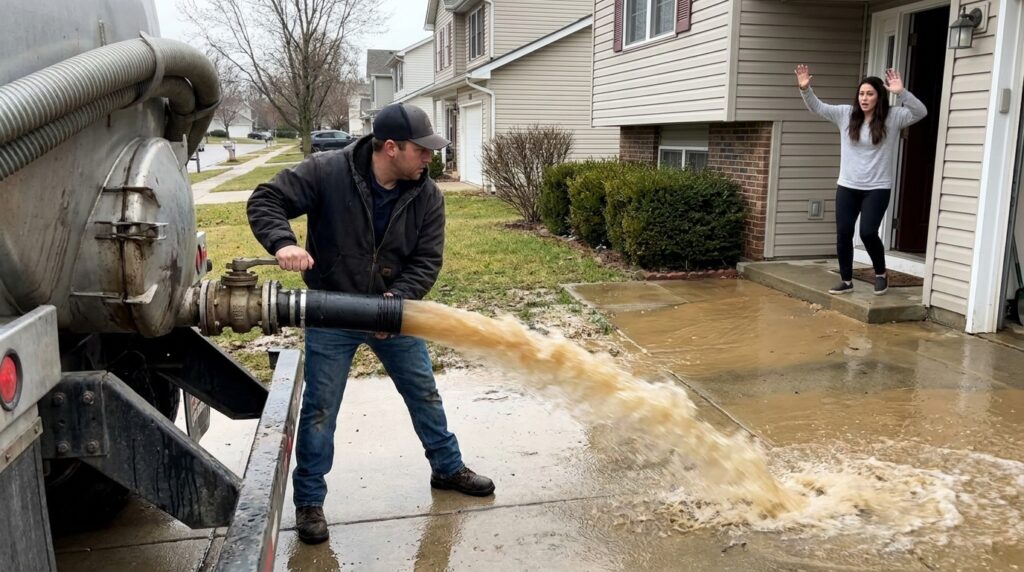
“Turn that valve back,” Elena said, her voice dropping into a register that cut cleanly through the steady, aggressive roar of the tanker’s diesel engine.
She did not flinch as the muddy slurry widened its footprint, eating another two inches of the grey concrete apron she had spent the entire previous spring sweating over. Every square foot of that surface represented a sacrificed weekend, a canceled trip, and a receipt filed away in a heavy folder inside her kitchen drawer. It was her family’s line in the dirt—the literal threshold protecting their foundation from the swampy crawl space beneath the floorboards.
The worker behind the valve didn’t move his hand. His fingers remained hooked around the corroded brass handle, skin whitening under the pressure as he glanced sideways toward the cab of the truck. “Orders came down the line an hour ago,” he muttered, his voice flat, stripped of any professional courtesy. “Main line on Elm Street backed up past the junction. We clear the low points or the basements two blocks down start taking four feet of backwash.”
“Your emergency isn’t my apron,” Elena stepped off the wood of the porch, her sneakers coming down hard on the dry, unaffected edge of the driveway. The contrast was stark: the parched, pale grey dust of the rest of the concrete suddenly meeting a thick, creeping tongue of gray-brown sludge carrying twigs, oil sheen, and street grit. “You have an easement four houses down by the utility pole. You know it, and the county plat maps prove it.”
Before the worker could answer, a sharp, artificial tap-tap-tap rang out against the side of the municipal truck’s aluminum storage bin.
“Step back, ma’am.”
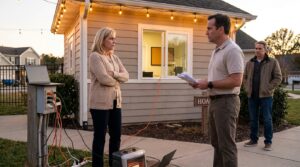
The project coordinator pushed past the rear fender, her stride brisk and rehearsed. Oversized designer sunglasses hid her eyes, but her mouth was a hard, pale line stretched thin across a face flushed by the midday heat. In her left hand, she clutched a bright yellow clipboard with such force her knuckles looked like polished bone. A laminated badge swung heavily from a lanyard around her neck, catching the glaring sun and throwing a bright, blinding flash toward Elena’s face.
“We operate under municipal code section fourteen-B,” the coordinator said, her tone dripping with the bored administrative certainty of someone who had rehearsed this exact speech to homeowners three times a week. “When the district drainage grid faces critical overload, designated surface runoffs are subject to immediate diversion protocols. Your driveway is part of the temporary arterial corridor. Now, I suggest you step back inside and let the crew finish their work before this backs up into the public right-of-way.”
Elena didn’t move. Her gaze dropped from the coordinator’s face down to the clipboard, tracking the edge of a paper sticking out from beneath a paper clip. It wasn’t an emergency municipal work order. It was a standard routing schedule, printed on cheap white stock, with a handwritten note scrawled across the margin in thick red ink: Reroute via private apron — save two hours on transit.
“That’s not an emergency directive,” Elena said, her voice dropping lower, acquiring a dangerous, metallic edge that mirrored the rusted iron of the tanker’s chassis. “That’s a shortcut to save fuel costs before your lunch break.”
The coordinator stiffened, her jaw tightening as she stepped closer, invading the private space between the truck and the porch. The smell of cheap perfume and hot asphalt drifted off her clothes, mingling with the stale stench of the wastewater pooling around their ankles.
“Watch your tone, property owner,” the coordinator snapped, lifting the clipboard like a shield. “You’re interfering with active municipal infrastructure maintenance. I can have county code enforcement out here within twenty minutes to slap a lien on this entire parcel for obstruction.”
The threat hung in the thick, baking air of the cul-de-scale, heavy and sharp. Across the street, the neighbor leaning over his garden hose slowly straightened up, his hand freezing on the nozzle as he turned his entire body to watch the confrontation unfold. Down the block, a screen door creaked open, adding its dry protest to the mounting silence.
Elena did not blink. She reached into her pocket, her fingers closing around the cold, familiar metal edge of her phone, feeling the pulse of the digital recording light blinking steadily against her palm.
“Call them,” Elena said, her eyes locking onto the blank mirrored lenses of the coordinator’s sunglasses. “Because I already have the doorbell footage of you telling your crew to bypass the main drain thirty minutes ago, and I’d love to see how the county inspector explains why my private concrete is paying for your budget deficit.”
The coordinator’s hand twitched against the clipboard, the paper rustling sharply in the dry wind as a flicker of genuine panic crossed her features before she slammed the administrative mask back into place.