CHAPTER 4: THE ESCALATION
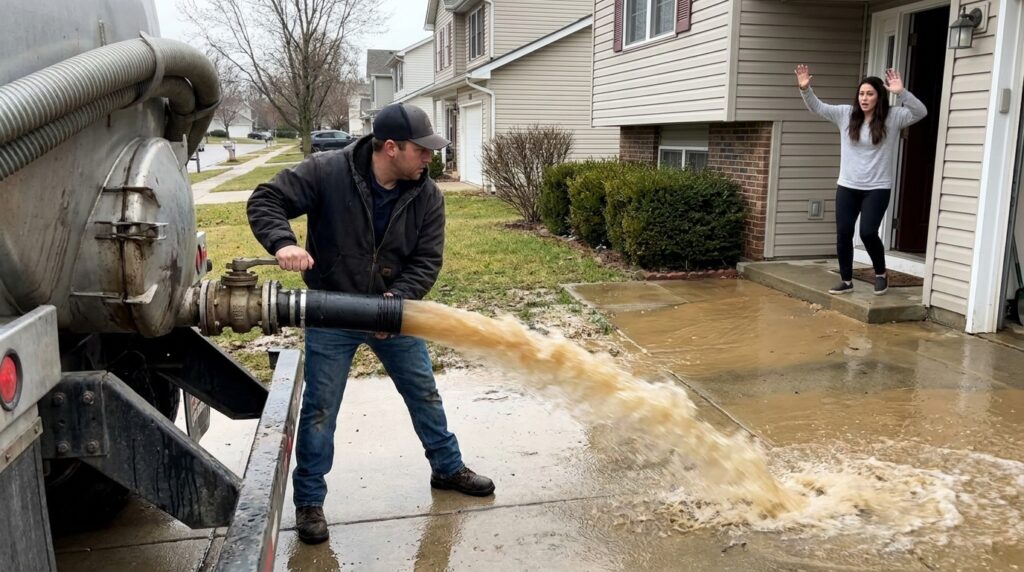
The worker’s hand twitched on the brass handle, the thick metal vibrating as the high-pressure surge hammered against the interior walls of the pipe. For a fleeting second, the stream stuttered, the dark, churning wastewater dropping to a thin, sputtering hiss that left a muddy brown arc across the pristine edge of the driveway.
“Hold on,” the worker muttered, his eyes darting from Elena’s unblinking stare to the rigid posture of the project coordinator standing beside the truck’s rear tire.
“Don’t you touch that valve,” the coordinator snapped, her voice cutting through the humid air like a dry saw blade. She planted her leather-shoed heel firmly into the grit of the street, thrusting her clipboard forward as if she could physically block Elena’s line of sight. “We have district clearance logged under the municipal stormwater maintenance act. If you shut down this flow now, the backpressure will blow the junction seals three blocks up at the commercial plaza. You want to explain to the district supervisor why corporate retail flooded on a Tuesday afternoon?”
The words hung heavy over the baking asphalt, coated in a layer of bureaucratic urgency designed to paralyze ordinary citizens with the sheer scale of civic liability. It was a well-practiced routine, honed across dozens of suburban job sites where a high-visibility vest and a laminated badge were enough to turn private property into a public utility dump.
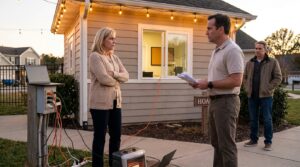
Elena didn’t retreat an inch. Her hand tightened over the thick manila folder, the cardboard stiff against her palm. She watched the way the coordinator’s fingers curled white around the edge of the yellow plastic clipboard, concealing a water-stained carbon copy receipt that peeked out from the bottom pocket—a receipt bearing a timestamp from a completely different sector of the county, hours earlier than the alleged emergency.
“Your corporate plaza isn’t my problem,” Elena said, her voice steady, stripped of any rising panic. “And neither is your scheduling failure. That runoff isn’t hitting a legal easement. It’s bleeding straight across four feet of private concrete that I paid to pour, cure, and seal with my own labor.”
The worker looked back and forth between them like a spectator at a tense, slow-motion match, his knuckles still resting near the weeping brass valve. The weight of the decision hung entirely on his hesitation. The heavy diesel engine of the tanker idled with a deep, concussive thrum that shook the loose gravel on the edge of the curb.
“Ma’am, I’m telling you, the permit covers temporary overland flow during active remediation,” the coordinator pressed harder, her tone shifting from sharp command to a smooth, patronizing cadence. She took a deliberate step closer, invading Elena’s threshold space. “The county inspector is tied up across town on an industrial spill. Nobody is coming out here to measure property lines over a little grey water. Let us finish the twenty-minute cycle, and we’ll spray down the apron before we pull out. No harm done.”
“No harm done?” Elena’s gaze dropped to the creeping edge of the sludge, now pooling dangerously close to the clean expansion joint of her garage floor. The fine silt was already settling into the porous grain of the concrete, leaving a permanent brown stain on the grey surface she had spent a year protecting.
A sharp metallic click echoed across the cul-de-sac as the neighbor across the street set his garden hose down on the dry grass, the sound carrying clearly through the midday heat. Down the block, another front door creaked open, adding the weight of hidden witnesses to the standoff.
“Take one more step onto this property with that hose,” Elena said, her voice dropping into a quiet, absolute register that brooked no argument, “and you won’t just be dealing with an inspector. You’ll be explaining to a county judge why your crew bypassed the main drainage trunk line to save diesel fuel on a shortcut.”
The coordinator’s face tightened, the professional mask slipping for a fraction of a second to reveal the raw, frustrated panic beneath. She raised her clipboard, pointing a sharp acrylic fingernail toward the street as if ready to issue a formal, fabricated citation on the spot. But before the words could leave her mouth, the heavy, distinctive whine of a county utility pickup truck turning hard into the cul-de-sac cut through the air, its amber beacon flashing a harsh, rhythmically pulsing light against the midday glare.