CHAPTER 5: THE AUDIT ON RIDGEVIEW COURT
The hydraulic winch of the commercial flatbed groaned under the six-hundred-pound strain of the first concrete block. Rusted iron links popped and creaked against the boom as the boom swung wide over the asphalt, dripping flecks of dried mud and black paint flakes into the ditch.
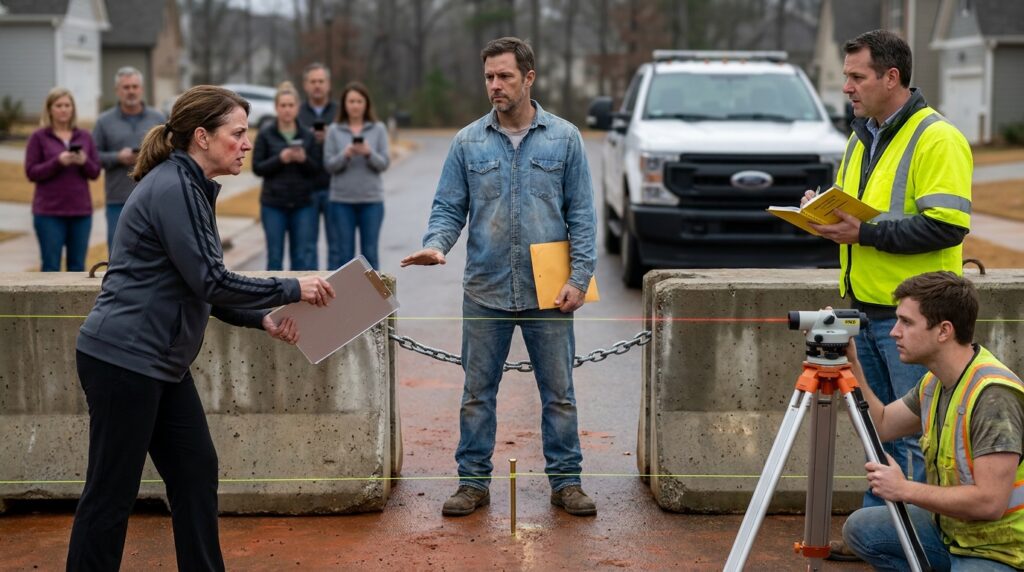
Inspector Greg Mercer stood with his arms crossed over his high-visibility vest, his steel-toed boots planted squarely on the curb pan. He didn’t take his eyes off Raymond Croft, who was operating the controls at the rear of his Ford Ranger with white knuckles and a sweat-soaked collar.
“Easy on the swing, Ray,” Mercer said, his voice cutting through the mechanical whine. “You drop that asset on Mr. Brooks’ private concrete apron, and I add property destruction to the obstruction charge.”
Raymond swore under his breath, yanking the lever back until the concrete block settled onto the bed of his truck with a dull, heavy thud that rocked the suspension.
Across the street, Arthur Pendelton stepped off his porch, his newspaper folded under his arm, his walking stick clicking against the pavement as he crossed the cul-de-sac. Behind him came Sarah Lin, stepping past her mailbox with her phone raised, recording the clear space emerging between Caleb’s driveway pillars. Within ten minutes, six more neighbors had gathered along the curb line—people who had spent months paying fifty-dollar fine notices for unclipped hedges and faded mailbox numbers.
Marlene Croft remained frozen on her front walkway. The yellow county citation fluttered in her fingers, the paper crinkling under her rigid grip. Her dark sunglasses were tucked into her collar now, exposing wide, bloodshot eyes that shifted from Inspector Mercer to the growing crowd of homeowners.
“This is a gross administrative overreach,” Marlene declared, her voice cracking as she tried to project it over the winch. She turned to Arthur, her hand gesturing wildly toward Caleb’s lawn. “Arthur! You saw this man bring heavy commercial equipment onto our street without a permit! He’s undermining the drainage infrastructure for the entire court!”
Arthur stopped at the edge of the neon yellow survey line. He looked down at the brass monument pin gleaming in the turf, then looked up at Marlene.
“Marlene,” Arthur said, his voice raspy with age but carrying the weight of twenty years on Ridgeview Court. “He showed the city permit to Mercer ten minutes ago. You told us at the June meeting that the HOA owned that ditch and we had to raise dues by twelve percent to repair it.”
“The board was acting under preliminary legal guidance!” Marlene snapped, her heels scraping against the concrete as she took two steps toward the crowd. “We were securing the perimeter before private excavation ruined the sub-grade!”
Caleb walked to the hood of his truck. He picked up the heavy manila envelope containing the certified county records and stepped across the yellow line. He didn’t raise his voice. He didn’t stride aggressively. He walked with the slow, unyielding cadence of a man carrying an iron ledger.
“It wasn’t legal guidance, Marlene,” Caleb said, stopping three feet from her.
He opened the envelope and pulled out the first document: the certified copy of the 1998 subdivision plat. He held it out so Arthur and Sarah Lin could see the red notary seal pressed into the corner.
“The county deed explicitly excludes this ditch from HOA common acreage,” Caleb said, his voice flat and clear. “It’s a Category B municipal easement on my private deeded parcel. The board never had jurisdiction. You knew that when you filed the first violation notice.”
Marlene’s chin trembled, but her eyes hardened into sharp, desperate slits. “A technicality in the original filing! The Architectural Review Board retains implicit authority over all visible streetscapes!”
“Then explain this,” Caleb continued, pulling out the second sheet—the municipal vendor disclosure form he’d pulled from the vault eighteen hours ago.
He held the onion-skin paper toward the two HOA board members who had wandered down from the top of the hill—Dave Miller and Frank Vance, both wearing lawn-mowing clothes, both looking uneasy as they took in the presence of the county inspector.
“This is an emergency capital proposal submitted to the board three months ago,” Caleb said, pointing to the typed lines at the bottom. “Eighteen thousand dollars for drainage remediation along Ridgeview Court. Issued to Croft Heavy Earthworks LLC.”
Dave Miller leaned in, squinting at the page. “Eighteen grand? We… we discussed a drainage review, but Marlene said it was a competitive county bid.”
“Look at the managing partner’s signature,” Caleb said, turning the sheet so the sunlight caught the blue ink. “Raymond Croft. Unlicensed since 2023. Operating out of the same residential address as your ARB Chair.”
Frank Vance looked from the paper to Marlene, his mouth dropping open. “Marlene… you told us this was an independent engineering firm from Alpharetta.”
“It’s a family business!” Marlene shouted, her composure shattering completely as her voice reached a shrill, hysterical pitch. “Raymond has twenty years of earth-moving experience! He was offering us a discount compared to city contractors! You think some outsider like Brooks gives a damn about your property values? I built the standards in this neighborhood! I kept this court from looking like a trailer park!”
“You used stolen county concrete blocks to block my driveway so your brother could land an eighteen-thousand-dollar contract for an eight-thousand-dollar job I was paying for myself,” Caleb said quietly.
The crowd went completely silent. Sarah Lin lowered her phone slightly, her eyes wide as she looked at Marlene.
Inspector Mercer stepped forward, taking the yellow citation copy back from Marlene’s limp hand and writing a second entry on the lower ledger line.
“Mr. Miller, Mr. Vance,” Mercer said, turning to the two board members. “As active officers of this incorporation, I am serving you with an official municipal notice of unauthorized interference with a public utility corridor. If this board attempts to issue another hold, fine, or lien against Parcel 14-B regarding this drainage permit, the city attorney will file an immediate injunction against the board members individually.”
Dave Miller took a fast step away from Marlene, his hands raised in defensive surrender. “We didn’t sign off on any barricade, Inspector. She told us she had a court order!”
“I didn’t sign anything either,” Frank Vance added quickly, backing toward his driveway. “We’re calling an emergency board meeting for tonight. Total audit.”
Raymond Croft slammed the tailgate of his Ranger shut, the second concrete block secured in the bed. He didn’t look at his sister. He climbed into the cab, fired the engine with a cloud of black exhaust, and sped out of the cul-de-sac without waiting for her.
Marlene stood alone on the pavement. The acrylic clipboard slipped from her numb fingers, hitting the asphalt with a sharp, hollow crack that echoed off the brick house fronts. Her face was pale, drawn, aged ten years in the harsh morning light.
She looked at Arthur, at Sarah, at her neighbors who were now turning their backs on her, whispering in quiet, disgusted clusters. Finally, her eyes met Caleb’s.
Caleb didn’t gloat. He didn’t smile. He gathered his certified papers, folded them neatly, and slid them back into his manila envelope.
“Get off my land, Marlene,” Caleb said softly.
Marlene didn’t say a word. She turned, her heels dragging against the concrete, and walked up her front steps, shutting the heavy oak door behind her with a muffled click.
Caleb turned toward his lawn. The driveway mouth was clear. The red clay ditch lay open, ready for the pipe. Down the street, the deep rumble of Hank’s flatbed truck signaled its return, carrying thirty-six feet of concrete culvert back to the job site.
Caleb walked up his porch steps, where Maya and Chloe were standing, watching him with quiet, awe-struck smiles. He set the envelope on the porch table, sat down on the top step, and pulled off his heavy work gloves, ready to lay the pipe.