CHAPTER 3: THE INK BENEATH THE DEED
The air in the basement vault of the Gwinnett County Land Records Office smelled of old paper, vinegar, and forty years of drying binder glue. High above the microfiche readers, industrial fluorescent tubes hummed at a low, maddening sixty cycles, flickering against the cold concrete walls.
Caleb Brooks sat at a formica table, his heavy forearm resting beside a canvas-bound ledger thick as a masonry block. His thumb, stained faintly with grease from his truck’s steering column, traced the raised red seal on a certified copy of the 1998 Gideon Crossing Plat Map.
Opposite him, a clerk with thick spectacles and a laminated county badge leaned against a rolling ladder, chewing on the end of a ballpoint pen.
“I told you three times, Mr. Brooks,” the clerk said, his voice flat with the boredom of a career public servant. “If the HOA registered their covenants after ninety-eight, they have concurrent enforcement rights on all visible easements. It’s standard boilerplate.”
“Concurrently doesn’t mean exclusively,” Caleb said without looking up. His eyes moved down the fine black lines of Lot 14—his lot. He picked up his brass scale ruler, laying the transparent edge along the curb line. “Look at the offset marker here. Section 12-A.”
The clerk sighed, stepped off the ladder, and leaned over the table. The smell of stale coffee drifted off his shirt. “Yeah? What about it?”
“The developer dedicated an eighteen-inch utility maintenance strip along the concrete pan,” Caleb said, his nail pressing into the heavy paper until the surface creased. “Eighteen inches. Not three feet. The moment you step nineteen inches past that curb, you are standing on private, deeded fee-simple dirt. My dirt.”
He pulled out the pink violation notice Marlene had slapped on his windshield six hours earlier and laid it directly beside the plat map. He pointed to the handwritten code on the back: GC-ARB-08B.
“She cited Section 4, Paragraph B,” Caleb continued, his voice steady, stripped of emotion. “Claiming the drainage ditch is designated HOA Common Parkland Easement. But according to this survey registered with the county clerk on October 14, 1998, that ditch was never dedicated to the association. It was retained as a municipal storm-drainage easement attached to the private parcel.”
The clerk frowned, adjusting his glasses. He reached for a magnifying loupe sitting beside the card catalog box and pressed it against the corner of the map. He stared through the glass for ten long seconds, his jaw working silently.
“Well, look at that,” the clerk muttered, scratching his chin. “It’s stamped. Faded, but it’s there.”
“What’s it say?”
“County Drainage Maintenance Right-of-Way. Category B,” the clerk read aloud. He looked up at Caleb, his expression shifting from annoyance to mild curiosity. “If this is a Category B municipal easement, your HOA doesn’t have the legal authority to issue a structural hold or a daily fine on it. Only the City Inspector or the County Water Resources Department can stop work or write citations on a Category B.”
Caleb felt a cold wave of clarity settle over his chest. Layer 1 was clear, exposed under the harsh fluorescent light: Marlene wasn’t just enforcing rules strictly—she was fabricating property boundaries out of thin air, using the neighborhood’s ignorance of municipal law to claim control over land the HOA had never owned.
“She’s using fake authority to force a halt,” Caleb said quietly, more to himself than to the clerk. “Why?”
“People like their power, Mr. Brooks,” the clerk shrugged, sliding the loupe back into his pocket. “Give a neighborhood committee chair a clipboard and a fancy title, and they think they’re the county magistrate.”
Caleb didn’t answer. He turned the plat map over to check the cross-referenced parcel filings attached to the back. A sheet of thin onion-skin paper was stapled to the ledger hinge—a municipal vendor disclosure form filed eight months prior.
His eyes scanned the lines of typescript until they stopped at a corporate name registered under the subdivision’s maintenance allocation registry: Croft Heavy Earthworks & Landscaping LLC.
Caleb paused. The name hit him with the weight of a dropped cinderblock.
Below the business name was a state tax ID and a listed managing partner: Raymond Croft.
Caleb knew the name. Raymond Croft was Marlene’s younger brother—a former site supervisor who’d lost his county commercial license three years ago after an unpermitted clearing job collapsed a retention pond in Loganville.
He looked down at the attached bid proposal stamped by the HOA board from three months ago. It was a pending capital expenditure request for $18,000 to “remediate and reconstruct sub-surface drainage structures along Ridgeview Court.”
Caleb’s fingers tightened on the edge of the formica table. The pieces clicked together with the cold, mechanical precision of a locked deadbolt.
Marlene didn’t just want to stop his $8,000 DIY culvert installation because it violated her aesthetic sensibilities. She needed his private repair to fail. If Caleb fixed his own drainage shoulder for eight thousand dollars out of his own pocket using a private permit, he proved to the entire street that the ditch didn’t require an eighteen-thousand-dollar emergency overhaul from her brother’s unlicensed company.
His simple, honest labor was standing in the way of a ten-thousand-dollar markup.
“Mr. Brooks?” the clerk asked, noticing the change in Caleb’s posture. “You need copies of these?”
“Certified copies,” Caleb said, his voice dropping an octave. “Every page. The plat map, the easement designation, and this vendor disclosure sheet.”
“That’ll be twelve dollars for the notary stamp and a dollar a page.”
Caleb pulled out his wallet, laid a twenty-dollar bill on the counter, and didn’t wait for the change.
Forty minutes later, the sun was sinking behind the pine tree line when Caleb pulled his work truck back into the cul-de-sac of Ridgeview Court. The air was thick with the scent of evening humidity and cut grass. Across the street, Arthur Pendelton was sitting on his porch glider, watching the road with a quiet, watchful gaze.
Caleb stepped out of the truck, the manila envelope containing the stamped county records held firmly in his hand.
As he crossed his lawn, he stopped dead in his tracks.
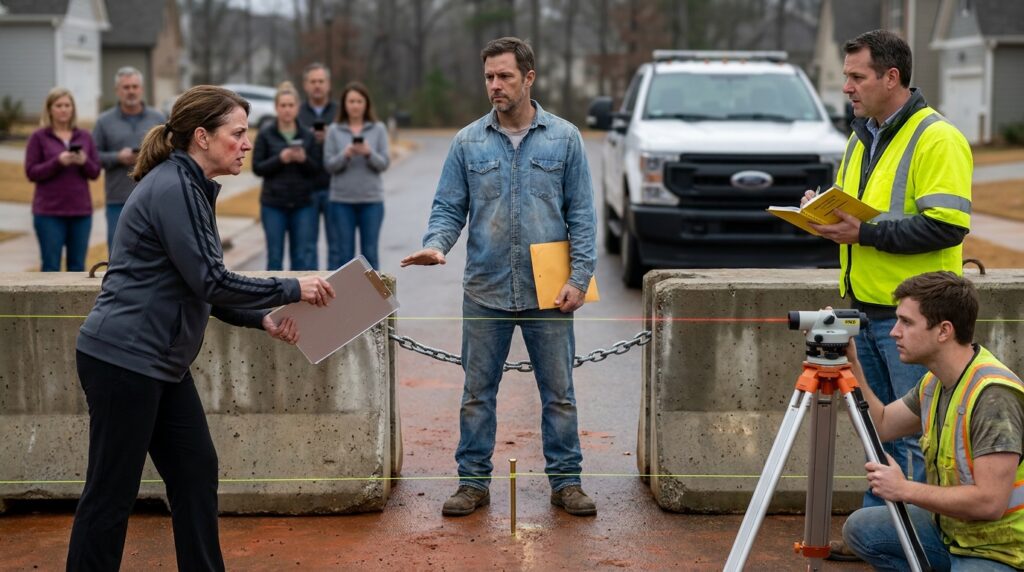
Parked across his driveway mouth was no longer just Marlene’s rented utility trailer. Two heavy, yellow concrete traffic barriers—each weighing at least six hundred pounds—had been dropped onto his concrete apron by an industrial forklift, completely sealing off his garage. Stretched between the two blocks was a heavy steel towing chain, secured with a heavy iron padlock.
Hanging from the center of the chain was a fresh, yellow warning sign printed in bold black block letters:
HAZARD SITE – PROPERTY RESTRICTED BY ARB ORDER. TRESPASSERS WILL BE PROSECUTED.
Beside the barrier stood Marlene Croft. She wasn’t wearing her magenta jacket anymore. She wore a dark gray track jacket, her arms folded over her chest, her dark sunglasses resting on top of her styled hair. Beside her stood a burly man in a grease-stained work shirt with Croft Earthworks stitched over the pocket.
“You’re late, Mr. Brooks,” Marlene called out, her voice cutting through the quiet evening air. “The board held an emergency session at four o’clock. Due to your failure to comply with the initial notice, we’ve declared this driveway apron an active structural hazard. The barriers stay until the fine is paid in full and a certified contractor inspects the integrity of the curb.”
The man beside her stepped forward, spitting a stream of dark tobacco juice onto the hot asphalt inches from Caleb’s boot.
Caleb didn’t look at the man. He didn’t look at the chain. He looked Marlene straight in the eyes, his face completely unreadable, the manila envelope tucked tightly under his arm.
“You’ve got until eight tomorrow morning to move these blocks, Marlene,” Caleb said, his voice terrifyingly calm.
Marlene let out a short, harsh laugh. “Or what? You going to call your little delivery truck back?”
“No,” Caleb said, stepping over the yellow survey line until he was standing six inches from the concrete block. “At eight-fifteen, I’m bringing the City Fire Marshal and Inspector Greg Mercer here. And I’m going to let them read what’s inside this envelope.”
Marlene’s smile faltered for a fraction of a second, her eyes darting toward the thick manila folder in his hand before she forced her chin back up.
“Call whoever you want,” she spat. “This is HOA land.”
Caleb turned his back on her, walked up his front steps, and opened the door. Inside, Maya and Chloe were standing in the hallway, their eyes wide with fear. Caleb closed the door behind him, locked it, and looked at his daughters.
“Dad?” Maya whispered, her voice trembling. “Are they going to take the house?”
Caleb set the manila envelope on the hallway table, walked over, and pulled both of his daughters into a firm, steady embrace.
“Nobody is taking anything,” Caleb said, his voice gravel-rough and unshakable. “Tomorrow morning, we finish this.”