CHAPTER 4: CONCRETE AND BINDING CHAINS
The dawn humidity clung to the red clay along Ridgeview Court like damp wool. At 6:45 AM, Caleb Brooks stood beside his pickup truck, his heavy work boots resting inches from the neon yellow string line he had stretched between the brass survey markers.
Across the driveway mouth, the two six-hundred-pound concrete traffic blocks sat embedded in the soft soil. Moisture beaded on the rusted steel chain links wrapped tightly through the lifting eyes. The heavy padlock hung low, coated in a film of morning dew that caught the gray light.
Caleb did not reach for his bolt cutters. He knew the law of physics and the law of the court: cutting that chain himself would give Marlene Croft the one thing she desperately needed—a clear, documented record of destruction of property on an active dispute zone.
“Dad?” Maya’s voice called from the porch steps. She held two metal travel mugs, her shoulders hunched against the morning chill. Chloe stood in the doorway behind her, clutching her backpack straps. “The bus is going to be at the corner in ten minutes. Are those blocks… are they going to stay there all day?”
Caleb walked over, took the mug, and wrapped his calloused fingers around the warm stainless steel. “The bus driver will pick you up at the corner just like every morning. Go on inside and get your jackets. Everything is moving according to the plan.”
Maya looked at the yellow warning sign hanging from the chain, then up at her father’s face. “She was out there at midnight, Dad. I heard a truck idling. A big one with air brakes.”
Caleb’s jaw tightened. “I know.”
He had heard it too—the hydraulic groan of a heavy knuckle-boom crane setting those blocks into place while the cul-de-sac slept. It hadn’t been a hired towing company. The grease smell lingering on the concrete was high-tack open-gear lube, the exact compound used on commercial earth-moving rigs. Croft Earthworks had left its fingerprint in the mud before the sun even came up.
The high-pitched whine of an approaching engine echoed from the entrance of the subdivision. A white Ford F-250 with a amber lightbar mounted to the cab turned onto Ridgeview Court, its tires crunching over the loose gravel near the storm drain. On the door, painted in crisp black block letters, were the words: GWINNETT COUNTY CODE ENFORCEMENT & BUILDING INSPECTIONS.
Behind the county truck, a rust-spotted Ford Ranger pulled up to the curb. A young man in a worn surveyor’s vest stepped out, sliding a heavy aluminum tripod and a digital transit level out of the bed.
Caleb walked down his driveway to meet them, his boots making a steady, rhythmic thud against the blacktop.
At the same moment, the front door of the two-story brick home at the head of the court swung open. Marlene Croft stepped onto the porch, her dark sunglasses already covering her eyes despite the overcast sky. She held her silver acrylic clipboard flat against her waist. Behind her stepped Raymond Croft, his heavy frame filling the doorway, a thick roll of blue chalk line tucked into his back pocket.
“Mr. Brooks!” Marlene called out, her heels clicking rapidly against her concrete walkway as she marched toward the street. “I see you’re continuing this public spectacle. I warned you yesterday that continuing to stage unauthorized personnel on this easement will result in immediate police intervention for disorderly conduct!”
Caleb ignored her entirely. He extended his hand to the man stepping out of the county truck.
“Inspector Mercer,” Caleb said.
Greg Mercer was forty-eight, with short-cropped salt-and-pepper hair, a weathered neck, and a heavy brass badge pinned to the pocket of his high-visibility vest. He didn’t smile. He took Caleb’s hand in a brief, firm grip, his eyes already sweeping the driveway, the concrete blocks, and the yellow string line stretching across the turf.
“Caleb,” Mercer said, his voice a low, raspy drawl. “Got your message at seven this morning. Brought the GIS tablet and the original county right-of-way plat like you asked.”
“Inspector!” Marlene interrupted, stepping directly between Mercer and the concrete barrier. She raised her clipboard like a barrier. “I am Marlene Croft, Chair of the Gideon Crossing Architectural Review Board. This property is currently under an active administrative hold for covenant violations and structural hazard creation. This man is attempting to alter a designated common easement without board clearance.”
Inspector Mercer didn’t back up an inch. He looked down over the top of his reading glasses at the silver clipboard, then at Marlene’s face.
“Ma’am,” Mercer said, his voice completely flat. “I don’t enforce HOA covenants. I enforce Gwinnett County Building Codes and Municipal Right-of-Way Ordinances. Step back from the site line, please.”
Raymond Croft sauntered down the lawn, his hands shoved deep into his denim pockets. “Hey, Mercer. You’re out of your zone here. This is private community property. City hall doesn’t have a say past the main archway.”
Mercer turned his head slowly, his eyes locking onto Raymond. “Is that right, Ray? Last time I checked your contractor registration with the Secretary of State, it was listed as administrative suspension for unpermitted grading down in Loganville. You want to talk to me about jurisdictional authority on a public drainage corridor?”
Raymond’s jaw worked silently. He spat onto the grass, took a half-step back, but kept his eyes fixed on Caleb.
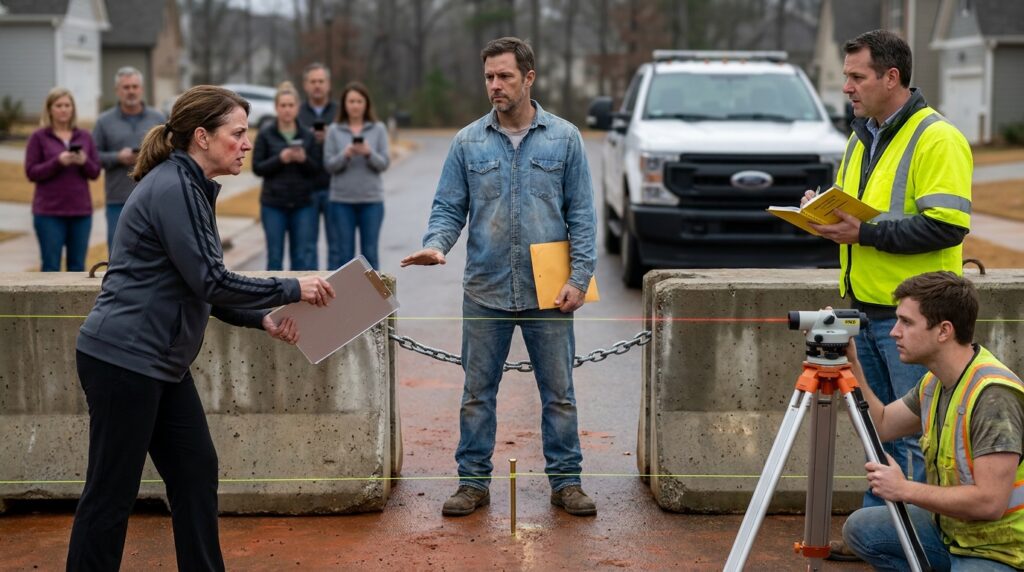
The surveyor set his tripod squarely over the brass pin embedded in the curb. He leveled the sight glass, clicked the digital laser module into place, and shot a red line straight down the edge of the ditch toward the property line. The red beam hit the exact center of the steel stake Caleb had driven into the earth three days prior.
“Pin to pin,” the surveyor called out, his voice crisp in the morning air. “The deed line runs twenty-four inches outside those concrete blocks. The blocks, the chain, and the trailer tongue are sitting entirely inside Parcel 14-B.”
Inspector Mercer pulled his digital tablet from his belt, tapped the screen three times, and cross-referenced the laser readout with the official county plat overlay. He looked up at the yellow warning sign hanging from the chain, then down at the two six-hundred-pound blocks crushing the grass.
“Mr. Brooks,” Mercer said, turning to Caleb. “You pulled a municipal culvert permit on Tuesday, correct?”
“Permit number 884-C,” Caleb said, pulling the laminated white card from his pocket and handing it over. “Paid in full. Approved for ten-inch reinforced concrete pipe.”
“And these blocks?” Mercer asked, pointing a thick finger at the concrete barricade. “Who put these here?”
“They were dropped at 4:00 AM by a knuckle-boom crane,” Caleb replied. “Blocking my private vehicular access to my garage, and blocking the designated city storm run-off corridor.”
Mercer walked over to the concrete block closest to the curb. He knelt down, his heavy boots sinking slightly into the wet clay. He pulled a small flashlight from his belt, shining the beam into the recessed lifting pocket of the block.
His hand paused. He reached in, scraping away a layer of fresh black spray paint with his pocketknife, exposing a riveted steel serial tag underneath.
“Well, now,” Mercer said quietly, standing up and dusting off his knees. “That’s interesting.”
“What is it, Inspector?” Caleb asked, taking a step closer.
Mercer didn’t answer Caleb immediately. He turned his head toward Marlene, his expression hardening into something cold and uncompromising.
“Mrs. Croft,” Mercer said, his voice carrying clearly across the cul-de-sac where Arthur Pendelton and Sarah Lin were now standing near the curb, watching. “You placed these barriers to enforce an HOA violation?”
“The board authorized the physical restriction of an unapproved work site!” Marlene insisted, her voice tightening, a thin edge of panic bleeding through her rigid posture. “It’s within our legal right to protect community aesthetics!”
“Mrs. Croft,” Inspector Mercer said, pulling a yellow citation book from his rear pocket. “This concrete block carries Gwinnett County Water Resources Asset Tag 441. It was stolen from the county storage yard on Highway 29 three weeks ago during the culvert expansion project.”
The neighborhood went dead silent. The only sound was the faint hum of the surveyor’s transit level.
Marlene’s face drained of color, her manicured hand gripping the clipboard so hard the acrylic groaned. “That’s… that’s impossible. Croft Earthworks provided those materials for community containment—”
“Croft Earthworks provided stolen county property to block a legal, permitted municipal drainage repair,” Mercer interrupted, his pen already flying across the yellow carbon paper. “And because these blocks sit within eight feet of that municipal fire hydrant at the corner of your lot, Mr. Brooks, this chain constitutes a Class-A illegal obstruction of an emergency response route.”
Mercer ripped the top copy from the pad, stepping past Raymond Croft, and slapped the yellow ticket directly against the front of Marlene’s silver clipboard.
“You have fifteen minutes to get a crane back here and clear this private driveway, Mrs. Croft,” Mercer said, his voice ringing like an iron hammer against an anvil. “Or I call the county sheriff, impound the equipment, and issue an arrest warrant for obstruction of a public officer and possession of stolen municipal property.”
Marlene looked down at the yellow citation, her lips trembling, her glasses slipping down her nose. Raymond took two fast steps back toward his truck, his eyes darting toward the main road.
Caleb stood on his lawn, his hands resting steady at his sides. He looked at Marlene, then at the manila envelope resting on his truck’s hood containing the certified kickback papers. The first wall of her authority had just cracked wide open, but as he looked at Raymond’s retreating back, he knew the real fight wasn’t over yet.