CHAPTER 2: STANDBY RATES AND COLD STEEL
“Four hundred bucks, Caleb. That’s what the yard charges me every hour this rig sits here with the PTO engaged,” the driver called down from the cab, his elbow resting heavy on the sun-faded door. His name was Hank, and his eyes were fixed on the dash clock ticking past 8:15 AM. “I got two more drops in Cherokee County before noon. I can’t sit here while your HOA chair plays sheriff.”
Caleb didn’t look up at the cab. His boots remained planted six inches from the concrete curb, his heels resting on the dry red dirt where his shoulder met the street. “Give me ten minutes, Hank. You’re getting paid.”
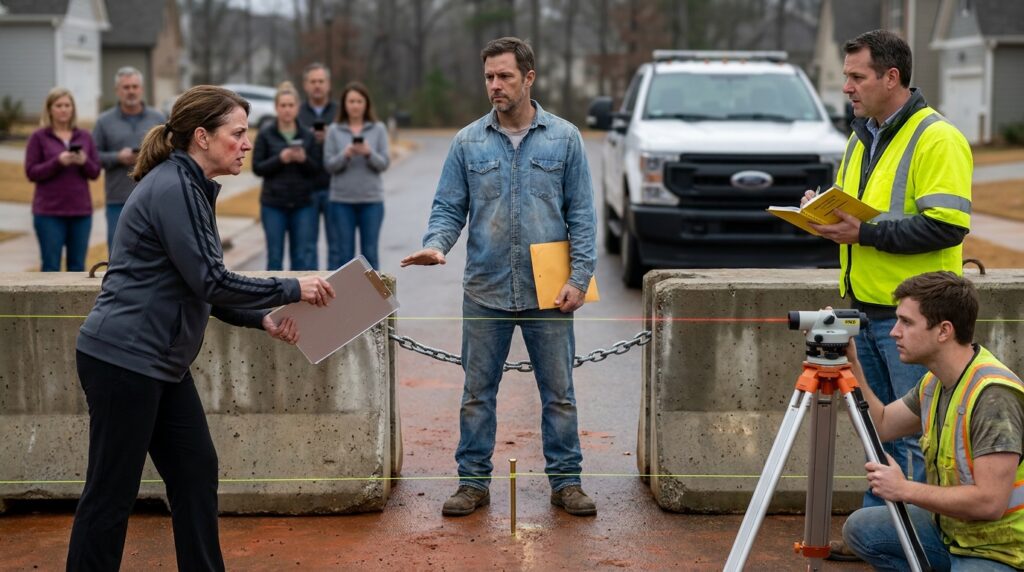
Marlene didn’t flinch at the figure. She stood in the center of the driveway mouth, her oversized dark sunglasses reflecting the idle vibration of the flatbed’s chrome grille. Her fingers gripped the silver clip of her binder so tight her knuckles showed yellow beneath her skin.
“Pay him whatever you like, Mr. Brooks,” Marlene said, her voice dropping into a razor-thin register that barely carried over the diesel rumble. “It won’t change the outcome. The moment that hydraulic arm touches a single piece of concrete over this curb, I am filing an emergency injunction with the county magistrate for illegal excavation on common acreage. And every day that truck sits blocking this cul-de-sac, the board levies an additional five hundred dollars in administrative penalties.”
She reached into the side pocket of her magenta jacket, pulled out a second folded sheet of heavy paper—this one a bright, fluorescent pink—and slapped it directly onto the hood of Caleb’s parked pickup truck. The paper was already stamped with a red ink seal from the Gideon Crossing Architectural Review Board.
“Consider yourself officially served,” she said. “You have fourteen days to cure the obstruction, remove all unapproved equipment, and pay the initial assessment, or a statutory lien attaches automatically to your deed.”
Caleb walked over to his truck. He didn’t rush. He didn’t snatch the paper. He picked it up by the corner, feeling the stiff, cheap grain of the cardstock. The ink was still fresh enough to smudge under his thumb. The total at the bottom was itemized in rigid, typed figures: $2,500.00 – Unauthorized Commercial Staging & Environmental Modification Fee.
Across the street, Arthur Pendelton shifted his weight on his porch, his hand holding his coffee mug mid-air, watching the bright pink paper in Caleb’s hand. Further down the block, a garage door hummed open three inches, a pair of eyes watching through the gap.
Caleb turned the pink notice over. On the back, in faint, purple carbon-copy ink, was the small print of the covenant enforcement section. But beneath the boilerplate legal text, his eye caught a small detail: a handwritten tracking code penned in greasy blue ink—GC-ARB-08B.
He looked back at the commercial utility trailer blocking his driveway. It was heavy, double-axle, built for hauling industrial bobcats or earth-moving buckets, not residential lawnmowers. On the frame near the tongue, tucked behind a thick layer of road grime and dried red mud, was a small, stenciled decal: Croft Rental & Equipment Co. And stamped right below it in yellow grease pencil was the exact same code: 08B.
Caleb’s throat tightened, a cold, familiar knot forming at the base of his neck. It was the same feeling he’d had seven years ago in a regional deposition room when he realized his former partner hadn’t just made a mistake on the structural load calculations—he had deliberately signed Caleb’s name to the altered blue sheets to clear his own bond.
“You rented this trailer yourself, Marlene,” Caleb said, his voice flat, stripped of all heat. “It didn’t come from the HOA maintenance shed down on the main road.”
Marlene’s head snapped toward him, her lips pulling into a tight, pale line behind her dark lenses. “The board utilizes private contractors and equipment as necessary to preserve community standards when individual homeowners refuse to comply. The rental fees are fully billable to the violator. To you.”
“Fourteen days,” Caleb read from the pink sheet. “That’s convenient.”
“It’s standard procedure,” she countered, stepping around the corner of the trailer and tapping her clipboard against its rusted steel side rail. “You clear the material, you submit a formal variance request to the committee at the next monthly meeting, and you wait for the review process. Like every other resident who respects the rules of this neighborhood.”
Hank leaned further out the cab window, the engine giving a heavy, throaty cough as he goosed the throttle. “Caleb! Five minutes, man! I either dump these pipes on your grass or I’m taking ’em back to the yard. I ain’t getting impounded by some neighborhood watch.”
Caleb looked at the pipe—three massive sections of six-foot corrugated concrete, resting on the bed like ancient fallen columns. If Hank dumped them on the lawn now, without the ditch prepped and the grade cut, they would sit in the red mud, sinking under their own weight, giving Marlene every legal excuse she needed to call the county code enforcement officer for an uncontained hazard.
He looked at Marlene. Her posture hadn’t softened an inch. She stood beside the trailer’s hitch, her hand resting on the heavy iron jack-stand as if she owned the ground beneath it.
“Take ’em back to the yard, Hank,” Caleb said.
Hank blinked, surprised. “You sure? It’s gonna cost you the restocking fee plus the standby.”
“Take ’em back,” Caleb repeated. He reached into his pocket, pulled out his wallet, and extracted a folded stack of bills he’d set aside for the crew’s morning fuel. He walked to the cab door and handed the cash directly up to the driver. “Tell the yard manager I’ll pay the hold fee for three days. Keep the pipes on the trailer.”
Hank took the money, nodded once with a grimace, and shifted the heavy truck into gear. The air brakes released with a sharp, deafening hiss that echoed off the brick fronts of the houses along the court. The flatbed backed slowly out of the cul-de-sac, its tires grinding the loose gravel against the hot asphalt until the sound faded down Ridgeview Parkway.
Marlene didn’t move until the sound of the engine was completely gone. She adjusted the strap of her clipboard, her chin tilted slightly upward.
“A wise decision, Mr. Brooks,” she said, her voice smooth again, taking on the artificial warmth of a bureaucrat closing a file. “It’s always cheaper to comply than to fight the board. You have until the end of the business day tomorrow to remove this truck from your front lawn, or the towing service will be dispatched.”
She turned and began walking back up the sidewalk toward her two-story brick home at the corner of the court, her heels clicking a rhythmic, victorious beat against the concrete.
Caleb stood alone by his pickup. He didn’t watch her walk away. He looked down at the pink violation notice in his hand, then back to the yellow survey pin glinting in the grass by his boot. He reached down, plucked a dry stalk of crabgrass that had grown over the brass head, and cleared the dirt from the stamped lettering: GA-DOT-SURVEY-MARKER-1998.
He folded the pink paper precisely into quarters and slid it into his front shirt pocket next to his mechanical pencil. Then he walked to his truck, opened the door, and reached for his clip-board—the old wooden one with the chipped corners and the brass spring that had held twenty years of job-site receipts.
He didn’t fire up the engine right away. He pulled out a clean sheet of grid paper, uncapped his pencil, and wrote three words across the top: County Records Office.
Through his windshield, he saw the curtain in his front living room window twitch. Maya’s pale face appeared behind the glass, her eyes wide, watching him with the quiet, helpless fear that had lingered in their house ever since her mother died. Beside her, Chloe reached up and took her older sister’s hand.
Caleb held his daughter’s gaze through the glass for three long seconds. He didn’t smile, but he didn’t lower his head either. He tapped the mechanical pencil once against the steering wheel, clicked the lead out two notches, and started writing down the exact dimensions of his property line.