CHAPTER 5: THE COLD CURB RECKONING
“We don’t need a formal hearing to see what’s sitting on the stones, Mark.”
The voice cut through the damp morning air with the flat, unyielding authority of a retired civil engineer who had spent forty years signing off on concrete compaction tests. Dave Henderson stood at the foot of Mark’s driveway, holding a brushed-aluminum clipboard against his chest like a breastplate. His windbreaker was zipped to the chin against the raw morning chill, his steel-toed boots planted squarely on the asphalt seam.
Behind him, Sycamore Lane was waking up in full view.
Two morning joggers in fluorescent yellow had slowed to a walking shuffle across the street, their eyes fixed on the yellow painter’s tape cordoning off Mark’s porch. A silver minivan carrying three children had pulled to the curb, its hazard lights blinking rhythmically against the overcast sky. Farther down the block, two more neighbors stood by their mailboxes, leashes in hand, their murmurs drifting over the wet lawn like low static.
Brenda had already crossed the street.
She had changed out of the pink pajama set and into a stiff navy-blue track jacket and pressed khaki slacks, but the hasty scrub hadn’t completely washed the gray grime from beneath her fingernails. Her hair was pulled back into a severe clip, her face flushed with a triumphant, aggressive certainty. She stood two paces to Dave’s right, her arms crossed tight over her ribs.
“He’s been washing toxic pet runoff into the common swale for three months, Dave,” Brenda announced, pitching her voice loud enough for the gathering neighbors to hear every syllable. “I warned the board. I told everyone this lot was an environmental hazard. Look at that stoop—he’s dumping biological and chemical waste right at his own doorway because he can’t control what he’s doing.”
Mark stood on his porch, three steps above the driveway. The cool breeze pulled at the collar of his blue polo shirt. In his right hand, he held a black ten-inch tablet, its screen asleep. In his canvas jacket pocket, the damp manila folder with the wholesale invoices pressed against his ribs like a cold iron plate.
“Are you asking me to clean this up, Dave?” Mark asked. His voice was calm, low, devoid of the theatrical outrage Brenda was expecting.
“I’m telling you that under Section 14 of the subdivision covenants, an active biological or hazardous accumulation on a front walkway carries an immediate emergency abatement fine,” Dave said, his pen hovering over the citation sheet on his clipboard. “Three hundred dollars, plus the cost of professional remediation if it isn’t cleared by noon. Brenda filed the emergency escalation forty-five minutes ago.”
“Did she tell you who delivered it?” Mark asked.
Brenda gave a short, harsh laugh that sounded like dry gravel grinding in a metal chute. “Always deflecting. Always blaming the neighborhood committee. You think someone else hauled fifty pounds of rotting manure and dead turf to your front door?”
“I don’t think,” Mark said. “I log.”
He tapped the glass face of the tablet. The screen flared to life, casting a cold blue reflection across his knuckles.
Mark turned the screen toward Dave and stepped down one paver, keeping his boots behind the line of yellow tape. He didn’t offer an editorial preface. He didn’t raise his voice. He simply tapped the playback button on the uncompressed, 4K feed captured at 06:14 AM by the overhead porch dome.
The high-definition display illuminated the grey morning light.
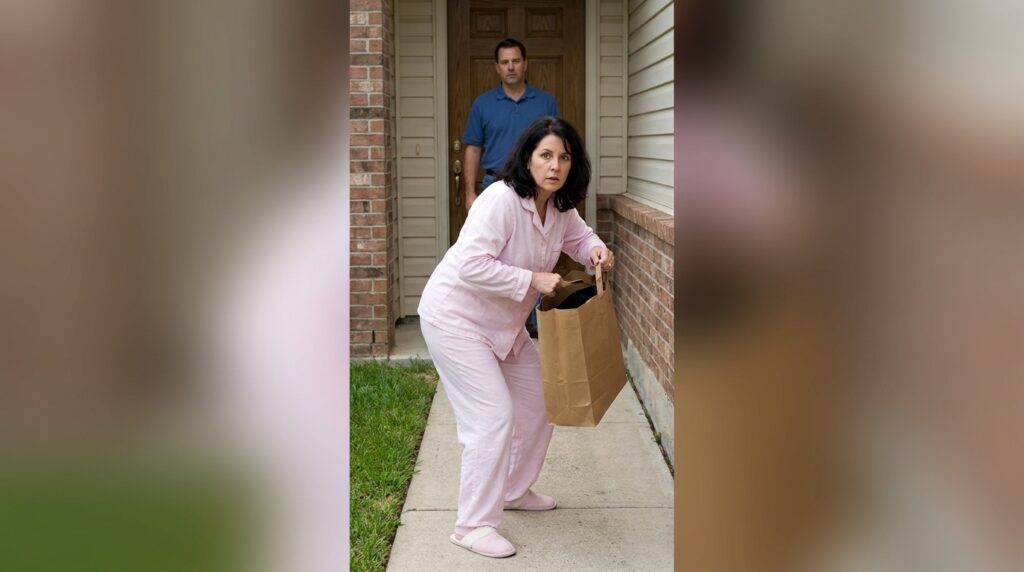
On the screen, in razor-sharp, sixty-frames-per-second detail, Brenda appeared at the foot of the walkway. The time stamp pulsed in bright white pixels in the bottom corner. The footage showed every detail: the pastel light pink pajamas, the gray silt clinging to her slippers, the white-knuckled heave as she ripped open the brown kraft paper sack, and the vicious downward snap that hurled the black sludge, decomposing root balls, and aluminum defoliant canister directly onto Mark’s stones.
The audio on the recording was terrifyingly clear—the sharp riiiip of the paper, the wet slap of the waste against the flagstones, the sudden click of Mark’s deadbolt, and Brenda’s eyes flashing wide with terror as she bolted into the grey fog.
Dave didn’t blink. His jaw set hard, the muscles around his temples tightening until the skin pulled pale.
The two joggers across the street had stopped completely. One of them, a woman with a phone in her hand, tilted her head toward the screen and let out a sharp, audible gasp. “Is that… Brenda in her pajamas?”
“That’s impossible,” Brenda stammered, her voice suddenly losing its brassy edge, cracking into a thin, brittle rasp. “That’s… that’s an altered feed. He works in software! He fabricated that to cover his dog’s damage—”
“The digital signature is SHA-256 hash-verified and uploaded directly to the cloud server at 06:15,” Mark said, his tone as flat and clinical as an autopsy report. “The local police dispatch has already received the raw copy along with the trespass report.”
Mark swiped the screen to the macro photo of the crushed aluminum canister resting in the center of the foul mound on the pavers.
“And here’s the chemical canister she dropped with the mulch,” Mark continued, his gaze shifting directly to Brenda. “Industrial-grade defoliant. Batch number TX-440-DEF-B9.”
He reached into his jacket, pulled out the damp manila folder, and extended it toward Dave.
“Along with the wholesale invoices she billed to the HOA’s common groundskeeping fund over the last four weeks to purchase twelve units of it.”
Dave took the folder. As he opened it and looked down at Brenda’s handwritten signature on the billing slips, the absolute silence that fell over Sycamore Lane was heavier than any shout. The neighbors watching from their driveways began murmuring, their expressions hardening from idle curiosity into open disgust.
Brenda backed away a half-step, her slippers scuffing against the dry asphalt. “You don’t understand what he was doing to the property line… I had to protect the easement—”
“Brenda, stop talking,” Dave said, his voice dropping into a register of cold, absolute finality that silenced the street instantly. He looked down at the folder, his thumb flipping through the invoices until his eyes caught a smaller, yellowed slip of paper tucked behind the last receipt.
Dave froze. He pulled the slip free, staring at a lab report stamped six months earlier—a private agricultural soil analysis for Parcel 412 that showed Brenda’s prized hydrangeas hadn’t died from dog urine, but from a systemic, untreatable fungal root-rot that had completely hollowed out the soil beneath her entire foundation.
Dave looked up from the paper, his eyes boring into Brenda with a look of stunned, unvarnished realization.