
CHAPTER 4: THE PAPER BURDEN
The drip from the rusted metal gutter above the utility easement fell with the cadence of a metronome. Tink. Tink. Tink.
Mark stayed low against the wet cedar pickets, the smell of damp rot rising through the knees of his denim work pants. He watched Brenda heave another load of blackened, foul-smelling loam into the heavy green wheelbarrow behind her garage. Her breathing was ragged, a rasping heave that rattled against the damp morning air. Every few seconds, she would freeze, head cocking toward the street, listening for the low rumble of a morning commuter or the metallic clink of a mailbox being flipped open.
She wasn’t just cleaning. She was excavating.
Mark waited until she turned her back, pushing the iron-framed wheelbarrow around the far corner of her sunroom, the rusted wheel axle squealing in a dry, ungreased groan.
He didn’t hesitate. Moving along the six-foot easement line where the property boundaries blurred into county-controlled drainage, Mark slipped behind the back corner of her freestanding garden shed. The ground here was spongy, choked with dead weeds that had turned into a greasy, gray paste.
Right beside the concrete slab of the transformer box sat three heavy commercial trash bins, their plastic lids weighted down by cracked masonry bricks.
Mark wedged his gloved fingers beneath the edge of the nearest lid, easing it up just enough to clear the lip. The smell that billowed out made his eyes water—a sharp, suffocating mixture of scorched grass, concentrated ammonia, and gasoline-grade solvent.
Resting on top of a heap of discarded black plastic nursery liners was a damp, grease-stained manila folder, curled at the edges from the morning condensation.
Mark pulled it out, letting the bin lid settle back down onto its rubber gasket without a sound.
He flipped the folder open. Inside were three carbon-copy invoices from Lone Star Wholesale Turf & Agricultural Supply, dated over the preceding four weeks.
The line items were stamped in fading purple ink:
Item 404-B: Tri-Chlor Defoliant (Industrial Concentrate) — 12 Units.
Item 112: Agricultural Acid Neutralizer Pellets — 5 Bags.
Item 880: Custom Midnight Bark Cypress Mulch — 20 Bags.
Mark ran his thumb over the customer signature line at the bottom of the top invoice.
It wasn’t billed to Brenda Vance personally. The billing account name was printed in cold, block lettering: Sycamore Lane HOA Common Area Maintenance & Groundskeeper Fund.
Beneath the invoice was a handwritten ledger detailing delivery drop-offs scheduled at dusk along the rear access swale—specifically listing the property pins bordering Mark’s southern line. Beside each date was a notation in Brenda’s unmistakable tight, slanted script: Soil neutralization required prior to regional estate inspection.
Mark’s jaw tightened. The pieces clicked into a brutal, tactical frame: Brenda hadn’t just acted on a solitary impulse of spite. She was using the subdivision’s own maintenance ledger to source chemical agents, stockpiling defoliant to create a documented trail of toxic runoff right along his fence line. The intent was clear—manufacture an environmental disaster that pinned the blame on a negligent neighbor and forced a formal property forfeiture or massive fines through the association’s legal retainers.
A sudden scrape of iron against gravel made Mark’s shoulders lock.
He slid the manila folder inside his canvas jacket and leaned his back against the weathered cedar siding.
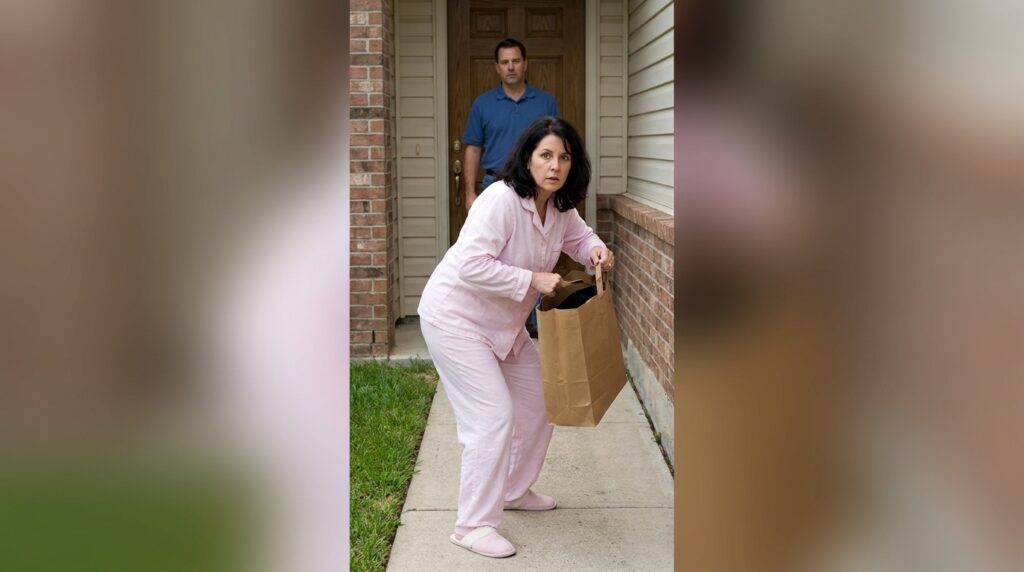
Brenda was coming back around the fence, dragging a heavy plastic garden hose behind her. Through the narrow space between the shed and the boundary fence, Mark could see the lower half of her pink pajamas, now soaked to the knees with greasy, chemical-laced runoff.
She turned on the brass spigot. Water hissed violently through the nozzle as she began blasting the remaining dark residue off her concrete patio, washing the caustic gray slurry directly down the slope toward the shared drainage swale—and straight toward Mark’s yard.
As the foam pooled around the survey pins, Brenda stopped, her slippers splashing in the puddle. She bent down and reached into her windbreaker pocket, pulling out a small yellow envelope.
She walked directly to Mark’s rear gate, slid the envelope through the latch gap so it wedged tightly against the lock, and whispered with venomous, trembling satisfaction:
“Let’s see the board ignore this one, you arrogant bastard.”
She turned and marched back toward her house, slamming the screen door so hard the glass pane rattled in its frame.
Mark stepped out from behind the shed, his boots sinking into the saturated turf. He walked to his gate, pulled the yellow envelope from the latch, and tore it open.
Inside was a single official document: an expedited hearing summons from the Sycamore Lane Executive Board, scheduled for 8:00 AM on the sidewalk in front of his house, demanding an immediate on-site inspection for “Willful Chemical Contamination and Hazardous Environmental Nuisance.”
Mark looked at his watch.
It was 7:12 AM. The street was about to wake up.