CHAPTER 3: THE RUSTED PERIMETER
The pdf attachment on the screen glowed with an austere, bureaucratic indifference: Notice of Non-Compliance: Hazardous Runoff Violation, Drainage Easement 4-B.
Mark did not touch the keyboard for a full sixty seconds.
Beside him, Buster’s heavy head rested on the edge of the kitchen island, his rheumy eyes watching Mark with the quiet, expectant gravity of an animal whose world had shrunk to a perimeter of eighty by one hundred and twenty feet. Mark reached down, his fingers sinking into the thick, coarse fur behind the dog’s ears, feeling the heat of the old retriever’s skull.
“They’re building a fence out of paper, buddy,” Mark muttered.
He stood up, walked to the heavy metal filing cabinet tucked beneath the stairs, and pulled a manila folder labeled Sycamore Lane / Correspondence.
When Mark had bought the lot two years ago, the land was quiet. The soil had felt solid under his boots—thick Texas black gumbo layered with river loam. But within six months, the paper began to arrive.
First came the yellow adhesive notes left under his wiper blades: CURB INTEGRITY MATTERS. KEEP LARGE ANIMALS OFF THE SOD.
Then came the printed notices from the Sycamore Lane Architectural and Safety Committee, always signed by the same flourish of blue ink: Brenda Vance, Alternate Compliance Officer.
Mark opened the folder, spreading the letters across the laminate counter. They formed a timeline of systematic, suffocating encroachment.
March 14: Unregistered canine exterior presence exceeding fifteen minutes.
April 02: Suspected turf acidification along southern frontage.
May 19: Request for mandatory soil core sample following neighbor dispute.
Every single claim had been accompanied by a photograph taken from across the cul-de-sac—grainy, zoomed-in shots of Buster simply standing on the cedar deck or sniffing the edge of the sprinkler heads. In every instance, Mark had complied with the bureaucratic dance. He had submitted Buster’s microchip telemetry, the orthopedic veterinary logs proving the dog’s rear legs could barely support a trot to the curb, and independent soil reports showing zero abnormal nitrogen levels.
The HOA board had dismissed every formal complaint. But Brenda hadn’t stopped; she had merely adapted.
Mark stepped through the back French doors onto the damp patio, carrying a pair of heavy work gloves and a digital soil tester in his jacket pocket.
The rear yard sloped gently down to the shared utility easement—a six-foot-wide drainage swale that separated his property from Brenda’s pristine, two-tier garden terrace. The morning mist had begun to burn off, replaced by the flat, blinding glare of an overcast Texas sky. The air down by the swale smelled foul, thick with the sulfurous rot of waterlogged silt and something sharper, chemical and dry, like battery acid leaking into mulch.
At the property line, Mark knelt on one knee.
Driven deep into the damp earth was a row of surveyor’s stakes. The cedar wood had turned grey and splintered from months in the rain, and the red plastic ribbon tied around their heads was bleached nearly white by the sun. Driven flush beside the stakes were iron rebar pins, their tops coated in a crust of flaking orange rust.
Mark reached out, his gloved thumb rubbing against the rusted metal cap of the central survey pin.
The iron was loose. Someone had pried it upward with a trenching spade, shifting the anchor point three inches into his property.
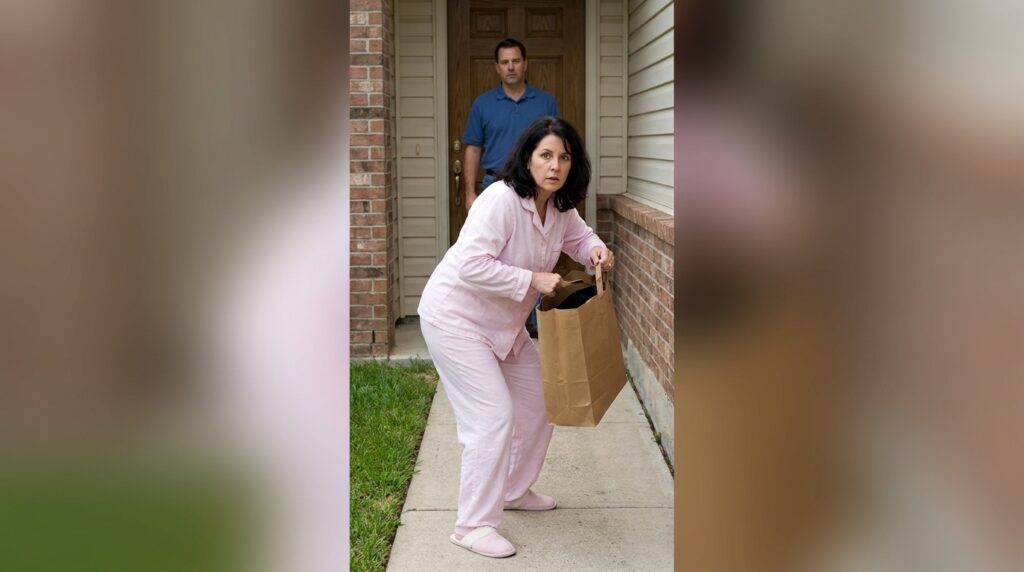
Beneath the rusted pin, the earth told a far more aggressive story. The grass along the swale was not merely yellowed from animal urine; it was dead. The St. Augustine turf had been reduced to a brittle, blackened crust that crumbled to dust under Mark’s boot heel. A faint, powdery residue—tinted the same neon blue as the fertilizer pellets found in the paper bag on his porch—clung to the dead roots.
Mark pulled the digital soil tester from his pocket, flipped the toggle switch, and drove the twin steel probes deep into the blackened dirt beside the survey marker.
The LED readout flickered, stabilized, and flashed a warning code: pH 3.1 — SEVERE CHEMICAL TOXICITY.
A sudden, sharp rustle broke the stillness on the other side of the cedar privacy fence.
Through the narrow gaps between the weathered pickets, a shape moved. Brenda stood at the edge of her terrace, still wearing the pink pajama set, her shoulders hunched inside an oversized gray windbreaker. She was not watering her hydrangeas.
She held a heavy metal rake in both hands, dragging the rusted tines violently through the mulch bed, pulling the dead, blackened soil from beneath her foundation and piling it directly into large plastic utility tubs lined along the fence.
Her breath came in short, jagged gasps, her slippered feet sliding in the mud as she shoveled the contaminated earth toward the property line.
Mark stayed low, his hand resting on the rusted iron pin. Through the fence, he saw the corner of a second aluminum canister sticking out from beneath her porch steps—its orange warning band freshly scratched and dripping with black runoff.