CHAPTER 2: RESIDUE AND COLD METAL
The brass key made a dull, metallic click against the canister’s dented seam.
Mark didn’t pick it up with bare skin. Years of handling server racks, frayed cabling, and corrosive battery leakage had wired a blunt, instinctive caution into his hands. He reached into his back pocket, pulled out a thick blue microfiber cloth, and wrapped it securely around his fingertips before pinching the crushed metal cylinder by its crimped base.
It was heavier than an empty aerosol can. The aluminum was pitted with small, chalky blooms of white oxidation, the metal eaten away in jagged crescents around the nozzle valve. The orange warning band had begun to flake, shedding tiny scales of brittle paint onto the wet flagstones.
Through the faint stench of rotting compost and stagnant storm-drain sludge, a sharper, chemical smell cut through the morning air. It smelled like scorched ozone and bitter almonds—the distinct, caustic sting of a non-selective chemical desiccant.
Mark straightened slowly, his lower back aching against the chill.
From the shadow of his hallway, the soft, uneven clicking of claws against hardwood broke the quiet. Buster emerged, his graying golden muzzle poking past the doorframe. The old dog’s left hip hitched with every second step, his tail giving a single, cautious wag before his black nose flared, catching the foul draft rising from the walkway. Buster let out a low, muffled huff and immediately backed into the foyer, sitting down with the heavy, obedient patience of an animal that knew his boundaries down to the millimeter.
“Stay, boy,” Mark murmured, his voice flat, steady, level.
He pulled his smartphone from his pocket with his free hand. The screen glowed against the dim grey dawn. The smart-home dashboard had already cataloged four distinct camera events, each time-stamped with cold, unquestionable precision:
06:14:22 AM — Driveway Floodlight: Motion Detected (North Boundary)
06:14:48 AM — Porch 4K Overhead: Boundary Crossing Confirmed
06:15:03 AM — Doorbell Optical: Subject Engaged Threshold
06:15:19 AM — Driveway Floodlight: Rapid Motion Exit (Southbound)
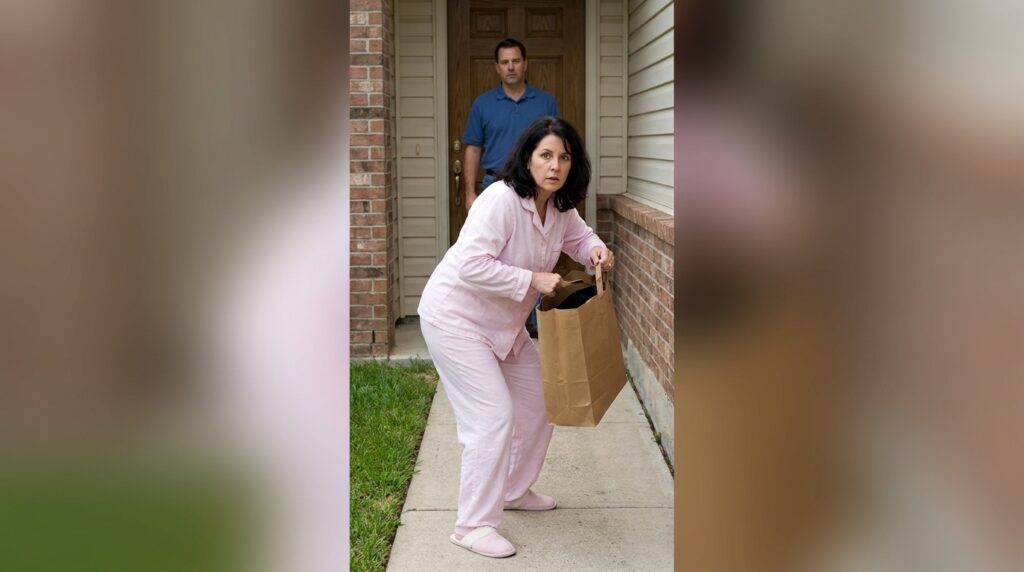
Mark tapped the high-resolution capture. On the five-inch glass screen, Brenda’s face appeared in terrifyingly sharp detail. Every stitch of her washed-out pink pajamas, every loose strand of unbrushed morning hair whipping across her forehead, and the distinct, manic set of her jaw as she hoisted the paper sack were rendered in crisp, pixel-perfect clarity. When the digital footage reached the 06:15 mark, the playback captured the exact micro-second her eyes snapped upward, catching the cold reflection of the camera lens before she bolted across the grass.
Mark didn’t smile. He didn’t feel the sudden rush of vindication that a younger, more reckless man might have chased. In a deed-restricted suburban enclave like Sycamore Lane, victory was never clean. It was a slow, exhausting war of attrition fought through municipal ordinances, certified mail receipts, and property line surveys.
He bent down again, holding the phone close to the crushed aluminum vial to record a macro video of the stamped lot number on its collar: TX-440-DEF-B9.
As the camera focused, Mark noticed something else ground into the damp mulch surrounding the metal cylinder.
Scattered among the dark cypress shreds were tiny, half-dissolved pellets of bright blue agricultural urea and three distinct plastic testing strips, their absorbent pads stained an unnatural, neon magenta. They were commercial pH and soil-toxicity indicators—the kind used by environmental testing services or industrial landscape crews to measure severe ground contamination.
Why would a woman trying to frame a leashed, arthritic dog for lawn damage carry laboratory soil-test strips in a bag of collected manure?
Across the street, the heavy iron latch of a gate clicked shut.
Mark looked up. Through the thinning grey mist, seventy yards down the curve of the cul-de-sac, the kitchen blinds inside Brenda’s pristine two-story colonial snapped shut. A second later, the exterior garage lights flickered on, casting a harsh, pale yellow glare across her driveway.
She wasn’t going back to sleep. She was already fortifying.
Mark methodically stepped back inside his foyer, unspooling a roll of yellow painter’s tape from his utility drawer. He laid a clean border across the threshold, sealing off the walkway to preserve the footprint treads Brenda’s rubber slippers had pressed into the damp silt.
He placed the aluminum cylinder inside an airtight plastic storage container on the entryway bench, stripped off his gloves, and opened his laptop on the kitchen island.
The HOA’s emergency compliance portal loaded with a sterile blue banner: Sycamore Lane Architectural & Safety Review Board — File Incident Report.
Mark attached the four raw video files, the macro shots of the stamped chemical canister, and the veterinary log detailing Buster’s mobility tracking from the past thirty days. His fingers moved across the mechanical keyboard with measured, rhythmic strokes, drafting a factual, dispassionate account stripped of anger or conjecture.
Just as his thumb hovered over the submit button, an email notification pinged in the upper right corner of his monitor.
It was an automated alert from the county’s public land records database—a tracking alert Mark had set two years ago when he purchased the property to monitor neighborhood zoning easements.
The subject line read: NOTICE OF PENDING ENVIRONMENTAL ASSESSMENT & LIEN INQUIRY: PARCEL 412-SYCAMORE.
Parcel 412 was not Mark’s lot. It was Brenda’s.
Mark clicked the attachment. The filing had been submitted forty-eight hours prior by the county agricultural extension office, citing a severe, unreported chemical groundwater anomaly detected along the shared easement line behind their adjoining properties.