
Chapter 7: What the Camera Taught Them
Mark immediately called the police.
The photograph was examined.
It did not prove who had taken it.
But the message was enough to remind everyone that the case was not entirely over.
For several days, Mark watched his security feeds more carefully.
Karen did too.
She even installed her own camera.
This time, she asked her neighbor for advice before doing it.
Mark helped her position it toward her own driveway.
They never discussed the photograph again.
Until one evening, Karen knocked on Mark’s door.
She was holding a small cardboard box.
Inside was his original camera.
She had kept it after the police returned it.
“I thought you might want this.”
Mark took it.
The camera was scratched, but it still worked.
He smiled faintly.
“You kept my camera?”
Karen nodded.
“I thought about throwing it away.”
“Why didn’t you?”
She looked at the device.
“Because it taught me something.”
Mark waited.
Karen looked toward the street.
“I was so convinced someone was watching me that I stopped thinking about what I was doing to everyone else.”
She admitted that she had spent years believing that being loud meant being right.
That if she acted first, argued harder, and refused to back down, people would eventually give her what she wanted.
But the camera had forced her to see herself differently.
Not through her own eyes.
Through evidence.
Mark understood.
People often remembered what they believed had happened.
A recording remembered what actually happened.
That difference could be uncomfortable.
Sometimes it could be humiliating.
But sometimes it could also be a second chance.
Months later, the neighborhood became quieter.
Packages stopped disappearing.
The service company changed its staff.
Residents became more careful about access to their homes.
The cameras remained.
But the cameras were no longer the most important lesson.
The important lesson was that neighbors had started talking to one another again.
Mark and Karen never became close friends.
They did, however, become something more practical.
They became neighbors who respected each other’s boundaries.
One evening, Mark stood on his porch checking the camera feed.
Karen was across the street watering her flowers.
She noticed him.
He lifted a hand.
She lifted hers.
No argument.
No accusation.
No shouting.
Just a small gesture between two people who had learned something the hard way.
A camera could record a person crossing a line.
It could preserve evidence.
It could expose a lie.
But it could not decide what someone did after being caught.
That part belonged to the person.
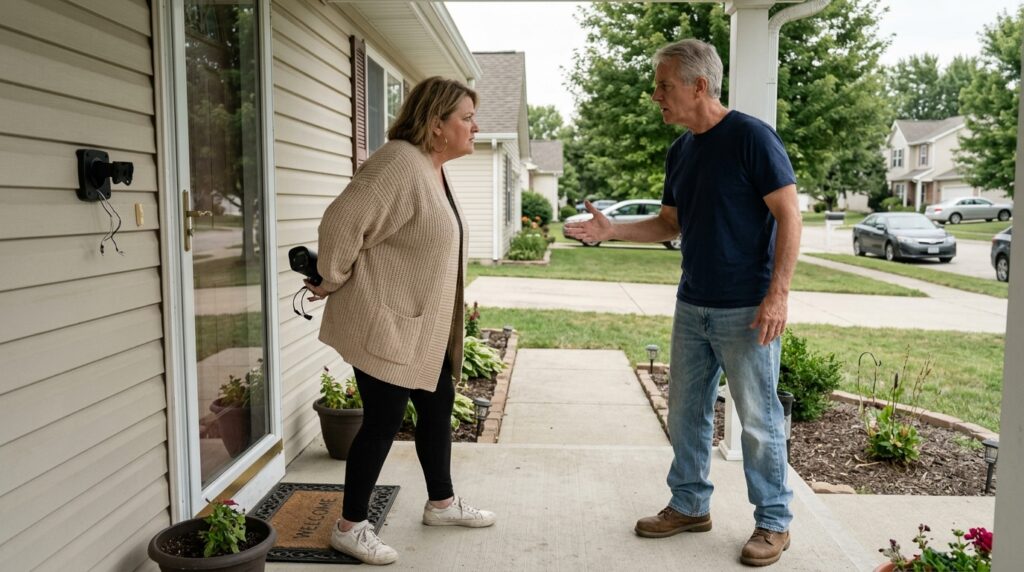
Karen had once ripped Mark’s camera from his wall because she believed destroying the evidence would protect her.
Instead, the camera became the very thing that forced the truth into the open.
And in the end, the greatest lesson was not about surveillance.
It was about accountability.
Because when the truth finally catches up with us, we can spend our time blaming the camera for showing it—
or we can finally look at what it captured and choose to do better.