Chapter 6: The Folder on the Table
The folder belonged to Mrs. Ellis, a seventy-four-year-old resident who lived three houses away.
She placed it on the clubhouse table.
Inside were photographs.
Dates.
Delivery records.
Maintenance invoices.
Security stills.
She had been keeping everything.
For months, she had suspected something was wrong but had never been able to connect the incidents.
Now the pieces fit.
The missing packages.
The service van.
The unauthorized entries.
The strange activity around garages.
The cameras being covered.
The police reviewed the documents.
The evidence did not prove every incident had been committed by the same person, but it gave investigators a much clearer pattern to follow.
Paul was questioned.
Darren was questioned.
The property-service company was investigated.
Several residents came forward with information.
And Karen?
Karen stood quietly at the back of the room.
She did not defend herself.
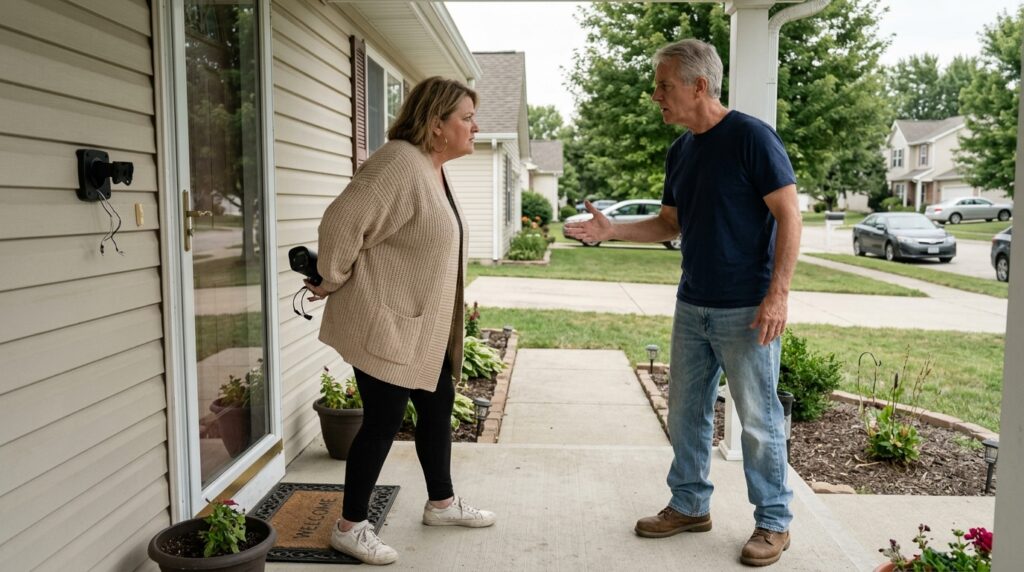
When the neighborhood president asked her to explain why she had removed Mark’s camera, she simply told the truth.
“I thought I was protecting myself.”
She paused.
“But I was wrong.”
Then she looked at Mark.
“I violated your property and your trust.”
The room became quiet.
Mark had expected an argument.
Instead, he heard an apology.
He accepted it, but acceptance did not mean forgetting.
He told her that people in a neighborhood had to be able to trust one another.
Security cameras could protect homes.
But they could also create suspicion.
And suspicion could turn neighbors into enemies.
The police eventually confirmed that Paul had been connected to multiple unauthorized property entries and theft reports.
Darren’s involvement was still being investigated.
The evidence from Mark’s camera became an important part of the case.
The same camera Karen had tried to remove.
The same camera she had believed was her enemy.
The same camera that had ultimately preserved the evidence she needed.
Weeks later, Mark replaced the damaged mount.
He installed a stronger bracket.
He also adjusted the camera slightly so it covered his property more precisely.
Karen did something unexpected.
She paid for the replacement mount.
Not because Mark demanded it.
Because she wanted to make things right.
The two neighbors were not suddenly friends.
Trust did not return overnight.
But something had changed.
They had learned that privacy mattered.
Property mattered.
And so did the responsibility that came with living beside other people.
Then, one Saturday morning, Mark found an envelope underneath his door.
There was no return address.
Inside was a single photograph.
It showed the side of his house.
The photograph had been taken from across the street.
On the back, someone had written four words:
“You still don’t see everything.”