
CHAPTER 5: The Convergence at the Curb
The morning sun broke over the pine ridges of Laurel Park Estates at 7:12 AM, casting long, razor-sharp shadows across the damp asphalt. The air smelled of cold river gravel, diesel exhaust, and raw earth.
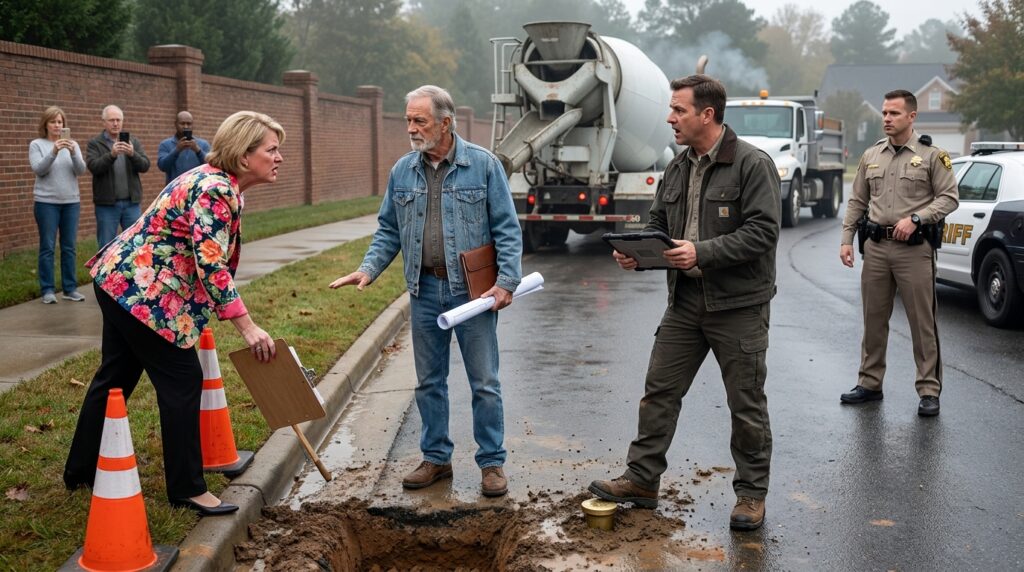
Arthur Bradley didn’t take off his faded denim jacket. His hands remained steady inside his pockets as he stood at the edge of the excavated ditch. Beside him, Miguel Reyes kept the concrete mixer idling, the low, mechanical thrum vibrating straight through the soles of Arthur’s work boots.
A tan county sheriff’s cruiser pulled to a stop behind the cement mixer, its overhead lightbar flashing silent, rhythmic pulses of red and blue against the front windows of forty-eight Laurel Park Court. Deputy David Mercer stepped out, his hand resting casually on his utility belt, his eyes taking in the scene with practiced, neutral efficiency. Seconds later, a white municipal truck pulled alongside him. Inspector Douglas Albright stepped from the cab, carrying a heavy digital survey tablet wrapped in a ruggedized rubber casing.
Across the street, front doors were swinging open. Eleanor Potts stood on her lawn in a heavy winter coat, holding her phone up to record. Carl Dixon leaned against his mailbox, arms crossed, his face pale in the autumn glare. Half a dozen neighbors lined the sidewalk, a quiet, vigilant witness layer.
Evelyn Delancey marched down her driveway, her floral blazer a sharp splash of magenta against the frost. She clutched her wooden clipboard against her chest like a shield.
“Deputy, thank goodness,” Evelyn began, her voice carrying across the quiet street, clipped and authoritative. “As I reported, this homeowner is executing an illegal, unpermitted excavation across community land. He has ignored multiple association cease-and-desist orders, and his contractor is currently obstructing a public thoroughfare with commercial machinery.”
Deputy Mercer looked at Arthur, then at the idling transit mixer. “Mr. Bradley?”
Arthur didn’t raise his voice. He unzipped his leather portfolio and pulled out three crisp, laminated sheets. He held them out toward Deputy Mercer and Inspector Albright.
“The work is fully permitted under Municipal Civil Permit 884-A,” Arthur said, his tone flat, procedural, unyielding. “The construction lies 100 percent within my deeded private property boundary. Here is the county engineer’s signature, the ADA access compliance certificate, and the certified boundary survey filed with the county recorder.”
Evelyn scoffed, taking two steps forward onto the lawn. “That survey is obsolete! The association’s master deed defines the green space along this entire cul-de-sac as common architectural ground. You cannot simply dig up a public drainage swell because you decided to pour private concrete.”
“The green space isn’t common ground, Evelyn,” Arthur said calmly. He pointed down at the edge of the ditch near her feet. “Look down.”
Inspector Albright stepped forward before Evelyn could reply. He knelt at the ditch line, his heavy boots sinking slightly into the cold mud. He pulled a small brush from his belt and cleared the damp topsoil away from the corner of the excavation.
The morning sun caught the face of the brass cap. The stamped numbers gleamed in the cold light: MUNI-DRAIN-EAS-1994.
Inspector Albright pulled a digital laser measuring wheel from his pouch and set it against the center of the brass monument. He flipped on his tablet, tapping the screen to bring up the live county GIS satellite layer. The high-resolution map loaded in sharp, color-coded lines, overlaying current satellite imagery onto the official municipal grid.
For twenty seconds, the only sound on the street was the steady drum of the concrete truck.
Albright’s thumb paused on the glass. He zoomed in on forty-eight Laurel Park Court, tracing the yellow boundary vector down to the curb line. Then he looked up at the physical brass pin beneath his boots.
“The survey is valid,” Albright declared, his gruff voice carrying clearly across the cul-de-sac. “The pin marks the true property boundary. Mr. Bradley’s secondary access lane and culvert are situated entirely within his private property line. His city permits are fully verified and compliant.”
Evelyn’s face flushed a deep, mottled red. “That is impossible! I have the architectural guidelines right here—”
“Your guidelines don’t override county deed lines, Mrs. Delancey,” Deputy Mercer interrupted smoothly, turning his head to look at her. “He has the legal right to pave his property.”
A quiet murmur rippled through the gathering of neighbors on the sidewalk. Eleanor Potts lowered her phone slightly, her eyes wide.
Evelyn’s fingers dug into the edge of her wooden clipboard until her knuckles turned white. “This is an outrage! He is destroying the visual uniformity of this neighborhood! I am filing an immediate injunction!”
“You might want to hold off on filing anything, Mrs. Delancey,” Inspector Albright said. His voice was oddly quiet, cold, and heavy.
Arthur watched the inspector. Albright hadn’t turned off his tablet. He was staring at the satellite screen, his brow furrowed as his fingers dragged the GIS map across the street—directly onto Evelyn’s property at forty-two Laurel Park Court.
“Inspector?” Deputy Mercer asked, noticing the shift in Albright’s posture.
Albright stood up, holding the tablet out so both Mercer and Evelyn could see the bright red vector lines flashing over the high-resolution aerial photo.
“When I ran the GIS parcel overlay for Mr. Bradley’s permit,” Albright said, his eyes locking onto Evelyn, “the system flagged the entire cul-de-sac’s drainage catchment. Mrs. Delancey, your brick retaining wall, decorative stone pillars, and extended lawn sit fourteen feet past your deeded property line.”
Evelyn froze. Her posture stiffened as if she had been hit by a physical impact. “What?”
“You built your retaining wall directly over the city’s primary storm drainage easement,” Albright continued, his voice echoing in the dead silence of the morning. “It’s an illegal structural obstruction. It encroaches fourteen feet onto municipal land and restricts the flood-control capacity of the entire street.”
Carl Dixon took a slow step back from the curb, his mouth slightly open. On the sidewalk, Eleanor Potts brought her phone back up, capturing every word.
Arthur stepped closer to the inspector’s tablet. His sharp eyes caught a detail printed in small yellow text inside the GIS system’s administrative audit log on the margin of the screen: EASEMENT MAINTENANCE BILLING – VENDOR CODE: M-LND-004 (MANNING LANDSCAPING LLC).
Arthur’s mind calculated the tactical geometry in less than a second.
The vendor code from his yellow violation notice. The vendor code on the environmental complaint. The same shell company Evelyn had been paying with HOA assessment funds for “common area maintenance” was the entity she used to maintain the city’s easement—the very land her personal brick wall was illegally occupying.
She hadn’t just built an illegal wall. She was using the neighborhood association’s money to pay her brother-in-law’s fake company to maintain the municipal ground she had stolen, covering her tracks under the guise of “suburban beautification.”
Evelyn looked around the street. Her eyes darted from Deputy Mercer’s neutral glare to Albright’s tablet, then to the crowd of neighbors who were no longer looking at her with fear, but with sharp, collective disgust.
“This… this is an administrative error,” Evelyn stammered, her voice cracking, losing its rehearsed authority for the first time. “My contractor assured me—”
“Your contractor built a wall on city land, Mrs. Delancey,” Deputy Mercer said, stepping forward. “And right now, your private traffic cones are illegally blocking a public road. I suggest you move them, move your Lexus, and let Mr. Bradley’s crew finish their work.”
Evelyn stood paralyzed on the pavement.
Arthur looked at her, his expression cold, steady, and unyielding. He didn’t gloat. He didn’t smile. He simply raised his hand toward Miguel Reyes.
“Pour the concrete, Miguel,” Arthur said.
The chute swung into place over the excavated ditch, and the wet, heavy gray stone began to flow smoothly into the forms, laying down a foundation that no clipboard could ever break.