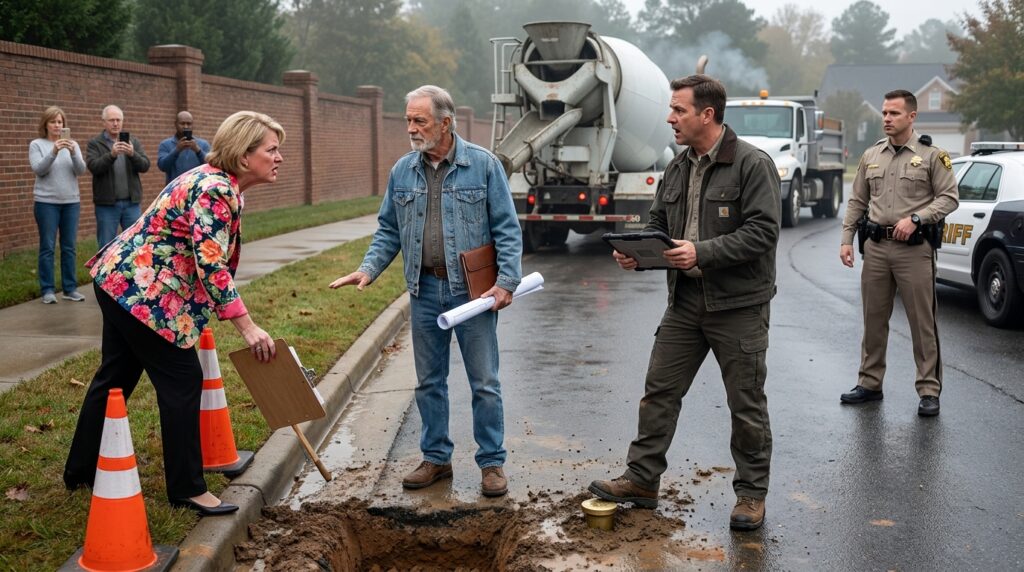
CHAPTER 3: The Cold Geometry of the Floor
“The association is not subject to municipal dictates when evaluating aesthetic harmony, Mr. Bradley.”
Evelyn’s voice didn’t echo; it died against the acoustic drop-ceiling of the library basement. The room smelled of damp paper, stale grounds, and cold floor wax. Six fluorescent tubes hummed overhead, casting a clinical, shadowless glare across the scuffed linoleum.
Arthur didn’t sit. He stood beside Clara’s motorized wheelchair, his hand resting lightly on the cold steel of her push-handle. Across the long oak conference table, Evelyn sat flanked by Carl Dixon. Between them lay a single Manila folder, neatly aligned with the edge of the polished wood.
“The permit isn’t a dictate, Evelyn,” Arthur said, his tone flat, measured, unyielding. “It’s a structural authorization issued by the county engineer. The culvert is designed to handle a ten-year storm event without washing out the curb.”
“And it creates a visual fracture,” Carl chimed in, leaning forward. His knuckles were pale against the table. He wore a golf polo with a faded crest, his posture rigid. “We have eighty-four homes in Laurel Park, Arthur. If we let you slice open the front drainage swell for a private concrete apron, every owner on the court will demand an exception for their trailers and utility vans.”
Clara touched the joystick on her armrest, pivoting her chair three inches to the left. The quiet, high-pitched whine of the motor cut through Carl’s sentence.
“It’s not for a utility van, Mr. Dixon,” Clara said. Her voice was steady, void of pleading, cold as ice. “It’s so I don’t flip my chair on the wet grass when the temperature drops below freezing.”
Evelyn didn’t look at Clara. Her gaze remained fixed on Arthur, sharp and transactional. She tapped the end of a silver ballpoint pen against her clipboard. Click. Click. Click.
“Personal circumstances, while unfortunate, do not invalidate community covenants,” Evelyn said smoothly, as if reciting a line she had rehearsed in front of a mirror. “The board voted this afternoon. The two-hundred-and-fifty-dollar fine stands. You have fourteen days to restore the front lawn slope to its original elevation and backfill the excavation ditch, or we will contract the work ourselves and attach a lien to your title.”
Arthur reached into his jacket pocket. He didn’t pull out a speech. He pulled out a folded piece of heavy stock paper—a certified land record he had pulled from the county recorder’s office three hours before the library doors locked. He slid it across the oak table. It stopped precisely two inches from Evelyn’s pen.
“That’s the parcel map from the 1994 county plat filing,” Arthur said, his eyes tracking her face. “Read line four.”
Evelyn didn’t touch the paper. Carl hesitated, then leaned over her shoulder to glance at the black-and-white grid.
“The front curb zone,” Arthur continued, “is classified as a class-two public right-of-way. The association’s jurisdiction terminates three feet back from the asphalt edge. My secondary access lane doesn’t cross your common area. It connects directly to the municipal street.”
Evelyn’s pen stopped clicking. Her lips thinned into a pale, rigid line. For a fraction of a second, her eyes flicked not to the map, but to a small, laminated card tucked inside her own binder—a duplicate property tax assessment receipt. Down near the bottom margin, printed in microscopic dot-matrix ink, was an unregistered parcel code: PRCL-94-B-EAS.
It wasn’t a standard residential tax ID. It was a municipal easement designation code.
Arthur caught the shift. His engineering brain instantly calculated the discrepancy. Why would Evelyn keep a municipal tax receipt for an easement tucked inside the private HOA architectural ledger? Unless she wasn’t just managing community guidelines—she was tracking a specific piece of public ground.
“This meeting is adjourned,” Evelyn said abruptly, slapping her binder shut with a sharp crack that sounded like a gunshot in the small room. She stood up, her chair scraping violently against the linoleum. “The citation stands, Mr. Bradley. If your contractor steps foot on that ditch again, the sheriff won’t just write a report. He’ll clear the site.”
She grabbed her folder and marched toward the exit, Carl scrambling behind her like an obedient shadow.
The heavy fire door slammed shut, the hydraulic arm hissing as it sealed the room.
Clara turned her chair toward her father. The fluorescent light reflected in her dark eyes, highlighting the sharp line of her jaw.
“She’s not afraid of the concrete, Dad,” Clara said softly, her fingers tightening on her armrest. “She’s afraid of what happens when you start digging.”
Arthur picked up his folded parcel map. His thumb brushed over the sharp ink lines of the boundary grid. He felt the cold, hard certainty that came from knowing a structure was built on compromised soil.
“She thinks she’s holding a legal line,” Arthur said, his voice dropping into a low, quiet rumble. “She doesn’t realize I’ve already mapped the foundation.”
He wheeled Clara out into the dim hallway, the sound of her electric motor humming steadily against the silent walls, while in his mind, the unregistered parcel code burned like a newly lit flare in the dark.