
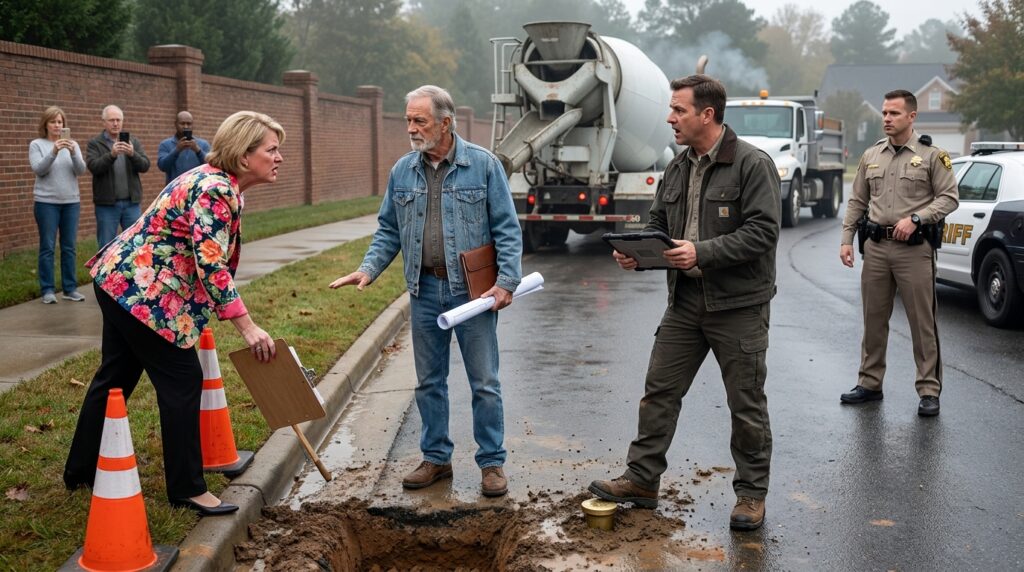
CHAPTER 4: The Geometry of the Dark
The steel blade of the spade met stone with a dull, ringing shock that vibrated straight through Arthur’s forearms.
It was 11:42 PM. The October air had turned brittle, dropping near freezing, freezing the dew on the grass into micro-crystals that caught the amber wash of the streetlights. Arthur crouched at the edge of the ditch line, his faded denim jacket dark with damp soil, his breath rising in tight, white plumes.
He didn’t use a flashlight. The glow from the streetlight forty yards down the cul-de-sac was enough to illuminate the edge of his tape measure.
Beside him, tucked into the shadow of his parked pickup, Miguel Reyes knelt with a brass probe rod. Miguel’s face was drawn, his collar turned up against the wind. He was working off a private contract now, off the clock, bound not by the hourly rate but by the cold, quiet respect he held for Arthur’s precision.
“Fourteen inches down,” Miguel muttered, his fingers slick with mud as he drove the steel rod into the earth. Clack. The probe hit solid resistance again. “That ain’t bedrock, Arthur. That’s poured concrete footing.”
Arthur lowered his spade and cleared the wet clay with his gloved fingers. Cold mud caked beneath his fingernails, biting through the fabric of his gloves. Beneath six inches of topsoil, nestled directly under the roots of Evelyn’s decorative hedge line, lay a heavy rectangular footing of poured cement.
It wasn’t a standard footing. It extended out from beneath Evelyn’s decorative brick wall, extending forward like a buried wedge toward the center of the drainage ditch.
Arthur reached into the hole, his fingers tracing the cold, rough concrete until they brushed against a cold metal cylinder embedded in the corner. A brass pin. Four inches long, stamped into the concrete with a surveyor’s mark.
He wiped the dirt from the cap with his thumb. The brass gleamed faintly under the streetlamp’s wash. Stamped across its face were the letters: MUNI-DRAIN-EAS-1994.
The physical reality clicked into place with the cold finality of a deadbolt.
“She didn’t just build her wall close to the line,” Arthur whispered, his eyes narrowing as he measured the distance from the brass pin to the face of Evelyn’s brick wall. “She built the entire footings inside the municipal culvert.”
Fourteen feet.
Evelyn’s expansive brick wall, her decorative stone pillars, her manicured upper lawn—they weren’t on association ground. They weren’t even on her own deeded parcel. She had extended her private landscaping fourteen feet out into the city’s primary storm drainage easement, burying the municipal infrastructure beneath tons of stone and soil to create the illusion of a grander estate.
And if Arthur poured his secondary access lane, the city inspector would be forced to verify the street’s drainage elevation before signing off on the culvert. The moment the city wheel touched the ditch, the entire municipal mapping system would flag her encroachment. She hadn’t blockaded his concrete truck to preserve neighborhood aesthetics; she had blockaded it because a single official survey would force the city to order the immediate demolition of her fourteen-foot brick wall.
“Arthur,” Miguel said softly, his voice dropping an octave.
Arthur stood up, wiping his muddy hands on his jeans. He followed Miguel’s gaze across the street.
The front door of forty-two Laurel Park Court was open.
Evelyn Delancey stood on her porch, framed by the bright yellow glow of her foyer light. She wasn’t wearing her floral blazer. She wore a dark trench coat, her arms crossed tight against her chest, her face pale and sharp in the night air.
In her hand, the screen of her smartphone glowed bright blue. She didn’t shout. She didn’t yell. She raised the phone to her ear, keeping her eyes locked on Arthur across the dark cul-de-sac.
A second later, the sharp chirp of a city vehicle’s radio echoed from the main road.
Down the block, a white municipal truck with a yellow strobe light turned into the cul-de-sac, its tires crunching heavily over the gravel. Printed across the driver’s door in dark blue block letters was: CITY OF LAUREL PARK – CODE ENFORCEMENT & ENVIRONMENTAL COMPLAINT UNIT.
Arthur didn’t run. He didn’t drop his shovel. He stood beside the exposed brass pin, his boots heavy in the wet soil, watching the strobe light paint the quiet suburban houses in rhythmic flashes of amber.
Evelyn stepped off her porch and walked down her driveway, her heels clicking rhythmically on the dry asphalt like a clock counting down.
“I warned you, Arthur,” she said, her voice cutting through the cold night air, crisp, triumphant, and completely devoid of warmth. “Environmental Services handles illegal site tampering after hours. You’re digging up city infrastructure without a trench permit. That shovel just turned your fine into a misdemeanor.”
The municipal truck pulled up to the curb, its driver’s door swinging open. A tall man in a dark canvas uniform stepped out, holding a heavy digital clipboard.
Arthur looked down at the exposed brass pin at his feet, then looked up at Evelyn. The decoy was broken. He knew about the wall. He knew about the easement.
Yet as he looked at the code inspector’s tablet, his eyes caught the heading at the top of the official digital complaint form pre-filed on the screen: CONTRACTOR VIOLATION – TRANS-M-LND-004.
The exact same vendor code from the yellow violation notice.
Arthur’s chest tightened. Evelyn hadn’t just filed an environmental complaint against his digging; she had routed it through a private commercial vendor account linked directly to the city’s emergency enforcement system.
The wall was an illegal structure, but the mechanism she was using to enforce her power went deeper than simple property line fraud.
“Inspector,” Arthur said, stepping between the city worker and the open hole, his denim jacket stiff with cold mud. “Before you write the citation, look at the brass cap at the bottom of that spade.”
The inspector paused, his finger hovering over his tablet screen.
Evelyn’s smile faltered for a fraction of a second, her fingers tightening on the lapels of her trench coat as the amber strobe light swept across her face.