CHAPTER 2: The Friction of the Grade
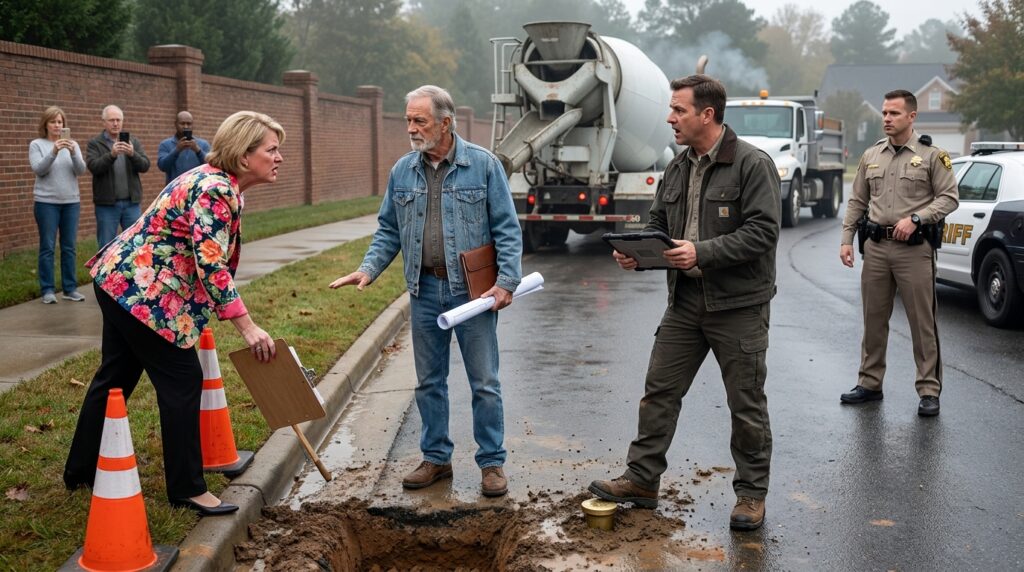
The transit mixer’s drum kept turning, a relentless, rhythmic grind of crushed river rock and wet Portland cement sliding against ribbed steel. The heavy diesel exhaust hung low in the October air, smelling of burnt oil and cold iron.
Evelyn Delancey stood her ground on the curb line, one hand pressing her gold-framed smartphone to her ear, the other white-knuckling her wooden clipboard. She was shouting over the roar of the engine, demanding badge numbers, demanding immediate dispatch, her voice a sharp, synthetic frequency that clashed against the industrial bass of the idling truck.
Arthur Bradley didn’t move to stop her. He stood at the edge of the excavated ditch, feeling the abrasive grit of displaced soil beneath his boots. Miguel Reyes caught Arthur’s eye, his hands resting on the hydraulic levers of the concrete chute. The contractor’s face was a mask of stoic pragmatism, but his grip on the steel was tight. Every minute this truck idled, the concrete cured a fraction more. The friction inside the drum was building.
“Let it spin, Miguel,” Arthur said, his voice quiet but carrying the heavy, calibrated density of a man who spent his life measuring stress loads. “The mix is good for another forty minutes.”
Arthur adjusted the worn leather portfolio under his arm. The leather was scarred, faded at the edges from decades of sliding across drafting tables and municipal planning hoods. He looked down at the brass survey pin exposed in the mud near Evelyn’s pristine designer shoes. The bright orange surveyor’s ribbon fluttered violently in the truck’s exhaust wash.
The harsh, grinding sound of the mixer seemed to echo backward in Arthur’s mind, morphing into a different kind of friction. It sounded exactly like the rusted gears of the rented hospital bed they had crammed into the living room of his old house.
He closed his eyes for a fraction of a second. Helen.
In her final months, the old two-story colonial had become a prison of architectural failures. The steep, narrow oak staircase. The uneven transition lips between the hallway tile and the bedroom carpet. Arthur remembered the sheer physical weight of trying to lift her wheelchair over those rusted brass thresholds, the scrape of rubber on wood, the quiet, dignified apologies she offered every time she needed help just to cross a room. He had been a senior municipal civil engineer, a man who designed multi-million-dollar aqueducts and load-bearing highway overpasses, yet he had failed to re-engineer his own home in time to save his wife from the humiliation of immobility. The cancer had moved faster than his permit applications.
He swallowed the dry dust in his throat. He had promised the soil of her grave that he would never be caught uncalibrated again. Laurel Park Estates was supposed to be the correction. A single-story ranch. Open sightlines. And this driveway—a flawlessly calculated, four-percent-grade access lane directly to the side door. It was a fortress of accessibility for their daughter, Clara. It was an apology written in reinforced concrete.
The soft, high-pitched whine of an electric motor broke through his memory.
Arthur turned. On the front porch, twenty yards away, Clara navigated her motorized wheelchair to the edge of the top step. She wore a thick wool sweater, her dark hair pulled back, her sharp eyes scanning the blockade. She didn’t look frightened. She looked tired, possessing a quiet resilience forged by a lifetime of navigating a world built with sharp, unforgiving edges.
She caught Arthur’s gaze and offered a small, questioning tilt of her head. Is she stopping us?
Arthur offered a single, flat shake of his head. No.
He unzipped the heavy brass teeth of his leather portfolio. Inside lay the pristine, stamped municipal permits, the structural engineering calculations, and the county surveyor’s map. But resting on top of the stack was the first piece of paper Evelyn had ever delivered to him—the bright yellow HOA violation notice.
Arthur pulled it out. The paper felt heavy, abrasive, like fine-grit sandpaper. Unauthorized alteration of front lawn elevation. The ink was stark and aggressive. Evelyn claimed the architectural review committee had issued it. But as Arthur stood in the diesel smoke, waiting for the sirens, his thumb brushed against the back of the yellow sheet.
He flipped the notice over.
Down in the bottom right corner, barely visible and partially smeared as if the paper had been pressed against a damp desk, was a faint blue ink stamp. It wasn’t an HOA seal. It was a commercial routing code. M-LND-004. RECV.
Arthur’s brow furrowed. The scent of wet soil and exhaust filled his lungs. Why would an internal neighborhood aesthetic warning bear the receiving stamp of an external commercial landscaping vendor? It was a structural anomaly. A crack in the foundation of Evelyn’s authority. He rubbed his thumb over the smeared blue ink, feeling the rough texture of the paper. It was a detail that didn’t belong, a stray piece of rebar sticking out of a poured wall.
“They’re three minutes out, Mr. Bradley!” Evelyn shouted, finally pulling the phone away from her face. She pointed a trembling acrylic nail at the transit truck. “You are going to be handcuffed in front of your daughter for this.”
Arthur didn’t reply. He looked past her, across the asphalt of the cul-de-sac, toward Evelyn’s own property. Her lawn was immaculate, rising sharply from the street, held back by a massive, professionally laid brick retaining wall. The stone pillars looked ancient, immovable, anchoring her manicured hill.
Faintly, slicing through the cold morning air, the rising wail of a county sheriff’s siren began to echo off the suburban facades.
Arthur watched Evelyn. She was standing tall, projecting total suburban dominance. But as the siren grew louder, a subtle, kinetic shift occurred in her posture. She wasn’t looking at the concrete truck anymore. Her head kept twitching, her eyes darting nervously over her shoulder, tracking back across the street. She wasn’t looking at Arthur’s property.
She was staring at her own heavy stone wall, her jaw clenched so tight the muscles leaped beneath her skin.
She wasn’t standing in the mud to stop Arthur’s concrete pour. She was standing here, blocking the curb, to ensure the county authorities never had a reason to measure the street.