
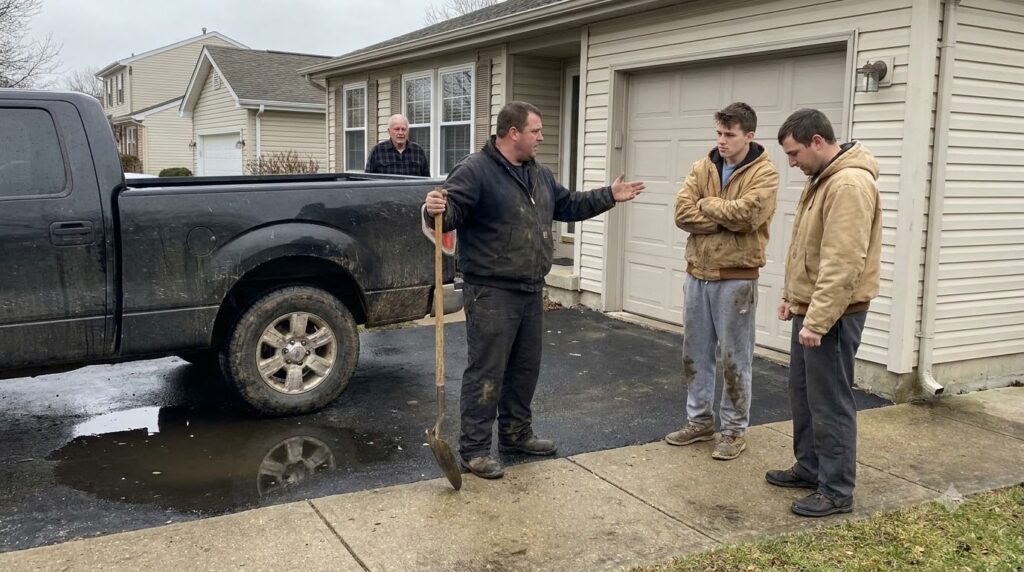
CHAPTER 3: THE GLASS AND THE GRAVEL
The single drop of condensation had barely finished sliding down the truck’s fender before the second man moved. He didn’t run—running in a narrow, gravel-choked driveway between a brick veneer wall and a rusted pickup bed was an invitation to turn an ankle—but his weight shifted with a sudden, deliberate purpose. His hand left his pocket, sliding out with the slow caution of a man drawing a blade from a tight scabbard, and came to rest flat against the side mirror of the truck.
“You think we dropped two inches of slab?” the second man asked, his voice dropping past anger into something cold and flat. “Look at the mortar joints on your own foundation, old man. They’ve been crumbling since the winter before last. You’re trying to pin a settlement crack on two guys who just wanted to get to the hardware store before the rain came down.”
The worker didn’t look at the foundation joints. He kept his eyes locked on the younger man, whose shoulders had begun to hike toward his ears, a defensive turtle posture born of sudden, sharp panic. But the worker’s silence wasn’t a retreat; it was a pivot. Without shifting his boots from the gritty concrete, he tilted the long-handled tool upward just enough for the iron head to clear the truck’s rear tire.
“The store’s three blocks the other way,” the worker said. His voice was a rasp of dry gravel. “And the hardware shop closed twenty minutes ago. You didn’t walk past here to buy nails.”
The younger man’s throat worked hard, a dry swallow that looked painful. His eyes flicked from the worker’s stubbled jaw over to the dark square of the house window. Behind the warped screen, the shadow belonging to the man in the plaid shirt hadn’t disappeared, but it had tilted slightly, as if leaning closer to the glass to catch the cadence of the vowels. No words drifted out through the warped aluminum frame, only the faint, rhythmic hum of an interior refrigerator motor kicking on through the floorboards.
The second man’s hand tightened on the truck mirror until the plastic housing gave a dry, protesting creak. “We took a shortcut. People take shortcuts when the alley’s blocked. You put that chain across the gate yourself back in April, remember? Or did the sun get to your head while you were out here playing watchman?”
“I chained it because things walk off when you leave the back open,” the worker said. He finally took half a step forward, the steel ferrule of his tool tapping the concrete with a dull, heavy chime that cut through the background drone of the distant interstate. “Just like copper pipe walks off. Just like fittings left out in a crawl space walk off when someone decides to squeeze through a rusted vent mesh.”
The younger man flinched, his right foot sliding back half an inch into the mud-stained grass bordering the driveway. It was a micro-movement, small enough to miss if you were watching his face, but to anyone who spent their life reading body language on construction sites, it was a confession written in dirt. His heel caught on a clump of crabgrass, and for a split second, his arms windmilled outward, his gray sweatpants pulling taut across his thighs.
“We didn’t touch your pipe,” the younger man snapped, his voice cracking into a high, defensive register that tore right through the quiet afternoon. “We were looking for a way out, that’s all! The back fence was locked, so we tried to cut through the side yard, and then—and then this damn thing started leaking right as we walked past!”
“Nothing starts leaking just because you look at it,” the worker said. He closed the remaining distance between them with a slow, mechanical inevitability, his dark work jacket brushing against the truck’s rear quarter panel. The metal was cold; the contrast between the sun-baked air and the chill radiating from the lower body of the vehicle made the hairs on the back of his neck prickle.
Before either of the two men could step back, the window above them rattled.
It wasn’t a loud sound—just the dry, loose vibration of old sash cords sliding against painted wood. The screen didn’t open, but the shadow behind it shifted, separating into distinct shapes as the man in the plaid shirt finally pressed his face close enough to the glass to fog the lower corner with his breath. The gray smudge of his hand remained where it had been stamped onto the pane, a greasy fingerprint marking the boundary between the inside and the outside world.
The worker didn’t turn around to look at the window. He kept his gaze fixed on the younger man’s chest, watching the rapid, shallow rise and fall of the mud-stained tan jacket.
“You tell him,” the worker whispered, his voice so low it barely carried over the hum of the truck’s cooling engine block, “or I let him open that door himself.”
The second man opened his mouth, a sharp retort forming on his tongue, but before the first syllable could clear his teeth, a dull, metallic clink echoed from deep beneath the concrete slab—the unmistakable sound of a copper line shifting, settling, and beginning to hiss.