
CHAPTER 2: THE SECOND MANS WEIGHING
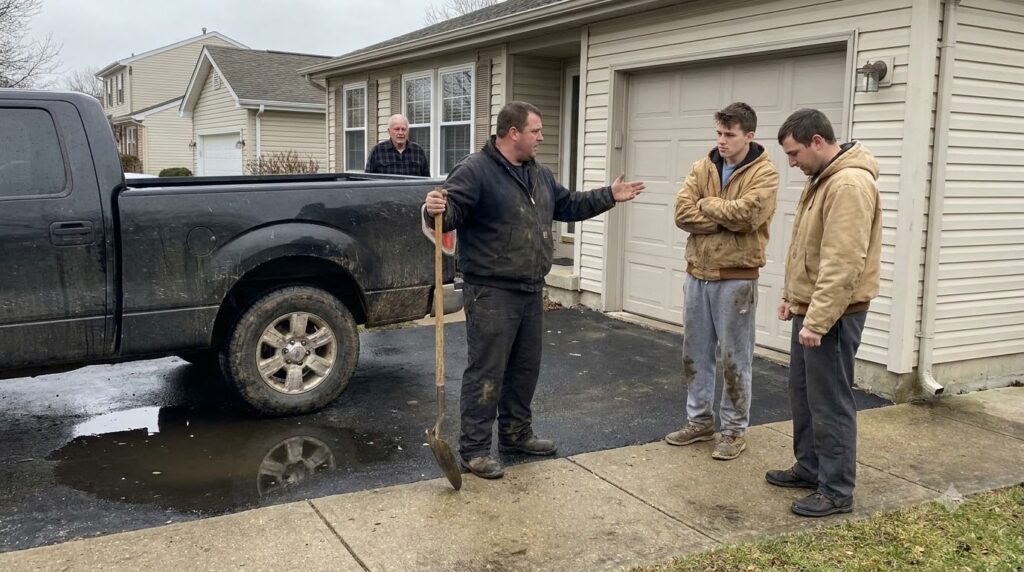
The point of the tool stayed leveled, a dull finger of iron pressing an invisible line into the space between them. The grit on the concrete crunched underfoot as the second man—the one in the tan jacket—shifted his weight, his shoulder brushing the flaking paint of the garage siding. He didn’t look at the worker’s face. He looked at the rust-pitted head of the tool where it met the hickory shaft, tracking the grain of the wood like a man reading the cracks in a dry cistern.
“We didn’t come over this side,” the second man said. His voice was lower than the younger one’s, coated in the flat, dry timbre of someone used to repeating measurements three times before cutting a board. “We came down the middle path by the fence. You know that.”
“I know what my eyes tell me,” the worker replied. He didn’t raise his pitch. That was the part that made the skin on the back of the younger man’s neck bunch tight. A man shouting had a margin for error, a peak he had to come down from; a man speaking at conversational volume while his knuckles turned white on a ten-pound bar was operating on a different schedule altogether. “And my eyes tell me this driveway was dry at seven this morning when I dropped the tailgate to unload the bags. Now it’s slick enough to grease a pig, and the only two pairs of boots that crossed this gravel since noon belong to you two.”
The younger man—the slim one with the mud-caked hem of his gray sweatpants—flinched as if a wasp had touched his ear. “You’re blaming us because your rig leaks like a sieve! Look at the axle seals on that pile of junk, man. It’s been weeping grease and condensation since the frost hit last month.”
“That ain’t grease,” the worker said.
The silence that followed was short, heavy, and smelled distinctly of dry earth and sulfurous lime dust lifting off the foundation wall. The worker didn’t move an inch to prove his point, but his left cuff—frayed at the button and grayed with powdery residue—lifted slightly as he adjusted his grip. There was no grease rainbow shimmering in the dampness on the concrete. No iridescent slick of motor oil. Just a dark, mineral-heavy spread that seemed to seep straight out of the mortar line where the driveway slab met the brick veneer of the garage floor.
The second man saw it. His gaze dropped from the tool handle to the wet ring, then flicked toward the small vent grill set low into the foundation bricks just behind the pickup’s rear tire. The iron mesh of the vent was rusted clean through at the corner, a dark toothless gap breathing out a faint, stale draft of basement air.
“We were just cutting across to the alley,” the second man murmured, his tone shifting from defensive to something flatter, more guarded. “The back gate’s stuck. You know how the wood swells when the humidity drops off like this.”
“The gate’s been chained since the spring,” the worker said, his eyes narrowing. The skin around his temples tightened into small, crisscrossed webs of salt and sun. “Nobody’s used that latch in six months. So don’t tell me about the alley.”
Inside the house, behind the warped screen and the smeared grease of the double-hung window, the silhouette of the man in the plaid shirt shifted. A hand came up—pale, square-fingered—and pressed flat against the inside of the glass, leaving a gray smudge that lingered even after the hand dropped back down. The man didn’t tap on the pane. He didn’t open the window to yell down into the driveway. He simply stood there, a dark cutout against the amber kitchen light, watching the three of them circle around a puddle that wasn’t supposed to be there.
The younger man swallowed hard, his Adam’s apple bobbing sharply beneath his stubbled chin. He reached out as if to steady himself against the side panel of the pickup, then thought better of it, his hand freezing two inches from the rusted wheel arch like a dog pulling short of a buried wire.
“You want to check the line, go ahead,” the younger man muttered, his voice dropping an octave, losing its sharp edge and sliding into a greasy sort of caution. “But you’re looking at the wrong end of the house if you think this is on us.”
The worker’s jaw didn’t relax. He kept the iron tool steady, his thumb tracing a smooth, worn groove in the wood where twenty summers of sweat had polished the grain down to the yellow core.
“I ain’t looking at the house yet,” the worker said quietly. “I’m looking at you standing right where the floor dropped two inches last Tuesday.”
The second man stiffened, his fingers curling into the pockets of his tan jacket as a single, slow drop of condensation detached itself from the truck’s rusted lip and hit the concrete with a tiny, sharp tick.