CHAPTER 5: THE METALLIC SNAP OF PROOF
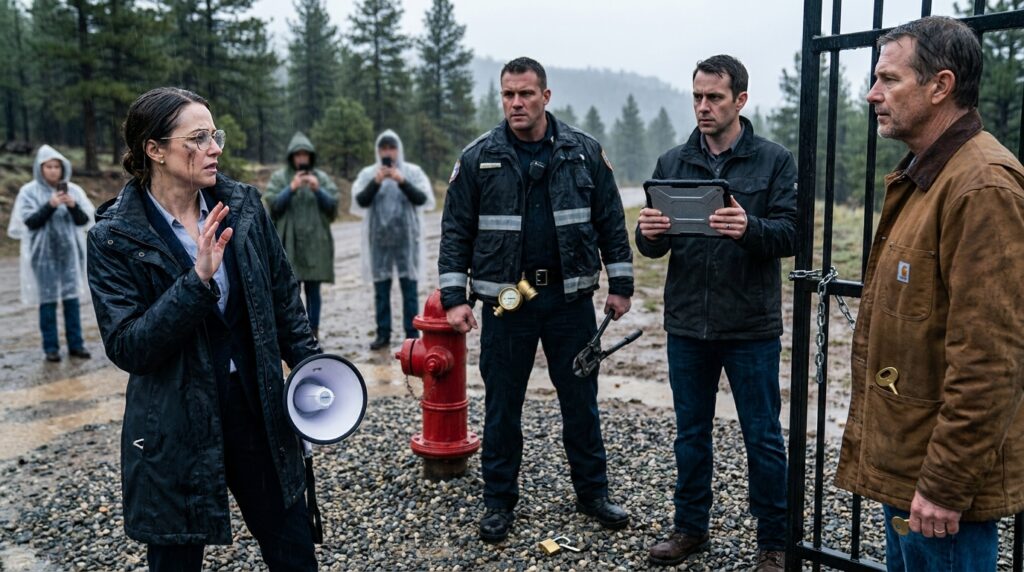
The heavy driver-side door of the red utility truck swung open before the engine came to a full stop. Fire Marshal Raymond Boyce stepped onto the wet gravel, his dark, weather-beaten face set in a rigid line beneath the brim of his official cap. High-visibility reflective tape flashed across his chest. Behind him, Inspector Donald Albright emerged from the white state sedan, a ruggedized digital tablet cradled under his arm and a thick leather folder tucked into his elbow.
The crowd of forty homeowners parted instinctively, creating a quiet corridor straight through the turnout to the folding table.
Evelyn Mercer’s hand froze over her plastic bullhorn. Her knuckles, already white from cold, turned a translucent, bloodless gray. Derek Mercer took a half-step backward behind the table, his unblemished orange vest catching the dim morning light.
“Who is the designated administrative contact for the Stone Mill Homeowners Association?” Fire Marshal Boyce’s voice boomed across the turnout. He didn’t ask; he commanded the space.
Evelyn adjusted her smudged reading glasses, forcing her shoulders back as she stepped around the table. “I am Evelyn Mercer, Treasurer and presiding Board Director for this executive session, Marshal. If this is regarding the emergency utility call—”
“This is regarding a Class-A municipal safety hazard,” Boyce interrupted, cutting her off without slowing his stride. He walked straight past her, his heavy leather boots crushing the gravel, and stopped three feet from the red dry hydrant.
He unclipped a brass pressure test gauge from his utility belt, threaded it onto the side port of the hydrant, and cranked the side valve counter-clockwise. The brass needle on the dial flickered once, gave a feeble twitch against the zero peg, and remained completely flat.
Boyce turned his head slowly, his eyes locking onto Evelyn. “Zero PSI on a dedicated fire-suppression riser. In a sixty-home wood-frame subdivision surrounded by four hundred acres of dry timberline.”
“The system suffered a catastrophic main line blowout less than seven hours ago, Marshal,” Evelyn said quickly, her voice sharp, rehearsed, and edged with cold legalism. She pointed an aggressive finger at Arthur. “Due to the unauthorized sabotage and improper machinery manipulation by a former volunteer, Mr. Arthur Pendelton—”
“Ma’am,” Inspector Albright spoke up, stepping forward with his tablet raised. His voice was dry, clinical, and precise. “I hold the state deed registry for Summit County, Section 14. This pump station and its associated intake valve sit inside a permanent municipal utility easement granted to the county fire district in 1994. Under State Water Code 104-C, no private board, individual, or corporate entity holds the authority to impede access to emergency bypass infrastructure.”
Albright walked directly to the padlocked iron gate of the pump house. He held his tablet up, pointing his camera at the heavy brass shackle.
“The lock currently securing this chain bears an asset code: BSW-01,” Albright noted aloud, his fingers tapping against the screen. “Mrs. Mercer, did you or any member of this board order or execute the placement of this specific physical lock on this gate?”
Evelyn’s chin came up. “We placed a security lock on common HOA property to prevent unauthorized, unvetted individuals from operating uncalibrated heavy equipment! We acted entirely within our rights under Board Directive 4-B to protect community assets—”
“You locked a primary emergency pressure-relief bypass,” Fire Marshal Boyce said. He turned toward his truck, unlatching the side equipment box. When he turned back, he was holding a pair of heavy thirty-inch industrial bolt cutters with forged steel jaws.
“Wait!” Evelyn took two steps forward, her hands coming up in a frantic gesture of authority. “That lock is private corporate property! You do not have authorization to destroy board assets without a formal administrative hearing!”
Boyce didn’t offer a single word of response. He set the hardened steel blades of the cutter against the thick brass shackle. He braced his boots against the wet gravel, leaned his weight into the handles, and compressed them.
SNAP.
The metallic strike echoed off the rock wall behind the pump house like a gunshot. The severed brass lock clattered against the gravel, and the heavy iron chain slid off the gate bars, pooling in the mud.
Arthur didn’t move. He stood with his hands in his canvas coat, watching the scene unfold with the quiet, cold precision of a man who had known the outcome before the first drop of rain fell. Beside him, Lydia Carmichael let out a long, slow breath she seemed to have been holding since Tuesday morning.
Boyce pushed the iron gate open. The heavy metal hinges creaked against the damp air.
Inspector Albright stepped past the threshold into the dark, concrete enclosure of the pump house. He opened the main electrical control housing, reached inside the sealed telemetry unit, and pulled a small, black industrial SD memory card from the internal logger. He slotted the card directly into his tablet.
A quiet hum filled the air as forty neighbors leaned forward over the turnout fence, their eyes glued to the inspector.
“Telemetry logging is automated, hardcoded, and tamper-proof,” Albright explained to the crowd, his finger tracing a red spike line graph radiating across his screen. “At 01:42 AM, rain intake exceeded normal volume. The primary automated sensor attempted to trigger the secondary mechanical bypass arm to purge silt from the weir.”
Albright looked up from the screen, his eyes fixes squarely on Evelyn.
“The mechanical arm hit a physical obstruction at exactly two degrees of rotation,” Albright declared, his voice carrying clearly across the quiet turnout. “The obstruction was a heavy brass padlock locked through the linkage chain. With the arm blocked, internal head pressure built from eighty pounds to three hundred and twenty pounds in twenty-two minutes, blowing the elbow joint at the high bend.”
A cold, dead stillness settled over the turnout.
Albright turned his tablet toward the crowd, showing the red digital spike lined up precisely with the mechanical obstruction fault code. “The blowout was not caused by volunteer operation, Mrs. Mercer. It was caused by the physical lock you attached to that gate.”
Evelyn stood frozen. Her lips opened, but no sound came out. The smudged lenses of her glasses reflected the white glow of the tablet screen.
Before she could recover her breath, Arthur stepped forward from the edge of the timberline. He reached into his coat and pulled out two neat, stapled document packages from his clear waterproof sleeve.
He handed one package to Inspector Albright and the second to Fire Marshal Boyce.
“While you’re reviewing the physical telemetry, Inspector,” Arthur said, his voice flat and steady as iron, “you might want to cross-reference the business registration dates for BlueStream Water Solutions LLC. Mrs. Mercer created the company eight months ago under her nephew’s name, three weeks before she introduced the board directive to lock me out.”
Fire Marshal Boyce flipped through the clear state corporate registry pages, his eyes tracking the dates, names, and undisclosed financial approvals. His expression hardened into something cold and unyielding.
Boyce looked from the paper directly to Evelyn. “You locked an emergency fire-suppression line, created a critical municipal hazard, and attempted to levy a forty-thousand-dollar emergency penalty against a resident while steering an undisclosed corporate contract to your direct family.”
“I… I acted in the best interest of community professionalization!” Evelyn stammered, her voice thin, shrill, and cracking at the edges. She looked around at the crowd, her hands trembling violently. “This is an internal HOA matter! You have no jurisdiction over private board governance!”
“State Water Safety Code 104-C is a Class-3 felony when applied to emergency infrastructure obstruction, Mrs. Mercer,” Fire Marshal Boyce stated, pulling a official yellow citation book from his belt. “You aren’t dealing with an internal board meeting anymore.”
Evelyn turned frantically toward Derek. “Derek, tell them! Tell them the contract was legally vetted!”
Derek Mercer didn’t look at her. He took two fast steps backward, unzipped his orange high-visibility vest, ripped it off his shoulders, and tossed it onto the hood of her car. Without saying a word, he turned, walked rapidly down the asphalt shoulder toward his sedan, got in, and slammed the door.
A collective, deafening roar of outrage erupted from the forty homeowners lining the turnout.