
CHAPTER 4: THE STREET CORNER TRIBUNAL
By 09:45, the rain had backed off to a needle-sharp drizzle, but the mountain air hung heavy with steam rising off the flooded turnout. Forty-two homeowners stood along the asphalt shoulder of Stone Mill Road. They wore rain ponchos, insulated work coats, and rubber boots, their breath fogging in rhythmic white bursts. Behind them, the dry hydrants stood useless, and the taps across sixty households remained dead.
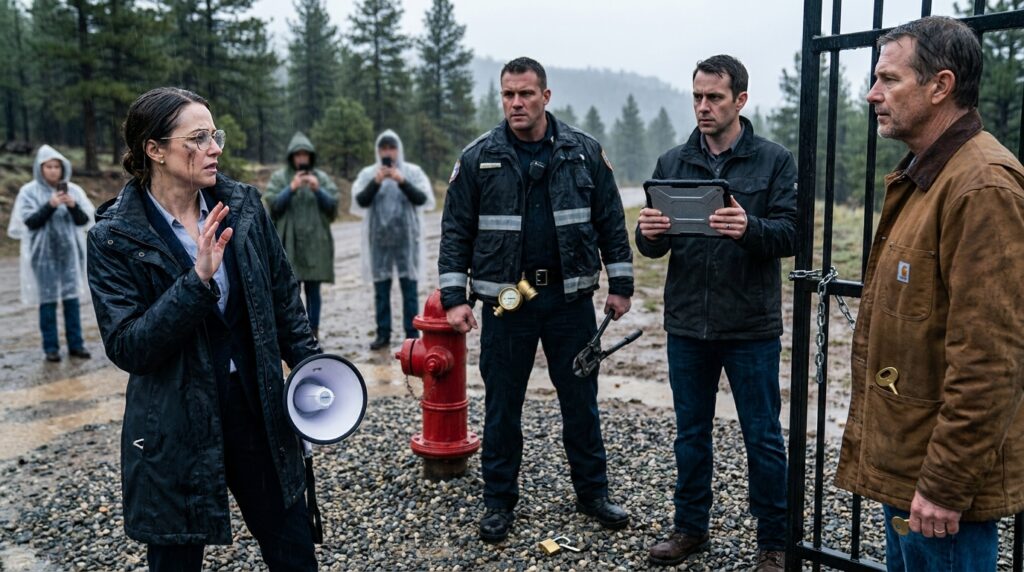
At the epicenter of the gravel turnout, Evelyn Mercer stood behind a folding plastic table she had ordered set up on the high dry ground.
She had exchanged her ruined pastel blazer for a dark, dry storm parka, but her gold-framed reading glasses were smudged, and her posture was rigid as iron. Beside her stood Derek Mercer—wearing an unblemished neon-orange high-visibility vest over a pristine navy jumpsuit that smelled of fresh factory sizing. Between them lay a stack of freshly printed white agendas and an emergency board resolution printed on heavy paper stock.
Arthur stood thirty feet back near the edge of the timberline, his canvas coat soaked through at the shoulders, his hands resting deep in his pockets. His thumb traced the cold, smooth brass of his override key. Beside him, Lydia Carmichael kept her arms crossed tight against her chest, her jaw set into a hard line.
“Thank you all for assembling on short notice under these extraordinary circumstances,” Evelyn began. Her voice, amplified through a battery-powered bullhorn, cut through the low murmur of the crowd. “As you can see, Stone Mill Acres has suffered a catastrophic infrastructure failure. Our primary main has ruptured, our private reservoir is compromised, and our fire suppression line is completely depressurized.”
She paused, letting her eyes sweep over the crowd, stopping deliberately when she reached Arthur.
“Over the past forty-eight hours, your board worked tirelessly to transition our community away from unregulated, volunteer-led operations toward professional, corporate stewardship,” Evelyn continued, her tone shifting seamlessly from corporate gravity to sharp, prosecutorial edge. “Regrettably, before our contracted vendor, BlueStream Water Solutions, could perform their initial baseline inspection, a critical bypass valve was subjected to extreme, unmonitored pressure build-up.”
She tapped a finger against the document on the table.
“Our interim legal counsel has advised us that when an individual continues to manipulate community water infrastructure without board certification, insurance indemnity, or calibrated oversight, any subsequent blowout constitutes willful gross negligence,” Evelyn declared into the bullhorn. “The board is hereby filing an immediate $40,000 emergency assessment against Mr. Arthur Pendelton to cover the structural repairs to the lower main and the stabilization of the upper embankment.”
A sharp, collective gasp rippled through the crowd.
Marcus Flynn stepped forward from the front row, his diabetic medical alert bracelet clinking against his coat cuff. “Now hold on just a minute, Evelyn! Artie’s been running that pump for six years without a single drop of water going where it shouldn’t! You locked that gate on Tuesday!”
“Mr. Flynn, you are out of order,” Evelyn snapped, lowering the bullhorn just enough to sharpen her cadence. “The physical facts are indisputable. A brass padlock was placed on the gate to secure HOA common property per Board Directive 4-B. A certified, licensed operator—Mr. Derek Mercer of BlueStream—was scheduled to take control of the station this afternoon.”
Derek stepped forward, adjusting the lapels of his unused vest, and cleared his throat. “Our preliminary diagnostic indicates that an unauthorized manual bypass was left closed prior to the storm, causing an internal surge that shattered the elbow joint.”
Arthur took three slow steps out of the shadow of the pine trees. The gravel crunched under his heavy work boots. Every eye in the turnout shifted toward him.
“Derek,” Arthur said. His voice wasn’t loud, but it carried a dense, mechanical weight that cut straight through the drone of the bullhorn. “What’s the rated burst pressure on a schedule-80 PVC elbow joint at forty degrees Fahrenheit?”
Derek blinked. His hand hovered over his clipboard. “That… that information is detailed in our full diagnostic report, which will be filed with the board—”
“It’s four hundred and eighty pounds per square inch,” Arthur said, taking another step closer. “And the static head pressure coming off the upper basin during a three-inch rainfall caps at two hundred and ten. The pipe didn’t shatter because of an open bypass, Derek. It blew because the primary intake screen froze solid with silt, and the automated mechanical relief valve couldn’t vent because somebody put a three-pound brass padlock directly through the mechanical link arm.”
Evelyn’s knuckles went white against the edge of the folding table. “Mr. Pendelton, you are not a licensed engineer in this jurisdiction! Your opinions are legally non-binding!”
“I’m a certified municipal water technician with thirty-two years on county mains,” Arthur replied calmly. He reached into his coat and pulled out the clear, waterproof sleeve containing the state corporate filings. “And you’re a treasurer who registered BlueStream Water Solutions LLC eight months ago using your brother-in-law’s home address in Connecticut.”
The crowd went dead silent. The only sound remaining was the steady drip-drip-drip of rainwater falling from the canopy onto the hood of the folding table.
Evelyn didn’t flinch. Her eyes narrowed into two razor-thin slits behind her smudged glasses. “The board has full authority to retain qualified vendors. BlueStream’s corporate registration is a matter of private business structure—”
“BlueStream doesn’t own a single flush truck,” Arthur cut her off softly. “I pulled your asset schedule from the state revenue portal last night. You billed this community $4,500 an hour for emergency response, and your certified operator couldn’t even tell a schedule-80 elbow from a galvanized nipple.”
A angry roar erupted from the back of the crowd. Trevor Kowalski, a retired carpenter from the lower road, pushed his way to the front. “You’re charging us forty grand for a company that doesn’t even have tools?!”
“Order! We will have order!” Evelyn shouted into the bullhorn, her voice cracking under the sudden surge of hostility. She slammed her hand onto the table. “This meeting is being recorded for legal proceedings! Mr. Pendelton’s unsubstantiated slander does not absolve him of his financial liability for the water blowout! Under HOA Bylaw Section 12, the emergency assessment stands, and if it is not paid, a lien will be placed on his home by five o’clock today!”
She thought she had backed him into a corner. She thought that by invoking the legal mechanism of a property lien, she could force his silence or bankrupt his resolve.
Arthur looked at her—really looked at her—and saw the desperate, hollow core behind her binder tabs and her pearl necklace. He didn’t yell. He didn’t raise a fist.
He simply turned his head toward the entrance of the cul-de-sac as two heavy vehicles crested the rise, their tires crushing the wet gravel in a slow, deliberate march.
First came a dark red county utility truck with high-visibility chevron striping across the tailgate and a gold star emblem painted on the door: County Fire Marshal — Emergency Services.
Directly behind it was a white sedan bearing the official seal of the State Department of Environmental Protection & Water Resources.
The crowd parted like a tide as the two vehicles pulled up to the edge of the turnout, their engine idle a low, ominous rumble against the silence of the mountain.