
CHAPTER 3: THE HYDRAULIC PRESSURE BLOWOUT
By 02:00, the rain was no longer falling in drops. It was a dense, gray sheet driving sideways across the ridge, propelled by thirty-knot wind gusts that whipped through the tops of the pine trees.
Arthur stood on his back porch, the brim of his oilskin hat shedding a continuous stream of runoff. The air smelled of wet earth, iron, and the sharp, sulfurous ozone of a mounting electrical storm. Underneath the roar of the wind, his ears tuned to a different frequency—a low, sub-audible hum reverberating through the bedrock beneath his work boots.
It was the water.
Six hundred feet up the slope, three inches of rain per hour were pouring off the granite face of the upper ridge, channeling directly into the Stone Mill retention basin. Without the manual secondary bypass open to clear the debris, the primary intake screen had reached critical mass.
Inside his house, the kitchen phone rang. Three long, sharp pulses before the machine picked up.
Arthur didn’t move toward the door. He listened through the screen as the speaker rasped. It was Marcus Flynn, two streets downhill. His voice was laced with static and panic: “Arthur, if you’re home—my basement main is screaming. The pipes are shaking off the floor joists. My water’s running brown.”
Arthur pulled his pocket watch from his vest. 02:14. The system had held forty minutes longer than he’d calculated. The silt pack was complete.
He stepped off the porch and walked to the edge of his property line, where the primary distribution feeder ran four feet under the asphalt. He bent down, pressing his gloved palm flat against the cold surface of the road.
The pavement was vibrating.
The automated check valve had slammed shut against the mud wall, locking three hundred pounds per square inch of hydraulic head pressure inside a secondary distribution loop rated for eighty. The water had nowhere to go.
A sharp, explosive crack echoed down the mountain, sounding like a high-caliber rifle shot cutting through the thunder.
Up the road, at the high bend where Evelyn Mercer’s multi-level property sat overlooking the valley, the high-pressure feeder line sheared at the elbow joint.
Arthur didn’t run. He walked with measured, unhurried steps up the asphalt incline. Water was already cascading down the centerline of the road—not clear rainwater, but a thick, viscous slurry of reddish-brown silt, decaying hemlock needles, and gravel.
By the time he reached the crest of the hill, the blowout had carved its path.
The pressurized jet had torn through the sub-base beneath Evelyn’s decorative stone retaining wall, collapsing forty feet of stacked flagstone directly into her lower lawn. A six-inch torrent of mud and pond sludge was surging across her manicured grass, engulfing her outdoor patio and pouring through the ground-level glass doors of her finished basement.
The glare of floodlights snapped on around her house. The front door flew open, and Evelyn stepped onto the porch in a yellow vinyl rain slicker, her hair plastered against her neck, holding a heavy halogen flashlight. The beam swung wildly across the destruction, illuminating her inground swimming pool, which was already half-filled with murky, churning mud.
“Arthur!” she screamed over the roar of the water, her voice shrill and breathless as she spotted him standing on the paved shoulder. She stumbled down her flooded front steps, her boots sinking two inches into the silt. “Arthur, get to the valve! Shut it off! The main line broke!”
Arthur stopped at the edge of her driveway, where the water swirled around his steel-toed boots. He pulled his hands into his canvas pockets.
“The shutoff is inside the pump house,” he said. His voice was entirely flat, carrying easily across the ten-foot gap between them. “Behind the iron gate.”
“Then unlock it!” she yelled, her flashlight beam shaking against his chest. “Use your key! Do something!”
“I don’t have a key to your lock, Evelyn,” Arthur replied smoothly. He did not blink against the glare of her light. “I handed you my compliance paper on Tuesday. Your lock has a commercial asset tag on it. BSW-01. That makes it corporate infrastructure under Board Directive 4-B.”
“Are you insane?” she shrieked, stepping closer, the water splashing against her knees. “My basement is filling with four feet of water! My foundation is compromised! I am ordering you as a board officer to open that line!”
“You’ll need to contact your vendor,” Arthur said. “Derek Mercer’s filing indicates BlueStream carries an emergency response mandate. I’m sure his team is on their way with the proper equipment.”
Her face went pale—a stark, bloodless white under the blue tint of the halogen beam. For a fraction of a second, the aggressive, legalistic mask slipped, revealing a raw, calculating terror. She knew, with absolute mathematical certainty, that Derek was two hundred miles away in Connecticut, sleeping in a suburban bedroom, and that the single commercial flush truck listed on BlueStream’s tax ledger didn’t exist.
A second low, groaning sound shook the ground beneath their feet. Down the hill, every streetlamp on the lower loop flickered once and died as water inundated the underground electrical junction.
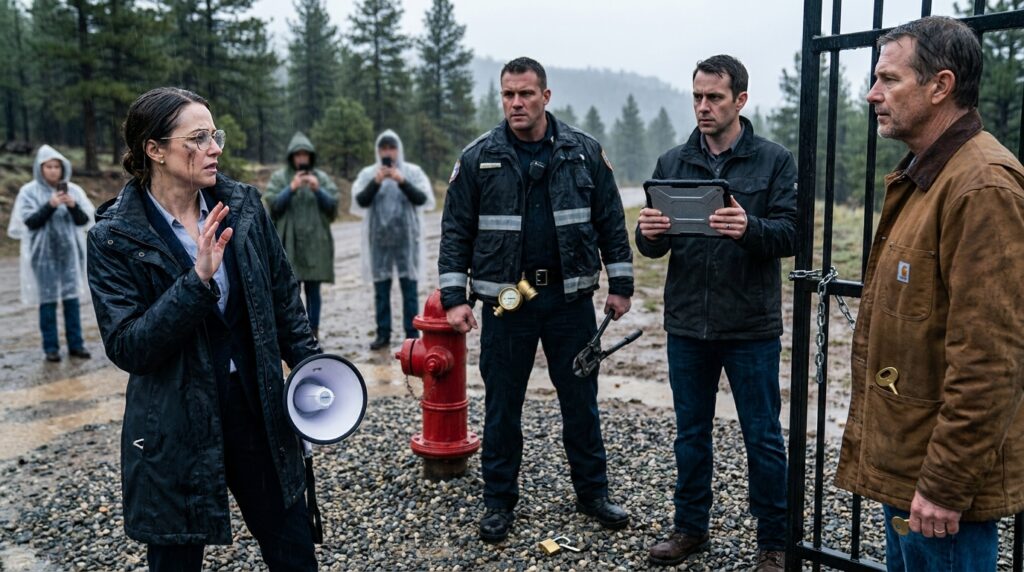
Simultaneously, the neighborhood dry hydrant—the bright red steel riser situated thirty feet from Evelyn’s driveway, designed to supply fire department pumper trucks from the retention pond—gave a soft, hollow hiss. A surge of muddy air blew from its relief cap, followed by complete, total silence.
The line pressure across the entire grid had plummeted to absolute zero. The fire-suppression reservoir was draining directly into Evelyn’s living room.
From down the street, headlights appeared through the rain. A dark sedan pulled onto the shoulder, followed immediately by Lydia Carmichael’s pickup truck. Doors slammed. Three more neighbors stepped out into the downpour, wrapped in ponchos, holding flashlights, staring in mute horror at the river of mud swallowing the treasurer’s lawn.
Evelyn turned to the gathering crowd, her hands shaking so violently the flashlight beam danced across the trees.
“He did this!” she shouted, pointing the trembling beam directly at Arthur’s face. “He knew the pressure was building! He let it blow out to destroy my house! This is sabotage!”
Arthur didn’t shift his stance. He reached into his coat, pulled out the waterproof document sleeve he had printed three hours ago, and tucked it deeper into his inner pocket, keeping it dry against his chest.
“I warned you on Tuesday, Evelyn,” he said, turning his back on her shouting and walking toward the gathered neighbors. “I told you the secondary bypass needed a manual flush before Friday. You told me capability wasn’t accountability.”
He passed Lydia, who was staring at the ruined lawn with her mouth slightly open. He caught her eye and gave a single, almost imperceptible nod.
The decoy secret—the paper shell of BlueStream Water Solutions—was now floating in the mud at their feet. But as Arthur looked up toward the dark timberline, where the pump house stood shrouded in the storm, he knew the real trap was just beginning to spring.