CHAPTER 2: THE PAPERWORK PARADOX
The silence after the phone call hung heavy, thick with the smell of idling diesel and crushed pine needles.
Evelyn Vance slowly lowered her phone. The screen went dark, but her knuckles remained white around the plastic casing. Her eyes, magnified behind the tinted lenses of her sunglasses, darted from Marcus’s face to the idling tracks of Frank’s excavator. The red flush on her neck had spread up to her jawline, splotchy against the pale linen of her collar.
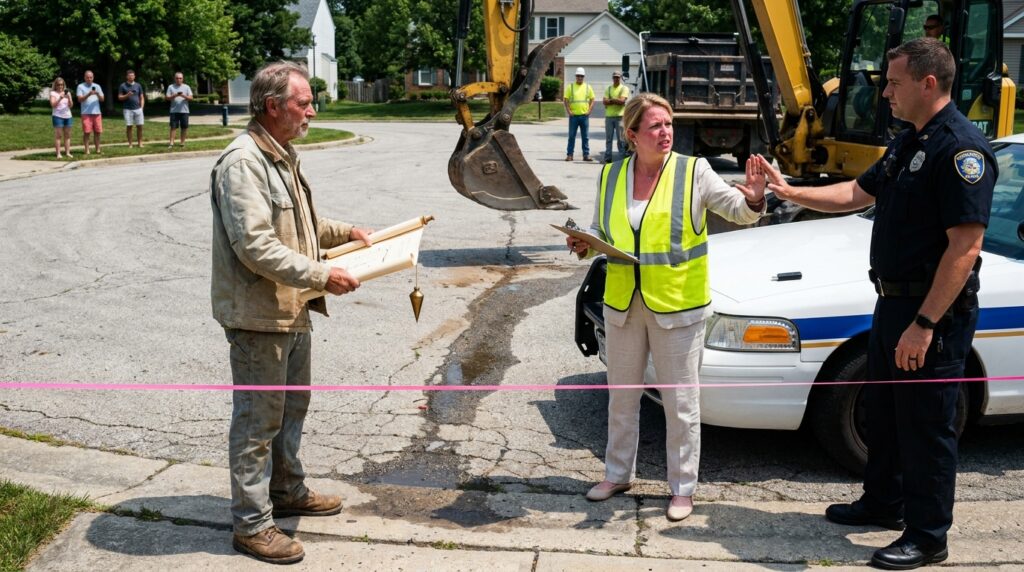
“An administrative error,” Evelyn said, her voice dropping an octave into a forced, brittle register. She didn’t look at Marcus. She snapped her steel clipboard open, the metal mechanism clacking like a pistol hammer in the quiet cul-de-sac. “A simple clerical mismatch on the county portal. The easement is valid under the 2018 municipal drainage code.”
She pulled a folded sheet of bright yellow paper from behind her main stack and thrust it toward Marcus. The sheet was crisp, but the edges were smudged with dark, greasy thumbprints.
“This is an emergency municipal hazard citation,” she declared, her posture re-stiffening as she found her footing on the familiar terrain of administrative threats. “Signed by the HOA board executive committee. Under Section 12-B, if an uncooperative owner refuses to allow immediate remediation of a subterranean water hazard, the board is authorized to levy a three-thousand-dollar civil penalty per calendar day. Effective as of eight o’clock this morning.”
Marcus didn’t reach for the paper. He let it hover between them in the humid air, fluttering slightly in the draft from the excavator’s cooling fan.
His eyes didn’t focus on her printed threat. They dropped to the clipboard itself. Tucked just under the steel spring hinge was a narrow strip of ruled notebook paper, covered in tight, hurried handwriting in red ink. Marcus’s decades of reading site estimates kicked in automatically. 40 Tons Surface Course—Lot 14 Drain Overlay—$8,400. Lot 14 was Evelyn’s personal parcel, two hundred yards up the gentle slope of the cul-de-sac.
“You’re quoting a drainage hazard, Evelyn,” Marcus said smoothly, his thumb rubbing the heavy brass weight in his jacket pocket. “Where’s the certified hydrological impact report?”
“It’s attached to the board memo,” she snapped, jerking the yellow paper closer to his chest. “Subterranean pooling beneath your blacktop is backing up runoff into the public street gutter, undermining the road base under Lot 12 and Lot 14. It’s an immediate structural risk to the entire lane.”
Frank, still leaning out the side window of his excavator cab, wiped his brow with a grease-stained forearm. “Evelyn,” he called down, his tone flat and cautious. “If there’s an active county red-flag on the parcel index, my insurance carrier won’t cover a blade touch. You told me the municipal right-of-way was cleared three weeks ago.”
“The county portal is running on a legacy database upgrade this week, Frank!” Evelyn spun around, her voice cracking slightly as she shouted over the low thump of the engine. “I spoke with the county clerk’s assistant personally yesterday afternoon. The drainage easement is a matter of public record! You are under a binding private contractor agreement with Boxwood Estates, and if you haul this rig off my street before that trench is cut, I will withhold the mobilization deposit and blackball your firm from every municipal bid in this township!”
Frank stared at her, his jaw set hard beneath a graying stubble. He didn’t touch the levers, but he didn’t turn off the key either. He was a small-town contractor trapped between an aggressive client with a checkbook and a quiet landowner holding a state license number that could revoke his excavation permit with a single phone call.
Marcus stepped around the yellow chalk line on his driveway, his work boots making a dry, gritty crunch on the unpaved shoulder. He walked directly up to the side of the excavator, completely ignoring Evelyn as she took a sharp step forward to block him.
“Frank,” Marcus said softly, looking up at the cab. “You’ve worked county roads in this district for twenty years. You know what a Section 404 water diversion permit looks like.”
Frank blinked, his eyes shifting toward the far tree line where the neighborhood slope met the old pasture creek. “Yeah. I know what one looks like.”
“Have you seen one for this cul-de-sac?” Marcus asked. “Stamped by the state department of environmental protection?”
Frank slowly shook his head. “She handed me a board resolution and a site diagram drawn on HOA letterhead.”
“Because an HOA resolution isn’t a legal permit,” Marcus said. He pulled his right hand out of his pocket and laid a small, folded card onto the excavator’s steel step ladder. “That’s my personal business card. On the back is the direct line to the regional chief inspector for environmental land use. You make one cut through this blacktop without a state Section 404 permit in your glovebox, and he won’t just fine your company, Frank. He’ll impound that rig right where it stands for illegal watershed modification.”
Frank looked down at the card, then up at Evelyn. His face hardened. He pulled his hands completely off the hydraulic controls, folded his arms across his chest, and leaned back into his vinyl seat. “Engine’s idling, Evelyn. It stays idling until I see a state stamp or a police cruiser.”
“You coward!” Evelyn’s voice lost its polished edge entirely, rising into a harsh screech that echoed off the front brick facades of the surrounding houses. Across the street, a garage door slowly rolled up, and an elderly man in an undershirt stepped onto his driveway, holding a mug of coffee and watching the standoff.
Evelyn whipped around to face Marcus, her chest heaving, her clipboard trembling in her hands. “You think you’re clever, don’t you? Sitting on your decaying little acre, holding up progress for forty families who actually pay dues to keep this community pristine! You don’t own this street, Marcus!”
“No,” Marcus replied, his voice falling into that deep, steady cadence that had calmed dozens of heated boundary disputes on county construction sites over thirty-five years. “I don’t own the street. But I own every square inch of earth from that mailbox to the oak tree, three feet deeper than your excavator can dig. And you are standing on it without permission.”
Evelyn pulled her phone back out with a jerk of her thumb. Her fingers stabbed at the touch screen so hard the glass tapped loudly.
“We’ll see what the township deputy has to say about an unregistered commercial operator threatening private contractors on a community access road,” she said, pressing the phone to her ear and glaring at Marcus through her dark lenses. “I am filing an emergency call for public obstruction right now. Stay right there, Marcus. Don’t you dare move a single inch.”
“I’m not going anywhere, Evelyn,” Marcus said quietly. He turned his back on her, walking unhurriedly toward his front porch steps. “I’ll be inside getting my records. Take all the time you need.”