CHAPTER 3: THE VAULT AND THE DRAINAGE DECOY
Marcus walked up the two oak steps of his front porch without looking back at the street. Behind him, the excavator’s diesel engine continued its low, rhythmic throb, rattling the screen door’s rusty mesh against the wood frame. Evelyn’s shrill voice cut through the stagnant heat as she argued with the police dispatcher, her pacing heel-clicks tapping against the concrete curb like a telegraph key.
Inside, the house was dark and cool, smelling faintly of cedar shavings, gun oil, and thirty years of quiet living. Marcus didn’t turn on the hallway light. He walked straight into his study—a room lined with floor-to-ceiling pine shelves packed with leather-bound county survey ledgers, brass transit scopes, and rolled topographical blueprints.
He stood before the dark green steel safe bolted into the floorboards in the corner. The dial was heavy, pitted iron. Marcus placed his fingertips on the cold metal and turned it with practiced muscle memory: four turns left to thirty-six, three turns right to fourteen, two turns left to eighty-two.
The heavy locking bolts retracted with a solid, metallic thunk.
Marcus swung the door open. Inside rested a thick, linen-wrapped cylinder tied with hemp cord. He pulled it out, untied the knot, and unrolled the thick parchment across his oak desk, smoothing the corners down with a cast-iron paperweight and a brass slide rule.
It was the official 1984 state boundary map for Parcel 408-A, bearing the raised gold foil seal of the County Recorder and the crisp signature of the State Chief Surveyor. Attached to the corner by a rusted brass grommet was the 2018 municipal exemption affidavit—stamped in dark red ink—confirming that the parcel was deeded prior to the incorporation of the Boxwood Estates HOA and retained full, unencumbered frontage rights to the public road.
Marcus tapped the raised gold seal with his index finger. The paper was dry and stiff, the ink lines as black and sharp as the day they were drawn. There was no easement. No utility right-of-way. No board jurisdiction.
He reached over to his laptop, waking the screen from sleep mode. A four-way grid of high-definition security feeds filled the monitor. Camera Two, mounted beneath the eaves above his porch, showed the street in crisp, wide-angle detail: Evelyn stood near the mailbox, clutching her steel clipboard against her chest, her jaw working furiously as she gestured at the sky while speaking into her phone. Frank remained in the cab of his excavator, his arms crossed tightly over his chest, staring straight ahead through the windshield.
Marcus clicked on Camera Four—the narrow-angle lens zoomed in on the property line running along his eastern fence line.
He narrowed his eyes.
Along the base of Evelyn’s newly built stone retaining wall, partially obscured by freshly dumped pine bark mulch, a six-inch white PVC drainpipe protruded from the soil. A steady, unnatural trickle of clear water was discharging directly into the shallow swale that fed into Marcus’s driveway apron.
Marcus zoomed the camera in further. The mulch around the pipe was wet, dark, and freshly disturbed, as if it had been dug out within the last forty-eight hours.
A sharp, sardonic smile touched the corner of Marcus’s mouth. This was Evelyn’s “subterranean water hazard.” This was the “catastrophic pooling” her board memo cited to justify cutting a six-foot trench through his driveway. She hadn’t just cited a natural drainage problem—she had physically engineered a temporary one, piping water directly onto his boundary line to create the visual proof she needed for her emergency board citation.
She wanted his apron condemned. She wanted his driveway re-routed through the muddy rear alley. And she was using an artificial flood to make it look like a matter of public necessity.
Marcus opened his desktop drawer, pulled out a thumb drive, and plugged it into the laptop. He downloaded the last seventy-two hours of continuous footage from Camera Four, highlighting the exact clip where two workers in unmarked grey jumpsuits had buried the PVC pipe beneath Evelyn’s retaining wall under the cover of dusk two nights prior.
He pulled the thumb drive out, slipped it into his jacket pocket alongside his brass plumb bob, and rolled the certified survey parchment back into its linen sleeve.
Outside, a faint, rhythmic siren echoed from the direction of the county highway, growing louder as it turned into the entrance of Boxwood Lane. The red and blue strobe lights flickered through the pine trees, casting long, moving shadows across the quiet cul-de-sac.
Marcus picked up the rolled map, held it firmly under his arm, and opened his front door.
Evelyn was already standing at the edge of the street, waving her arms dramatically to flag down the white-and-blue municipal cruiser as it pulled up to the curb. The cruiser’s brakes squerusted softly against the asphalt, stopping precisely between Marcus’s mailbox and the idling excavator.
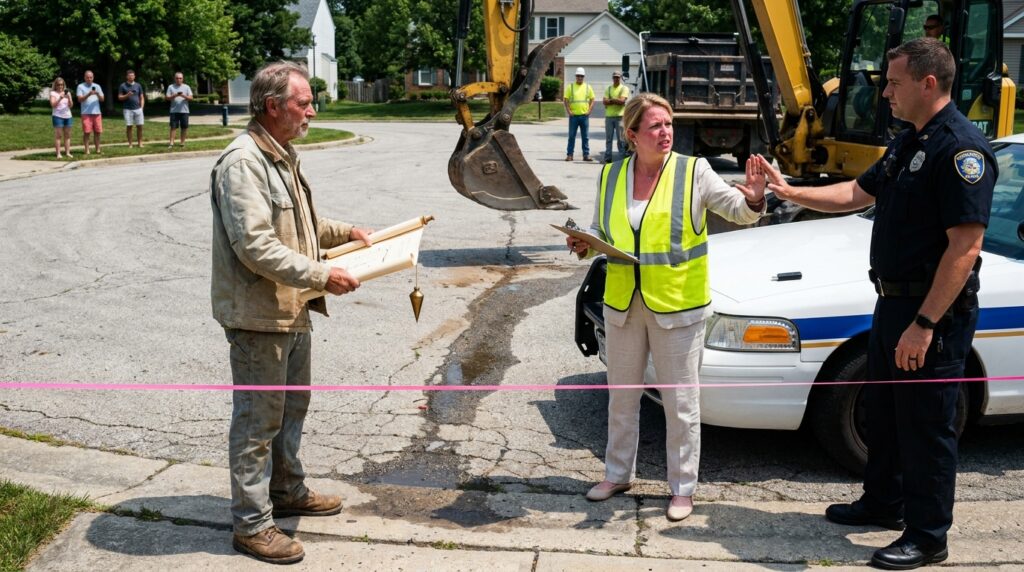
Officer David Kowalski stepped out of the driver’s seat, adjusting his utility belt. His face was worn, his eyes squinting against the harsh glare of the midday sun as he took in the scene: the neon pink survey string, the heavy excavator resting on the gravel turnaround, and the small crowd of neighbors now watching from three different front lawns.
“Alright,” Kowalski said, his voice flat and unhurried as he pushed his cap back on his forehead. “Who called in the public disturbance?”
Evelyn stepped forward immediately, holding out her steel clipboard like a prosecutor presenting evidence. “I did, Officer. Evelyn Vance, HOA Board Treasurer. We have an uncooperative resident actively obstructing an authorized municipal safety repair on a public drainage swale.”
Kowalski didn’t take the clipboard. His gaze drifted past Evelyn to where Marcus stood on his porch steps, holding the rolled parchment under his arm.
“Hello, Marcus,” Kowalski said, nodding slightly. “You got heavy iron parked on your grass again?”
“Hello, David,” Marcus replied, stepping off the porch and walking calmly down the path toward the property line. “It’s not on my grass yet. Just resting on my blacktop. But Ms. Vance here seems convinced she owns the dirt beneath it.”
“He doesn’t have a permit to halt board operations, Officer!” Evelyn interjected, her voice rising in pitch. “The board approved this drainage intervention under emergency charter provisions! He is violating community bylaws!”
Marcus stopped at the edge of the driveway, two feet from the pink survey line. He unrolled the top four inches of the parchment under his arm, revealing the raised gold seal of the State Chief Surveyor.
“Officer Kowalski,” Marcus said, his voice quiet, steady, and utterly devoid of anger. “Before we discuss community bylaws, I’d like you to run a land-record verification on your squad car computer. Because right beneath Ms. Vance’s feet is Parcel 408-A… and she is currently directing a commercial crew to commit criminal trespass and property destruction on private deeded earth.”