CHAPTER 4: THE FINANCIAL AUDIT COALITION
The heavy oak double doors of Caleb’s workshop were locked, the heavy brass deadbolt thrown. Outside, rain tapped a steady, rhythmic cadence against the high, wire-reinforced clerestory windows. Inside, beneath the harsh amber glow of overhead tungsten shop lights, nine people sat in a tight circle around the heavy cast-iron table of the sixty-inch cabinet saw.
The room smelled of raw walnut oil, cold rain, and the bitter, dark roast coffee Mona Higgins had brought over in a tin pot from the bakery.
Joel stood at the head of the saw table. Unfolded across the rusted iron surface lay three distinct stacks of paper: the certified 1968 city easement grant, a printout of the cloud camera video logs, and a fourteen-page forensic bank spreadsheet compiled over forty-eight hours with the help of Sal Ross, who ran the corner flower shop and had spent twenty years as a commercial bank auditor before retiring.
“She’s calling an emergency board meeting for Saturday at noon,” Mona said, her fingers clutching a paper napkin. She looked exhausted, her flour-dusted apron replaced by a dark rain jacket. “Her text said it’s a mandatory vote to authorize private security sweeps and raise the district maintenance fee to four hundred dollars a month. If we don’t pay, she threatens to block the alley access during the Street Fair.”
“She can’t block the alley,” Eli Abbott said from his stool. The bike mechanic leaned forward, resting his calloused forearms on his knees. “We saw the city grant Joel pulled. The pavement belongs to Fairfield.”
“She doesn’t care who owns the pavement, Eli,” Sal Ross interrupted softly, tapping his forefinger against the financial spreadsheet. His voice was precise, dry, and terrifyingly calm. “She cares about leverage. She’s been running this scheme for four years, and none of us ever checked the state registries. Look at these numbers.”
Sal slid the spreadsheet into the center of the table under the tungsten light. The column headers were highlighted in yellow marker: Historic Merchants Association—Account #4091.
“Every month, Patsy collected an average of three thousand dollars in ‘alley access fees,’ ‘patio permit assessments,’ and ‘boot release charges’ from the nine businesses on this block,” Sal said, scanning the row of faces. “She told us the money went into a dedicated district improvements fund for street lighting and snow removal. But look at the routing numbers.”
Joel leaned over the table, pointing to the bottom row of transactions. “Every single electronic deposit was swept within twenty-four hours into a commercial escrow account registered to Highland Development Holdings LLC—Garrett Finch’s company.”
A heavy silence fell over the workshop, broken only by the hum of the dust collector system idling in the corner.
“She wasn’t running a merchant association,” Mona whispered, her voice cracking with anger. “She was running an unregistered private shake-down. She took thirty-six thousand dollars from us over four years.”
“Thirty-seven thousand four hundred,” Sal corrected gently. “And forty percent of those funds were used as collateral proof to secure the commercial lien Garrett filed against this building.”
Joel pulled the uncancelled 2018 promissory note from his leather binder, laying it beside the spreadsheet. The name Caleb Carver gleamed under the overhead bulb in faded blue fountain pen ink.
“My brother took a twelve-thousand-dollar loan from Garrett Finch six months before he died,” Joel said, his voice flat, devoid of self-pity or melodrama. “Garrett used that uncancelled note to manufacture a fake tax encumbrance, and Patsy used your stolen access fees to fund the legal filings for the administrative lien. They didn’t just want control of the alley. They wanted the title to parcel 410 so Garrett could clear the block for a commercial development.”
Eli swore softly under his breath. “So what do we do, Joel? She’s got the stage booked for the Street Fair opening on Saturday. She’s got the mayor sitting in the front row, and her cousin’s got lawyers on retainer in Cincinnati.”
“We let her take the stage,” Joel said.
He reached into his pocket, pulled out a small black flash drive, and set it on the iron saw table. Beside it, he placed his tablet computer and a compact, high-lumen wireless video projector.
“Patsy’s entire power depends on a lie—the lie that she represents municipal authority and that we stand alone,” Joel said, looking each merchant in the eye. “She thinks I’m going to contest Garrett’s lien quietly in a county chancery court three months from now while she takes control of the Street Fair. She doesn’t know Sal audited her bank routing numbers. She doesn’t know Inspector Frank Callahan from city code enforcement received a certified copy of the 1968 grant two hours ago.”
“What happens on Saturday?” Mona asked, her eyes searching Joel’s face.
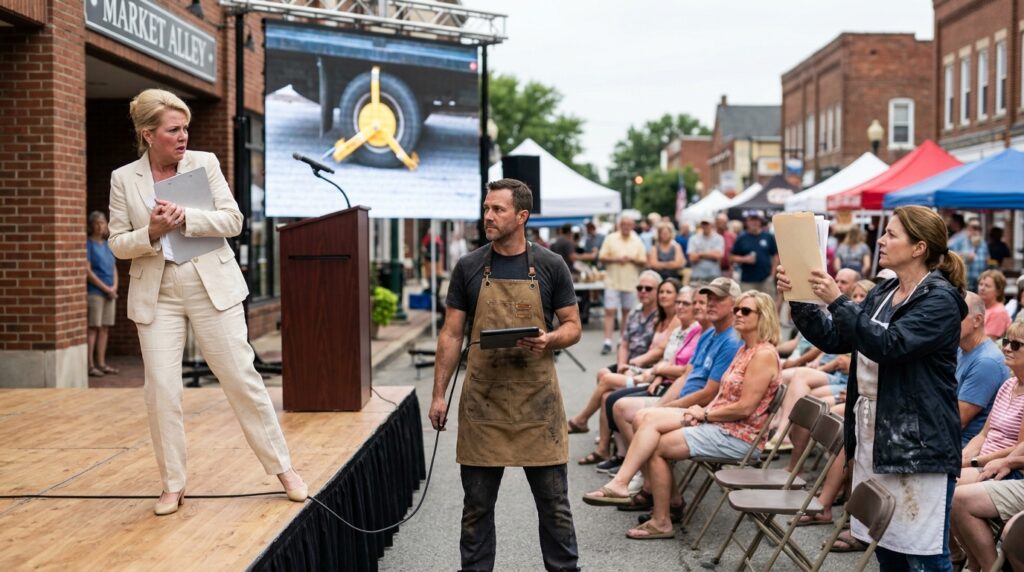
“On Saturday, at one o’clock, during her opening speech on the main stage, I’m using the festival screen,” Joel said. “We project the camera footage of her clamping Dan’s truck, followed immediately by Sal’s bank audit spreadsheet and the 1968 city seal. In front of three hundred residents, the mayor, and the local press.”
Sal let out a short, dry chuckle. “That’s not a legal defense, Joel. That’s a public execution.”
“It’s an eviction,” Joel replied. “She evicted Marcus the tinsmith four years ago by isolating him until he broke. She won’t isolate anyone on this block ever again.”
Eli stood up, his jaw set, extending a hand across the saw table. “I’m in.”
Mona stood up next, followed by Sal, until all seven merchants were standing around the table, their hands resting on the cold iron frame of Caleb’s cabinet saw.
When the merchants left through the alley door at midnight, Joel stayed behind in the dark shop. He walked to the back corner where his brother’s unfinished white oak workbench stood against the brick wall. He picked up Caleb’s heavy brass-backed hand saw, feeling the balance of the wood, the fine teeth that Caleb had sharpened by hand years ago.
Joel set the saw down carefully. Then he pulled out his phone and tapped the screen to open his email.
Sitting at the top of his inbox was an official notification from the Butler County Recorder’s Office, sent at 11:45 PM:
ALERT: Expedited Judicial Attachment Filed—Parcel 410. Claimant: Highland Development Holdings LLC. Hearing Date: Saturday, August 15, 11:00 AM (Butler County Courthouse, Room 302).
Joel looked at the time stamp on the email, then at the calendar on the wall.
Patsy and Garrett hadn’t waited for the thirty-day foreclosure window. They had used an emergency judicial motion to schedule a surprise lien hearing at the county courthouse for Saturday morning at eleven o’clock—two hours before the Street Fair opening speech.
If Joel didn’t show up in court at eleven, Garrett would secure an automatic default judgment, seizing the workshop deed before the festival ever began. But if Joel went to court in Hamilton, thirty miles away, he would miss the one o’clock Street Fair opening on Market Street—leaving Patsy completely unchecked on the main stage.
Joel closed his phone screen, the blue light fading into the dark, quiet workshop.